


Famous American Beekeepers. Part 4. Charles Dadant, A. I. Root, G. M. Doolittle
Description
This section is from the book "A Living From Bees", by Frank C. Pellett. Also available from Amazon: A Living From Bees.
Famous American Beekeepers. Part 4. Charles Dadant, A. I. Root, G. M. Doolittle
Charles Dadant
The failure of his business in middle life, just when he was looking forward to retirement to a life of leisure in the country, compelled Charles Dadant to begin life all over again. He left his native France and settled on a small brush farm in Illinois. By means of a newspaper and a dictionary, he learned the English language and was soon able to write with ease, although he never mastered the spoken English.
Depending upon the production of honey and the cultivation of grapes for a livelihood, he overlooked nothing of importance bearing on these subjects. The new methods of beekeeping were just coming to be known and he put to the test every new idea offered. Finding the things advocated by Lang-stroth and Quinby to be of practical advantage, he was soon writing to the bee magazines of Europe to tell of his results. He found much prejudice against the new methods and received more of censure than praise in his home country for many long years. Charles Dadant was a fighter and determined never to give up until the new methods had displaced the old. In due time the hive which he developed from combining the Langstroth and Quinby ideas came into very general use over a large area in Europe under the name of "Dadant hive. "
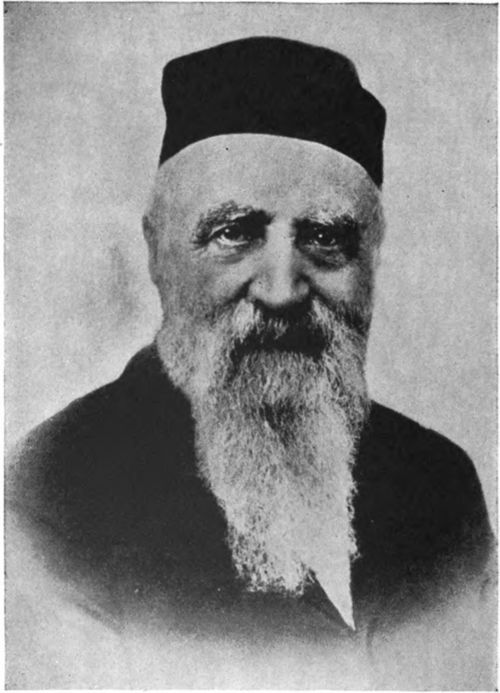
Charles Dadant who introduced American methods to Europe.
When the question of the validity of Langstroth's invention arose, Dadant was in position to give important evidence, since he had tried all the European hives in question and could point out the fundamental differences between them and the Langstroth hive. He did much to secure for Langstroth the credit which was his due.
Charles Dadant was a profound student of bee behavior and at the same time a prolific writer. To him, much of the credit is due for the progress of bee culture in Europe. Probably nowhere is his fame more secure than in Russia.
A. I. Root
No American beekeeper has had a greater following than A. I. Root. He secured his first bees when little was known of practical bee culture. His boundless enthusiasm led him to try every new invention and to report results in the new American Bee Journal. He reported failures as freely and frankly as successes and thus gave invaluable help to the new recruits.
He started to manufacture bee supplies and tried endless experiments as each new invention appeared. Many things first proposed by others were improved or perfected by Root and given an introduction to the public. It is impossible to measure the results of his work because he had a part in the development of many things, although I can think of no one outstanding invention or development which can be credited to him alone.
In 1873 he founded "Gleanings in Bee Culture, " which soon attained wide influence, and he continued to contribute to its pages until the time of his death fifty years later. He wrote "A. B. C. of Bee Culture, " compiling into a cyclopedia a digest of what had been written on the subject of bees from many sources. Probably no other bee book ever attained a wider circulation.
Root found so much interest in so many things that he could not confine himself to any one subject for very long. Gardening, electricity, automobiles, flying machines, temperance-a hundred subjects attracted him and to each he gave close study at the moment.
A. I. Root was the type of man who succeeds as a missionary or crusader. He did more than any other to bring beekeeping to popular attention in America, as Charles Dadant did in Europe.
G. M. Doolittle
While Doolittle was a prolific writer for the bee magazines during his lifetime, it was the system of queen rearing already mentioned which gives him a claim to long remembrance. The system was revolutionary and yet so completely did he develop it that little has been added in the way of improvement. Unless some better way to rear queens be found, Doolittle's name will remain a household word in the industry.
Continue to:


My Books

