


October, Thrift
Description
This section is from the book "A Living From Bees", by Frank C. Pellett. Also available from Amazon: A Living From Bees.
October, Thrift
October
'Tis October, time of maturity; the season when the yellow pumpkins bask in the mellow autumn sun; when the corn is ripening in the field; and when the birds are moving southward on their annual migration. October is the season of realization. The crops for which we have labored are all gathered or are attaining the final ripeness in preparation for harvesting. If the season has been propitious, we are blessed with abundance; or if there is scarcity, we can no longer conceal the fact. There is nothing more to be done to add to the store until another seed time shall anticipate another harvest.
Now is the time when we must husband our resources to provide for the months of cold. Apples must be put away, turnips and potatoes, squashes and carrots must be stored, and fuel must be provided; for Winter is just around the corner. Not only is October the time of fruition but it is also the time of beauty; a time of celebration of abundance attained. Early frosts are turning the leaves to bronze and gold, and painting the landscape with such an array of color as is to be seen at no other time.
In the apiary we find everything in harmony with the season. The bees seem peaceful and quiet. The nervous activity of the harvest season has given way to a restful attitude. The harvest is gathered, the honey is ripened, the cells are sealed and brood rearing is in its last stages. The queen no longer lays a thousand eggs daily and the nurses no longer find it necessary to continue their ceaseless round of activity. Perhaps egg laying will have ceased entirely and the last cycles of brood be emerging from the cells. If the honeyflow has been prolonged, colony activities will be extended until its close, but here in the Mississippi Valley we expect the bees to have finished their labors by mid-October.
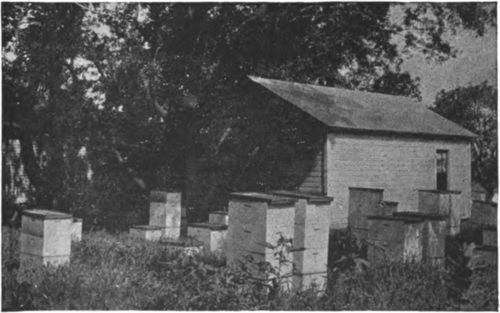
Small honey house built in sections to facilitate moving when necessary.
With no more honey coming from the field the worker bees drive out the drones and they, poor fellows, gather in disconsolate groups beside the hives to find such comfort as they can in each other's society. With no food provided by provident sisters they soon die. "They who will not work shall not eat" is the law of the hive, and since the drones have made no contribution to the store, they are not permitted to enjoy its benefits during the time of scarcity.
Thrift
With the coming of cold nights, we find most insects hard pressed to survive and soon they must disappear. Having made no provision for food, they find no supply and having provided no fuel they must suffer from cold. The honeybee, however, suffers no such inconvenience. She has laid up an abundance of food and by clustering together with her fellow workers, she is able to warm her habitation.
Autumn is vacation time in the hive. There remains little work to be done and the bees quietly cluster on their combs and move about lazily with no apparent object in view. Except for the guards, who must be constantly alert to prevent robbers from removing their store, and the few house bees who clean and scour every trace of dirt or refuse, the colony takes its ease. The quiet of autumn is in marked contrast to the bustle and hum of harvest time. When there is work to be done, the hive fairly vibrates with tense activity, but now that the harvest is all gathered, there is no longer need of bustle and haste.
The storehouse is filled with row on row of sealed cells filled with golden honey and rich pollen, food which has no superior for either quality or purity. So cleverly has it been preserved that it will not deteriorate, even though months or even years elapse before it is needed. What matter to the prudent bees that the flowers no longer yield nectar, for they have enough and to spare, if perchance the covetous beekeeper has not robbed them of too great a share.
This abundant store of honey will serve them well for food during the idle days of autumn, and it will serve them equally well for fuel to warm the hive during the cold days of winter, when they generate heat by muscular activity. Likewise there will be a reserve to feed the hungry larvae when spring comes again and the bees begin once more the round of duties in preparation for another harvest.
Here is a house sufficient unto itself, one that reminds me of the provision for winter in grandfather's cellar. There was no worry about hard times when nature gave forth abundantly, for money was only for the payment of taxes and the few incidentals which could not be produced at home.
Grandfather brought in barrels of apples and bushels of potatoes. He brought in carrots, parsnips, squashes, turnips and nuts. To all this grandmother added her store of dried corn and dried apples and canned tomatoes. There were canned strawberries and rhubarb and raspberries and blackberries, plums and cherries. There were beans in abundance from the garden and hams and bacon from the smokehouse. Always fresh eggs and milk came in as a daily contribution.
Alas how far we have strayed from the ways of our fathers when thrift provided a competence even for those with small incomes. No longer do we emulate the bees, but rather the grasshoppers, who live in the abundance of the moment, and perish from want with the coming of adversity.
Continue to:


My Books

