


Some Necessary Precautions, When Bees Annoy The Neighbors, Bees At Watering Places
Description
This section is from the book "A Living From Bees", by Frank C. Pellett. Also available from Amazon: A Living From Bees.
Some Necessary Precautions, When Bees Annoy The Neighbors, Bees At Watering Places
Some Necessary Precautions
If one would keep bees in town there are a few precautions which should not be overlooked. Bees will sting when things are not to their liking. Stings are painful and injured persons are not always reasonable. If the beekeeper uses care he can usually avoid trouble with his neighbors.
In the first place do not risk anything but a gentle strain of bees. Gentle bees gather as much honey and cost no more. Perhaps where one has an apiary so located that it is likely to be disturbed by mischievous boys or pilfering night raiders there might be some advantage in having cross bees. To bring such bees into a city or town is only to invite trouble and plenty of it.
In selecting a location for the hive put it where there is no occasion to walk directly in front of it. The bees resent having persons or animals in their line of flight. If it is necessary to place the hive near a walk or drive be sure that the entrance faces in the opposite direction. Many apiaries on town lots are surrounded by trees, shrubs or vines in such a way that the bees take flight and arise at once high into the air when leaving the hives. In such a place the neighbors seldom are conscious of their presence.
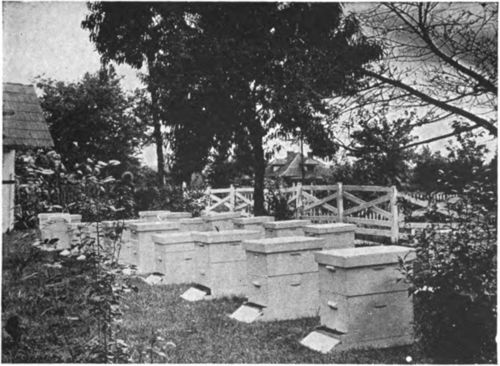
Apiary in city of Nashville, Tenn.
When working with the bees take care not to disturb them when there is no work for them to do in the field. When they are busy bringing in pollen and nectar they are quiet and pay little attention to the presence of their keeper. When all the old field bees are idle and loafing about the hive, a disturbance is likely to arouse them and start them on the war path. Neighbors a block away may be stung at such times. Learn when it is safe to open the hives.
When Bees Annoy The Neighbors
Since bees insist on going where they will regardless of property boundaries or line fences there is an occasional annoyance of an individual who has no interest in the insects except to avoid them.
Such cases are more frequent in early spring when the bees are beginning to fly after a long winter confinement. Especially annoying to the housewife is the spotting of her washing which freshly laundered is hung out to dry. Such trouble is easily avoided by a little forethought.
The bees void their excrement only on the wing if in normal health. On the first mild days, after long confinement, the bees are heavy with waste matter and find relief in flight. They do not go far but often spot everything within a short distance of the apiary. After a good cleansing flight there is no further trouble. Accordingly the beekeeper, who winters in the cellar, should make sure that the bees are not set out at the time when washings are on the line. Either the washing should be postponed or the bees left in the cellar until a later day. However, it often happens that outdoor wintered colonies will find opportunity to fly for the first time after several weeks' confinement on the fine day when washings go out. In this case the bees can scarcely be confined so the housewife should be forewarned as to probable consequences.
Such difficulties are seldom met except in cities and towns where families live close together. The one who keeps bees under such conditions is bound to use every precaution to avoid annoying his neighbors.
Bees At Watering Places
Another source of annoyance which often persists for weeks, is the presence of the bees at open water. In the spring of the year when brood rearing is in progress the bees consume large amounts of water. The water carriers are constantly afield in nice weather bringing in a supply of moisture. They congregate in large numbers about stock tanks, bird baths or other places where open water is available. Usually these bees are quiet and inoffensive but nervous persons are much afraid of them and occasionally someone gets stung. Cattle or horses coming to drink are often frightened away when bees are too plentiful. Once the bees find a convenient supply they are likely to continue making use of it for an indefinite period.
The beekeeper should take special pains to insure a dependable supply near to the hives to avoid such difficulty. If there is no pond or spring near at hand where the bees can water without disturbing anyone, an artificial supply should be provided. There are several ways in which this may be done. Where there is opportunity to connect with a water pipe with pressure it is a simple matter. A small pipe may be attached with a faucet closed down to the point where it merely drips. The drip can be released in any convenient container. One beekeeper hollowed out the end of a large block of wood and thus provided the bees with a watering place and the birds with a bath.
A common plan is to use a trough with sloping sides with lath or cork chips floating in the water to permit the bees to drink without danger of drowning. The addition of a small amount of salt seems to attract the bees as well as keeping the water from becoming stale. At the author's home we have built a lily pool and find that the plants provide resting places for the bees.
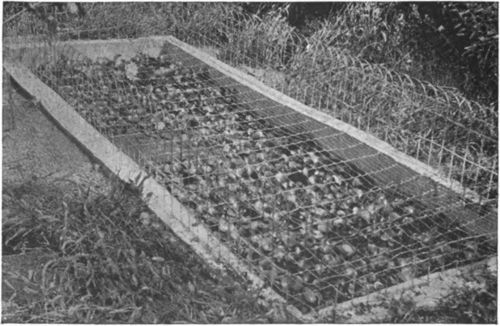
Lily pool for watering bees at American Bee Journal experimental apiary. The plants provide resting places for the bees. The wire fence prevents dogs and children from getting into the water.
Continue to:


My Books

