


Why Freight Rates Are High, Value Of Attractive Packages
Description
This section is from the book "A Living From Bees", by Frank C. Pellett. Also available from Amazon: A Living From Bees.
Why Freight Rates Are High, Value Of Attractive Packages
Why Freight Rates Are High
To get back to the beginning, the first thing that confronts the honey producer who would send his honey to market is the matter of freight rates. Too much care cannot be taken in packing honey for shipment, not only to guard against damage in shipment but also to keep the number of broken packages down to the point which will enable the railroad to carry honey at a low rate and still make a profit. Too many beekeepers take the attitude that it matters very little, for in case the shipment is damaged in transit the railroad company will pay for it anyway. This is a mistaken viewpoint. Claims for damages are a part of the regular expense account of the railroad company and when the damages absorb too large a part of the profits the rate is raised accordingly. It is not only the damage to the honey which results in a loss to the railroad but the damage to other goods which may happen to be in the same car with the broken package. As an example may be cited a case where a broken package of honey damaged a shipment of silk. The railroad had to pay for both the honey and the silk, the latter, of course, worth many times the value of the honey. In many cases the damage from broken packages could be avoided if the producer would use sufficient care in preparing his shipment. It is easy to see that in the end the entire loss must be borne by the honey producer. The careful shipper must divide the expense with the careless one, since the freight rate is made high enough to cover all such losses in addition to the operating expenses of the railroad.
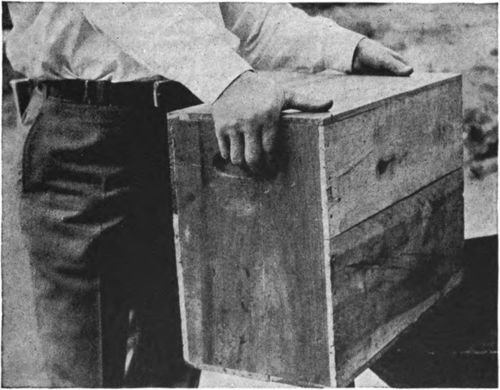
Case holding two sixty-pound cans for shipment to distant markets.
The writer was for a time engaged in the practice of law and never during the years when his time was so occupied did he find any difficulty in getting a fair settlement for a client for loss or damage in shipment by freight. Some railroads are much more prompt in payment than others, but all with whom we had any dealings seemed entirely willing to make good any loss for which they were responsible. There was never any necessity to start suit on cases of this kind, for once proper proof of loss was pro-sented settlement was secured without difficulty. The attitude of the railroads seemed fair enough and if it were possible for them to get into touch with the shippers and make clear the difficulties under which they work there would be much less friction because of high freight rates.
If the beekeepers desire to reduce freight rates, the first move to make is to educate the shipper to use more care in packing for shipment and thus reduce the amount of damage. If the careless man can be kept from shipping improperly crated honey there will be no difficulty in getting a reduction of freight rates on this commodity. Until then all honey shippers must contribute something to pay the losses.
Value Of Attractive Packages
When a man goes into the large markets and sees the large variety of products that are offered, he at once learns that in order to appeal to the consumer any commodity to be used for food must be offered in the most attractive form possible. The writer saw a very good example of that in one of the well-known commission houses when a retailer came in to make a purchase with which to supply his trade. There was a liberal supply of extracted honey in sixty-pound cans on the floor of the warehouse. He examined the various lots with a good deal of care, sampling each lot two or three times to make sure that the quality was good. The thing that impressed the writer, however, was not the care this man used in looking for the best flavor, but that he refused to sample honey in rusty cans. There was one shipment in cans that were rusty on top and which had a rather unattractive appearance generally. He sampled honey only in bright new cans that did not show a particle of rust. When the writer asked the commission man about the difference in price he was informed that they were compelled to sell the honey in rusty cans at from one to three cents per pound less. In spite of the difference in price this buyer would not even look at it. Probably the shipper of that lot of honey will blame the commission merchant for loss of a dollar or two per case on the shipment. If the writer had not already been convinced of the value of new packages for honey this observation would have convinced him.
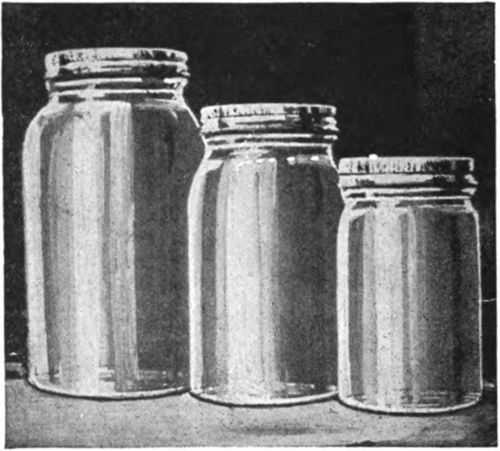
Popular jars for retail sales of honey.
However, another example was in store, with comb honey this time. The honey was well graded and in new shipping cases, but seconds had been used which showed dark streaks of wood instead of the clean white of the first quality shipping cases. This was on the floor of another store so that the two examples did not occur in the same establishment. Although the honey was of about the same quality, the more attractive package sold for fifty cents more per case than the other. Someone had bought inferior cases and had probably saved a few cents in the price, but it cost two cents per pound in the selling price of the honey. The producer who must sell in a distant market should insist on the best possible quality in shipping cases, and before placing an order for supplies should know that the quality is O. K.
In this establishment the writer was shown a model shipment of comb honey. The grading was remarkably uniform, the sections were perfectly cleaned and the cases as clean and white as one could wish. This honey was selling at the highest price the market would afford.
Continue to:


My Books

