


How To Produce Section Comb Honey. Part 4
Description
This section is from the book "How To Succeed With Bees", by E. W. Atkins and K. Hawkins. Also available from Amazon: How To Succeed With Bees: More Than 190 Successful Plans To Produce Big Crops Of Honey.
How To Produce Section Comb Honey. Part 4
Questions You Should Be Able To Answer
1. Why is it essential to have strong colonies of bees?
2. How are bees gotten off their combs?
3. What is the object in dividing colonies into two groups for comb honey production ?
4. What are the principles of swarm control used in comb honey production?
5. Why is an intense honey flow essential for comb honey production?
6. How many supers are placed on the colony at the time it is prepared for section honey production, and why?
7. When are colonies reduced to one hive body?
8. What color and other characteristics of honey are best for comb honey production ?
9. Why is it important to have a thorough knowledge of your honey plants when producing section comb honey?
10. Why is it preferable to have brood in place of honey next to the comb honey super?
11. If bees are not shaken off their combs, how can they be removed from the body they are in?
12. How can you determine that a queen is present in a hive body?
13. How can weak colonies be put to work to good advantage when producing comb honey?
14. What is done with the hive body which is removed?
15. When is an additional super placed on the hive?
16. Why is it a good plan to leave parent hive behind the hive containing swarms for 18 days?
17. What do you understand by travel stain?
18. Why is the new super placed next to the brood chamber?
19. Toward the end of the honey flow, why is it preferable to place new super on top rather than next to the brood chamber?
20. When a comb honey colony swarms, how is a maximum crop produced from it?
21. Why is it important to remove supers as soon as filled?
22. How would you proceed to prevent "after-swarming?
23. In which way are supers manipulated to get as many young bees as possible away from the brood nest?
24. Do colonies of bees vary in their ability to produce comb honey?
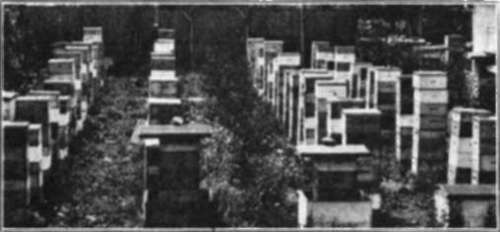
Fig. 45-One of Morley Pettit's apiaries at Georgetown, Ontario. It's efficient management that gives him sky scraper colonies practically every year.
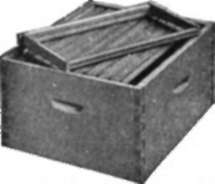
Fig. 46-The full depth hive body is the most popular extracting super for standard hives.
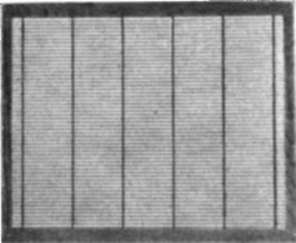
Fig. 47-The queen excluder.
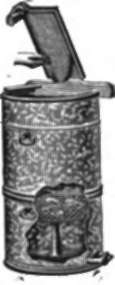
Fig. 51-Uncapping a comb of honey. Honey drains from cappings, which drop on screen near the bottom of the can.

Fig. 49-How to use the bee escape for taking off either extracted or comb honey. Note the cleats of the inner cover are up. Be sure the cover on top of supers is bee tight.
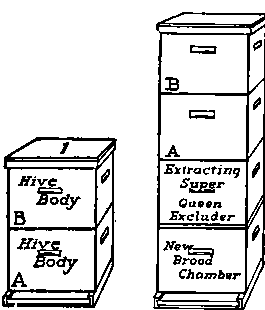
Fig. 48-The diagram of a colony of bees before and after it is prepared for the honey flow. The queen with one or more frames of brood is placed in the new brood chamber.
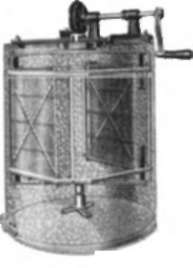
Fig. 52-Hand Power Honey extractor.
Fig. 53-Honey from the extractor is first strained and run into attractive containers if sold direct to retailers or consumers.
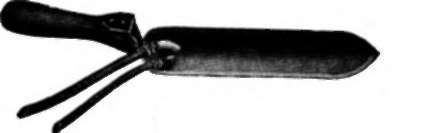
Fig. 50-Latest style of steam heated knife for uncapping combs of honey.
Adequate Supering And Swarm Control Important
1. Colonies strong at beginning of honey flow.
a. Equivalent of two bodies full of bees and emerging brood.
b. Holding this strength without division by swarming.
c. Abundance of worker comb available for queen.
d. Adequate number of supers on hand for surplus storage.
e. All this planned for beginning of honey plant bloom.
2. Whole procedure aimed at producing a maximum crop of honey.
f. Demaree method of swarm control to be used.
g. Watch colonies to see if further swarm control measures are necessary after Demareeing.
h. Keep colony supplied with sufficient storage room throughout flow.
i. Avoid excess storage room at end of flow.
j. Handle supers to segregate dark and light flows.
3. Taking off filled supers at end of honey flow.
k. Do not remove supers until honey is fully ripe. 1. Use of bee escape for removal of filled supers.
4. Leave adequate stores on hive or in honey house to supply winter and spring food for each colony.
5. Extract honey as soon as possible after removal from hives.
m. Have temperature right for working rapidly.
n. Fat combs produced by proper manipulation allow speed in extracting.
o. Honey should be strained clean and placed directly into selling receptacles either from extractor or from tanks.
p. Empty combs to be returned to hives if another crop is in sight or in progress; or stored for next season.
Continue to:


My Books

