


Question You Should Be Able To Answer
Description
This section is from the book "How To Succeed With Bees", by E. W. Atkins and K. Hawkins. Also available from Amazon: How To Succeed With Bees: More Than 190 Successful Plans To Produce Big Crops Of Honey.
Question You Should Be Able To Answer
1. How does a windbreak help a colony of bees to winter better?
2. Why may bees be fed 10 pounds of sugar syrup advantageously just before put into winter quarters?
3. Is waterproof packing of additional advantage? Why?
4. What relation has 57° F. to bees?
5. How can you determine in advance which will be the best day to carry bees in, if wintering in cellars?
6. How would you go about it to make up a batch of feed for 50 hives of bees if you wanted each to get 10 lbs. of syrup?
7. How can you gauge the quantity of packing needed in your locality?
What is the best type of packing material?
8. What effect will mice have on successful wintering of a colony outdoors?
In cellars?
9. Why does protection assist the colony to winter?
10. How many bees weakened during winter regain their vitality?
11. How do bees create heat in winter? In summer?
12. Is a cellar moist at all times good for bees?
13. Tell how to protect stored combs against mice. Against wax moth.
14. Why does correct fall management play so important a part toward the success of your wintering operations?
15. Describe how bees retain heat within their cluster.
16. Why is it disadvantageous to pack bees several weeks after settled cold weather?
17. Why is honey stored early in any season best for bees to winter on? What causes dysentery among bees ?
18. Where may you receive the most reliable information regarding wintering of bees in cellars?
19. Why must cases be made so bees may pass through a tunnel to open air?
20. How much honey will a strong colony of bees require over winter for food alone?
21. How far south in the U. S. A. do freezing temperatures ever occur?
22. Is it correct to protect bees for ordinary winters?

Fig. 19-A complete hive with two styles of supers. We do not recommend this system of supering, but show the picture to acquaint you with hive and supers.
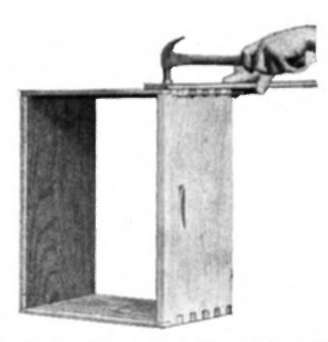
Fig. 20-The hive body walls are dovetailed. The dovetails should be tightly locked together to make the corners square and prevent water from getting in.

Fig. 21-Position of nails usually preferred for assembling frames.

Fig. 22-Lay one edge of foundation in bottom of top bar groove. Hold wedge tightly against foundation by four 2d nails.

Fig. 23-A comb of drone brood, the result of not using full sheets of foundation in the frames.

Fig. 24-A frame complete with foundation ready to give to the bees.

Fig. 25-Hendricks' method. Edge of foundation melted by heated blade, then attached to section. Square blocks hold foundation in position.

Fig. 26-A strip of foundation slightly less than 1/2 inch wide attached to bottom of section. Top piece should come within inch of bottom piece to obtain well filled sections.
Styles Commonly Used And How To Assemble Them
1. How "standard" equipment insures lower costs.
a. Can be obtained most readily.
b. Has higher resale value.
c. Is "standard" because based on adaptation to instincts of bee.
d. Used by majority of successful beekeepers.
2. Necessary equipment for honey production.
e. Use of 2-story brood nest and storage nest.
f. Full sheets of foundation essential.
g. Necessary tools needed are few.
h. Elimination of drones important.
3. Super equipment for extracted honey.
i. Full depth hive bodies interchangeable with brood nests, j. Shallow supers for bulk comb honey.
k. Number required for maximum crops of honey.
4. Super equipment for section comb honey.
1. Choice of beeway or no beeway sections, m. Why beeway section is the most popular, n. Use of full sheets of thin super foundation.
5. How to assemble hives.
o. Proper nailing up of hives and hive parts, p. Care and protection in and out of use.
6. Other equipment for extracted honey production.
q. Extractors; uncapping knives; capping containers and storage tanks.
r. Arrangement of honey house.
Continue to:


My Books

