


581. Song Sparrow. Melospiza Melodia Melodia
Description
This section is from the book "The Bird Book", by Chester A. Reed. Also available from Amazon: The Bird Book.
581. Song Sparrow. Melospiza Melodia Melodia
Range. - North America, east of the Plains, breeding from Virginia to Manitoba and New Brunswick, and wintering chiefly in the southern half of the United States. A favorite and one of the most abundant in all sections of the east. They are sweet and persistent songsters and frequent side hills, pastures, roadsides, gardens and door-yards if English Sparrows be not present. They nest indifferently upon the ground or in bushes, generally artfully concealing the nest by drooping leaves; it is made of grass and weed stems, lined with fine grass or, occasionally, horse hair. As is usual in the case of birds that abound about habitations they frequently choose odd nesting sites. They lay two and sometimes three sets of eggs a season, from May to August, the eggs being three to five in number and white or greenish white, marked, spotted, blotched or splashed in endless variety of pattern and intensity, with many shades of brown; some eggs are very heavily blotched so as to wholly obscure the ground color while others are specked very sparingly. They measure .80 x .60 with great variations.

Song Sparrow.
581a. Desert Song Sparrow. Melospiza Melodia Fallax
Range. - Desert regions of southern Nevada, Arizona and southeastern California. The eggs of this very pale form are the same as those of the last.
581b. Mountain Song Sparrow. Melospiza Melodia Montana
Range. - Rockies and the Great Basin from Oregon and Montana southward.
This variety is paler than the Song Sparrow but darker than fallax. Eggs the same.
581c. Heerman's Song Sparrow. Melospiza Melodia Heermanni
Range. - California, west of the Sierra Nevadas.
Similar to melodia but with less brown and the markings blacker and more distinct. The nesting habits are the same and the eggs similar to large dark specimens of the eastern Song Sparrow. Size .85 x .62.
581d. Samuels Song Sparrow. Melospiza melodia samuelis.
Range. - Coast regions of California, chiefly in the marshes.
Similar to the last but smaller. They nest on the ground in marsh grass, usually in sandy districts along the shore. The eggs average smaller than those of melodia. Size .78 x .58.
581e. Rusty Song Sparrow. Melospiza Melodia Morphna
Range. - Pacific coast of Oregon and British Columbia. A dark species with the upper parts dark reddish brown and heavily streaked with the same below. The nesting habits and eggs are like those of melodia.

White.
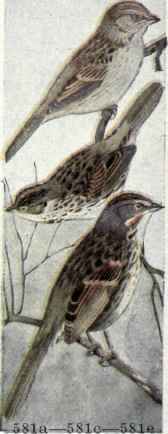

581f. Sooty Song Sparrow. Melospiza melodia rufina.
Range. - Pacific coast from British Columbia to Alaska.
A darker bird, both above and below, even than the last. Eggs like the last but averaging a trifle larger. Size .82 x .62.
581g. Brown's Song Sparrow. Melospiza melodia rivularis.
Range. - Southern Lower California.
A light colored form like the Desert Song Sparrow; said to build in cat tails above water as well as on the ground; eggs not different from others of the genus.
581h. Santa Barrara Song Sparrow. Melospiza Melodia Graminea
Range. - Breeds on Santa Barbara Islands; winters on adjacent coast of California.
A variety of the same size but paler than samuelis. Nesting or eggs not peculiar.
581i. San Clemente Song Sparrow. Melospiza melodia clementae.
Range. - San Clemente and Santa Rosa Island of the Santa Barbara group. Slightly larger than the last; habits and eggs the same.
581j. Dakota Song Sparrow. Melospiza melodia juddi.
Range. - North Dakota, breeding in the Turtle Mountains.
Practically indistinguishable from the common Song Sparrow; the eggs will not differ.
581k. Merrill's Song Sparrow. Melospiza Melodia Merrilli
Range. - Northwestern United States; eastern Oregon and Washington to Idaho.
Very similar to, but lighter than the Rusty Song Sparrow.
581l. Alameda Song Sparrow. Melospiza Melodia Pusillula
Range. - Salt marshes of San Francisco Bay, California. Similar to, but still smaller than Samuel Song Sparrow. Eggs will not differ.
581m. San Diego Song Sparrow. Melospiza Melodia Cooperi
Range. - Southern coast of California; north to Monterey Bay. Similar to, but smaller and lighter than heermanni.
581n. Yakutat Song Sparrow. Melospiza melodia caurina.
Range. - Coast of Alaska from Cross Sound to Prince Williams Sound.
Similar to the Sooty Song Sparrow but larger and grayer. Eggs probably average larger.
581o. Kenai Song Sparrow. Melospiza Melodia Kenaiensis
Range. - Kenai Jeninsula on the coasts. Like the last but still larger; length about 7 inches.
581q. Bischoff's Song Sparrow. Melospiza Melodia Insignis
Range. - Kadiak Island, Alaska. Similar to and nearly as large as the next species, but browner.
581r. Aleutian Song Sparrow. Melospiza melodia sanaka.
Range. - Found on nearly all the islands of the Aleutian group, excluding Kadiak.
This is the largest of the Song Sparrows being nearly 8 inches in length; it is similar in appearance to the Sooty Song Sparrow but grayer. It nests either on the ground or at low elevations in bushes, the nest usually being concealed in a tuft of grass or often placed under rocks or, sometimes, driftwood along the shores. The nests are made of grasses and weed stems, and the eggs are similar to those of the Song Sparrow but much larger and more elongate. Size .90 x .65.

Greenish white.

Continue to:


My Books

