


719. Bewick's Wren. Thryomanes Bervicki Bervicki
Description
This section is from the book "The Bird Book", by Chester A. Reed. Also available from Amazon: The Bird Book.
719. Bewick's Wren. Thryomanes Bervicki Bervicki
Range. - South Atlantic and Gulf States, and the Mississippi Valley north to Minnesota and locally to the Middle States in the east.
This species is not common on the Atlantic coast but in the interior it is the most abundant of the Wrens, nesting in holes in trees, stumps, fences, bird boxes, tin cans, etc., filling the cavities with grass and rootlets. Their eggs are laid in the latter part of April or May; they are white, specked and usually wreathed about the large end with reddish brown and purplish. Size .65 x .50.
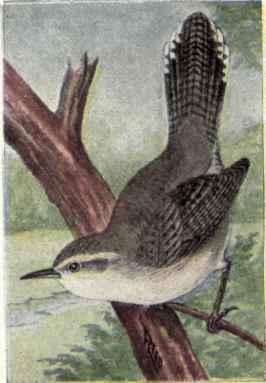
Bewick's Wren.
719a. Vigors's Wren. Thryomanes Bewicki Spilurus
Range. - Pacific coast of California.
This similar bird to the last has the same general habits and the eggs are not in any way different from those of Bewick's Wren.

717a-719a

White.
719b. Baird's Wren. Thryomanes Bericki Bairdi
Range. - Southwestern United States, from western Texas to eastern California and north to Colorado and Nevada.
Like the two preceding Wrens, this one nests in natural or artificial cavities, and the four to seven eggs that they lay are precisely alike, in every respect, to those of the others.
719c. Texas Wren. Thryomanes Bervicki Cryptus
Range. - Texas, north in summer to western Kansas.
A very abundant bird in Texas. Nesting habits not unusual nor eggs distinctive.
719d. San Diego Wren. Thryomanes Bervicki Charienturus
Range. - Coast of southern California.
719e. Seattle Wren. Thryomanes Bervicki Calophonus
Range. - Pacific coast from Oregon to British Columbia.
These last two sub-species have recently been separated from Vigors's Wren, but their habits and eggs remain the same as those of .that variety.
719.1. San Clemente Wren. Thryomanes Leucophrys
Range. - San Clemente Island, California.
This species is similar to Vigors's Wren but is grayer and paler above. It is not peculiar in its nesting habits and the eggs are like those of bervickii.
Continue to:


My Books

