


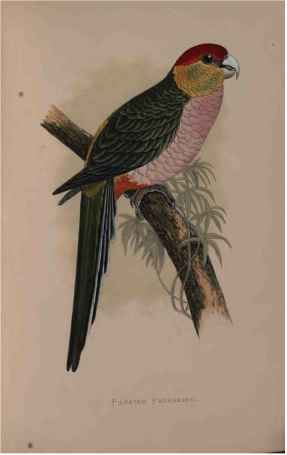
Pileated Parrakeet. Psittacus pileatus, Gould. Platycercus pileatus; P. spurius
Description
This section is from the book "Parrots In Captivity", by William Thomas Greene. Also available from Amazon: Parrots in Captivity.
Pileated Parrakeet. Psittacus pileatus, Gould. Platycercus pileatus; P. spurius
Psittacus pileatus, Gould. Synonyms: Platycercus pileatus; P. spurius.
French: Platycerque à bonnet rouge.
PRE-EMINENTLY distinguished among its peers by the harmonious and varied tintings of its plumage, the Pileated Parrakeet is no less to be recommended to the notice of amateurs for its gentle and loveable disposition, its inoffensive habits, and the softness and sweetness of its notes - it never screams or screeches, but warbles delightfully in a low and pleasing tone - than for the charm of its personal appearance; which, though not showy, is extremely attractive and neat.
A native of the sparsely-timbered ranges of Western Australia, the Ruby-capped Parrakeet was first described and figured by the late John Gould, F.R.S., the author, inter alia, of that magnificent work, The Birds of Australia, of which a single copy is now worth about £300; and well worth it, too, in our estimation and that of many people.
"Pilate", contracted from pileated, has been in the writer's possession for several years, and is believed to be the only specimen of its species now living in this country, where, until recently, a second was to be seen at the "Zoo", but has gone over to the majority; while a few young ones, in immature plumage, that were imported during the summer (1885) by the late Anton H. Jamrach, are believed to have all died soon after leaving his hands.
The present writer is, unacquainted with the early history of the lovely bird of which Mr. Lydon has so admirably drawn the portrait for the present work, for it was purchased at a little suburban bird-shop, of which the owner had obtained it from a boy in the neighbourhood; to whom it had been made a present by a friend, who was reported to have brought it from Australia.
It was then adult, and perhaps two years old, in splendid condition, and very tame and gentle. It soon grew reconciled to its new home and surroundings, but after awhile, whether it pined for its late ungrateful master, or the change of diet did not agree with it, for the dealer was unable to say to what food the bird had been accustomed, before passing into his possession; it grew sick and weak, and seemed as if it must certainly die.
Careful nursing, however, soon brought it round, and in the course of a week or two "Richard was himself again", while a sojourn in a large out-door aviary during the summer months so improved its appearance, and invigorated its frame; that, at the present time it is able to fly a dozen times or more round the room, without losing breath. It is rather sensitive to cold, and a small eater, preferring canary seed, but taking a little maize and hemp now and then. Of fruit it is extremely fond, but if given a lump of sugar, it proceeds at once to drop it into its water-tin, into which it also dips every piece of crust, or biscuit, or even boiled potato, that may be given to it.
When it perceives anything on the table that it fancies, it comes close up to the wires, stretches out its head, and raising its tail to the level of its back, flaps its wings quickly; without, however, opening them out, and emits a series of little calls, that sound something like "chee chu chu" rapidly repeated; but so far, although it answers to its name, "Pilate", by the above-described call, it has never attempted to speak, or even to imitate any kind of domestic noise, as most of its congeners are in the habit of doing.
It is amazingly fond of whittling, and if not supplied with a log of soft wood on which to exercise its long and sharp upper mandible, soon cuts a perch to pieces, or picks holes in the wall; in default of other material, it will even nibble the bars of its cage, but it is always supplied with timber, which it converts into minute chips in a very short space of time.
Eating little, and always, or nearly always, dry food, it is a very clean bird, bathes frequently, and takes great care of its beautiful plumage, which is in as perfect condition as if it enjoyed entire liberty; which it might do but for one objection, namely, the havoc it makes with wood of every description'; picture-frames, backs of chairs, and especially the top of an over-mantle, of which it seems to be particularly fond; it has quite a passion for overhawling a desk, or box, lifting up the covers of the little receptacles for pens, etc., and pulling out and scattering the contents on all sides. Pencils and penholders it seems to have an extreme liking for, and will even try to pull them from one's fingers, when they are speedily broken, or cut rather, into pieces, if the bird is allowed to have its way.
" Pilate" and the Hawk-headed Parrot, already described, often have a battle royal when the former alights softly on the top of the cage usually occupied by the latter; but when both are out together they are very good friends, and like to explore each other's dwelling, occasionally making an exchange; "Pilate" taking possession of "Pinto's" abode, and the latter ensconcing himself in the cage ordinarily occupied by the former. All the same, the Pileated Parrakeet is a decidedly timid bird, and when in the aviary would surrender its place at the seed-box to the smallest of the inmates, without even an attempt at resistance.
Mr. Lydon's beautiful plate renders a detailed description of the Pileated Parrakeet unnecessary; it will be sufficient to observe that the green of the back and wings and the purple of the breast appear to change into various shades of the same colours, according to the light in which the bird is seen. The same remark holds good, though in a less degree, of the ruby-coloured cap, from which this Parrakeet takes its name, the golden green cheeks and the grey blue under surface of the tail. This appendage is about eight inches in length, and consists of twelve feathers, of which the central pair are the longest and dark green; the next pair are about half an inch shorter than the first, and are pale blue tipped with white; an arrangement of colour that also obtains with the third pair, which are about half an inch shorter than the second; the rest of the tail feathers are without white tips, and very much shorter than the others, the sixth or outside pair not being more than two inches long.
The beak is long and narrow, of a dull blue, lighter at the tip, and so formed that the horn-coloured tongue can always be seen. The eyes are hazel, and the legs and feet grey.
Although strong on the wing, and an excellent flyer, the Pileated Parrakeet has long legs, and is very active on the ground, where it passes a considerable portion of its time, walking freely, and running with as much nimbleness as the Grass Parrakeets; to which it seems to bear, in the opinion of the present writer, more affinity than to the Broadtails (Platycerci), with which it is usually classed.
Gould observes that it feeds mainly on the ground, probably on the seeds of the indigenous grasses.
The sexes are very much alike in respect of colour, and general appearance, but the adult male has a dull red shade on the rump, which in the female is yellowish green.
The plumage of the young is all of a dull green, but the cap and cheek patches are already defined, and the change to the adult habit is speedily effected. Little is known of these birds in their wild state but it is reasonable to conclude, that they are not as hardy as many of their congeners in captivity.
Owing to the scarcity of the Pileated Parrakeet in its native country, and the rarity with which it is imported into this, a good specimen commands a high price in the bird-market, and the young ones, already referred to, were readily disposed of on arrival, at prices varying from £3 to £5 each.
Incredible as it may appear, this rare and beautiful bird has been twice exhibited at the Crystal Palace Bird Show, without attracting the attention of the Judges, who awarded the prize on one occasion to an indifferent specimen of Pennant's Parrakeet, and on the other to something else; truly a casting of pearls before swine, which shall not occur again; the fact being, that the majority of people do not know a good bird when they see one. In palliation, however, of the conduct of the Palace authorities, it may be here incidentally mentioned, that the light is anything but good at the Bird Shows that are held there every year.
Dr. Buss, of Berlin, who passes for an authority, does not even mention the Pileated Parrakeet, which, as far as the writer of these remarks is aware, has previously been described by Gould alone. True, an anonymous contributor to the Boys Own Annual, just mentions it, and calls it Platycercus spurius, but affirms it to resemble Barnard's Broad-tail, which is certainly a wide stretch of imagination, as readers will have an opportunity of judging for themselves; when the latter handsome bird is reached in the course of the present volume.
In concluding this brief sketch, it will be sufficient to say that the subject of it is one of the most desirable birds to make a pet of. Elegant of shape and of beautiful plumage, it has the further advantage of not being in the least noisy; it is very tame and gentle, and, once it has become acclimatised, fairly hardy, providing that extremes of cold are avoided. It is very friendly and sociable, and may safely be kept with even the tiniest Waxbills, without the least fear of its doing them an injury.
On the other hand, it will not learn to speak, and cannot be classed with "The talking Parrots", like many of its congeners; it is rather expensive, too, and when first imported, delicate. It is an inveterate cutter and clipper of wood, a very Gladstone in the matter of timber, if not in any other respect; and cannot, consequently, be kept in a conservatory, or even in an out-door aviary planted with trees and shrubs.
It seems invidious, however, to take leave of so charming a bird with words of dispraise, and we therefore repeat that among desirable pets, the Pileated Parrakeet, in our opinion, occupies a very high place indeed.
That it is not noisy in the least degree, and is extremely beautiful, without being gaudy or "loud" in colour, is surely enough to recommend a most delightful creature to the favourable notice of connoisseurs. It is much to be regretted that so few of these eminently desirable birds should be imported, and that their treatment should be so little understood; that when one arrives, it as often as not, is lost through ignorance of the proper way to manage it on the part of its owner.
The death of the young birds, brought up from the nest by hand, that were received by the late A. H. Jamrach may be attributed, without doubt, to the insanitary condition of their surroundings during the voyage; for on their arrival at his place of business, that well-known dealer, much to be regretted by amateurs, assured us they were in a deplorably filthy state, and although he at once attended to them, and placed them in more comfortable quarters than the poor creatures had occupied for weeks; they all, as far as we are aware, ultimately died.
Should another of these birds ever pass into the hands of the writer, he would keep it very warm in the first instance, gradually lowering the temperature as the bird became acclimatised; would not permit it to wash except in tepid water, which he would also supply for drinking purposes, and would feed on oats and bread-sop, gradually weaning to canary seed; by which means he believes he would be more successful than he was in the last instance, when one of these very charming birds came into his possession; and thus secure a mate for "Pilate".
Continue to:


My Books

