


Splendid Parrakeet. Psittacus splendidus. Euphema splendida, Gld., Gr.; Euphema chrysostoma, Wgl
Description
This section is from the book "Parrots In Captivity", by William Thomas Greene. Also available from Amazon: Parrots in Captivity.
Splendid Parrakeet. Psittacus splendidus. Euphema splendida, Gld., Gr.; Euphema chrysostoma, Wgl
Psittacus splendidus, Russ. Synonyms: Euphema splendida, Gld., Gr.; Euphema chrysostoma, Wgl.
German: Der Glanzsittich.
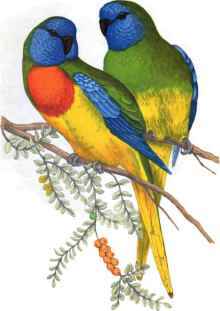
SPLENDID PARRAKEET.
THE vast, sparsely timbered plains of Western Australia, clad during part of the year with abundant verdure, chiefly consisting of a strong coarse grass, known to the settlers by the name of Kangaroo-grass, from the partiality with which it is regarded by the herbivorous Marsupials in general, and the Kangaroos and Wallabies in particular, afford a secure asylum for a number of beautiful Parrakeets, many of which are extremely local in their distribution, and two or three of which are, perhaps, even better entitled to the specific designation splendidus than the subject of the present notice, upon whom it has been bestowed by several authors.
"Every eye", says the proverb, "makes its own beauty"; that is to say, every eye has its own standard of perfection, by which it measures, often unconsciously, the objects that are being continually passed in review before it, and not unfrequently the popular judgment is reversed by a private decision; but, more frequently, the strongest views of a single individual have to give way before the fiat of the majority, which is exactly the case in the present instance, where we refrain from pressing our private opinion on the public, in deference to that of the ornithologists whose names are affixed to the synonyms of the lovely bird that forms the subject of the present chapter.
Pennant's Parrakeet, for instance, has been described under the specific title "splendid" by a number of writers, and we think with better judgment, but as that is a matter of opinion, we shall not, as we have said, dispute the point; although so strong were the feelings of Shaw upon the subject, that he went beyond even Gould in his admiration for the bird to whom he applied the epithet of gloriosus, namely, the grand Parrakeet named after Mr. Pennant.
The Splendid Parrakeet, although not to say uncommon in its native land, is very rarely imported into ours, which is the more to be regretted that it is a grass-seed eater, and not more difficult to preserve in captivity than the Turquoisine and the Elegant.
Seen running nimbly over the ground, among the long grass, the Splendid Parrakeet might, by its green back, blue face, and wings edged with blue, be taken for a Turquoisine; but when, alarmed by the approach of an intruder upon its ancestral domain, it rises with a "whirr" that somewhat reminds the beholder of a Partridge, and flies to the nearest she-oak, banksia, or mimosa, the deep red neck and breast reveal the fact that it is another and quite different bird.
It is rather smaller than the Turquoisine, and of equally slim and graceful build. The nest is made in a hollow bough, where the female lays three or four eggs on the soft wood, hatching them in about eighteen days; and there are usually two broods in the season.
The movements of this bird are in a great measure regulated by the supply of food; thus in one district where the crop of grass has been good, the Grass Parrakeets, with the Splendid at their head, abound; although in the next, whore either a "Squatter's" flocks, or the presence of an unusual number of the indigenous mammals, or perhaps of the prolific rodent so recently imported from the mother country, and which in the land of its adoption has displayed a fecundity so marvellous that it actually threatens to drive not only the native animals, but man himself from the scene, where, in such a case, the grass has been either totally consumed, or at least prevented seeding, these birds are of rare occurrence; while if a bush-fire has recently desolated the land, they are not to be seen at all.
When the breeding season is over they all retire to the far interior, to reappear on and near the southern coasts, as the season of love and marriage invites them to the fulfilment of the all-important duties of reproduction; which, accomplished, they retire once more to their favourite fastnesses, and it is on these journeys that the trapper could make of them an easy prey.
It is much to bo desired that dealers would endeavour to procure some of the rarer members of the family, instead of confining their attention to the importation of the few species they usually keep in stock, and which are as familiar to amateurs as the Linnet and the Robin: we might then hope to become more intimately acquainted with the subject of the present notice, and others of its beautiful congeners, now quite unknown to the great majority of the English bird-loving public.
It is difficult to understand the apathy of traders in this respect, for the importation of a rare bird is sure to cause a flutter in the breasts of connoisseurs, who rush to purchase it with one accord, as soon as its advent has been made known, when the dealer has only to name, in order to obtain his price for the phenomenon: and even in those rare cases where the sum demanded is beyond the limit of even the largest private purse, our "Zoo", or one of the continental Zoological Societies is certain to step in and secure the prize, no matter at what enormous figure, or, as the French say, "prix fou."
A Grass Parrakeet, or seed-eater, the Splendid Parrakeet is not a difficult bird to keep, so that the £10 or so given for him is much more safely invested, than if risked upon a couple of pairs of Paradiseas, or Many-coloured Parrakeets. Canary, millet, and oats should form his staple diet; a handful of sweepings from the hayloft thrown into the aviary will afford him amusement in picking out the seeds, as well as a welcome change of food; and, should he chance to go to nest, as he probably would, if lodged according to his notion of the fitness of things, dry crumb of bread should not be forgotten; a little hemp is permissible, as a variety, now and then, and the same may be said of flax and maw-seed: tufts of flowering grass in the season, or a bunch of half-ripe French millet will form an agreeable change in his bill of fare, but must not, at first, be supplied with too lavish a hand; groundsel tops and dandelion flowers he is also fond of, while mignonette in blossom, or just commencing to seed, will be much appreciated.
Lodged and fed as recommended, we have no doubt the Splendid Parrakeet would soon cease to be the vara avis of our collections, for he would then certainly breed, and, ere long, we should be almost, if not altogether, independent of a foreign supply for this charming bird, now so rare that wo venture to say not one in ten of our readers has ever seen it alive; for the home production of the species would soon be adequate to meet all demands: he is not delicate either, which is yet another point scored in his favour, and as, at least for some time to come, he is certain to command a high price in the market, it would certainly be worth the while of amateurs to attempt to breed him in captivity.
One point, however, demands attention, - the Splendid Parrakeet is of somewhat uncertain temper: like his relative the Turquoisine, one individual may be of a purely angelic disposition, affable and kind to all his neighbours, small, no less than great; and another may have a temper of exactly the opposite kind, and commit sad havoc before his unfriendly behaviour to his fellow-captives is discovered, and he himself removed from their society, tried and condemned to durance vile for the term of his natural life.
Continue to:


My Books

