


Undulated Grass Parrakeet, Or Budgerigar. Psittacus undulatus. Melospittacus undulatus, Gld.; Euphema undulata, Shw
Description
This section is from the book "Parrots In Captivity", by William Thomas Greene. Also available from Amazon: Parrots in Captivity.
Undulated Grass Parrakeet, Or Budgerigar. Psittacus undulatus. Melospittacus undulatus, Gld.; Euphema undulata, Shw
Psittacus undulatus, Russ. Synonyms: Melospittacus undulatus, Gld.; Euphema undulata, Shw.;
Nanodes undulatus, Jard. & Slb.; etc., etc.
German: Der Wellensittich.
French: La Perruche Ondulee.
BOOKS have been written about the Budgerigar, which has now become as familiar in our midst as the Canary Pinch, and like the latter bird has "sported" from the original stock into several varieties, so distinct from their common ancestor as to completely puzzle persons unacquainted with their parentage, and render it all but impossible to say to what species, or genus rather, of the Psitta-cidoe they belong.
One of the prettiest accounts of this delightful bird with which we are acquainted is that by M. Leroy, of Paris, whose book is not only most charmingly written and interesting, but thoroughly exhaustive.
We cannot, however, give equal praise to La Perruche Ondulee of M. Leon Mary, who has thought proper to enter into certain details of moeurs, or character, he had far better have left unnoticed; but he also goes into the statistics of the matter, which may be of use to beginning aviarists, and an encouragement to others.
"With two hundred francs", writes M. Mary, "you will build your aviary, and, at that figure, it will not be inelegant."
Food | 20 Parrakeets during 305 days | Francs | Cents | |
111 " " 180 " | 272 80 | |||
Repairs, say ••• ••• ••• •• | 25 | 0 | ||
Interest at 10 per cent on price of 10 pairs | 14 | 0 | ||
Interest at 10 per cent on cost of aviary ... | 20 | 0 | ||
• | 831 | 80 | ||
111 young ones sold | 666 | 0 | ||
Deduct cost of keep, etc. | 331 | 80 | ||
Profit | 834 | 20- | Between £18 & £14. | |
"Such" he continues, "is the result I obtained, but I must admit that it is culminating, a desideratum to which it will be well to aspire.
So we should say: but even in this colder climate we have had twenty-six young from two pairs in one season, and, perhaps, no more than two the next.
Budgerigars, we prefer this name to the longer appellation of Undulated Grass Parrakeet, do better in small companies of from six to ten pairs, than when kept in single couples; and if their aviary is of sufficient extent, one hundred pairs may be placed together, with the best aggregate results: but there must be no odd birds, neither solitary hen, nor mateloss cock, among the number.
Of course there must be a sufficiency of nesting accommodation, in the shape of hollow logs of wood, natural, or artificially made, or of cocoa-nut husks; and, failing these, small boxes, such as cigar-boxes, with a hole cut in the upper edge of sufficient size to admit of the birds passing freely in and out, and half a cocoa-nut shell cemented into the bottom; as otherwise the eggs would roll about on the flat surface of the wood and bo spoiled, while the concavity of the shell affords a suitable receptacle for them. If a portion of the aviary is protected from the weather, the birds may remain in it all the year round, as they are very hardy, and appear to feel no ill effects from the severest cold: of draughts, however, they are, in common with all birds, very impatient, so that the aviary we prefer for them is one placed against a wall that faces to the south, or the south-west, and open at the top for the greater part of its extent; the open portion should bo well grassed, but it is useless to plant trees in the enclosure, as the inhabitants would immediately pull them to pieces.
When the grass is long, the Budgerigars much delight to roll in it, especially when wet with the morning dew, or a passing shower: and it is a pretty sight to see them swimming as it were in the ocean of verdure that surrounds them.
The covered-in part of the aviary should be well lighted, or the whole front may advantageously be made of glass, wired on the inside, lest during a sudden nocturnal panic, to which these birds are subject, they injure themselves by dashing against the glass: the top, however, should be securely boarded over, and on the boards should be a covering of thatch or felt.
The nests should bo placed in the covered-in portion of the aviary, as near the roof as possible, and whether hollow log, or cocoa-nut husk, or box, the aperture should be turned towards the light, in order to enable the old birds to feed their young, which we have found that they were unable to do in complete darkness, though, a small modicum of light seems to suffice them for the purpose.
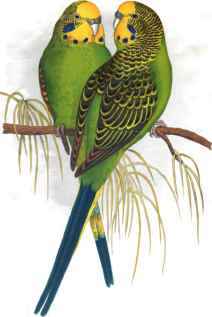
BUDGERIGAR.
The eggs of this species, like those of all the Parrot family, are white, and vary in number from four to nine, five or six being, perhaps, the average number laid.
In their wild state these birds have two broods in the season, but in domesticity three or four; not unfrequently, especially when kept indoors, breeding continuously all the year round.
They are extremely precocious birds; so much so that we have known them pair, lay eggs, and rear young before they had moulted their nest-feathers, and were themselves not more than three or four months old, and in fact we have seen them caress before they had left their nest three weeks! It is not desirable to permit this, as the offspring of such immature birds are worthless, and the effect of rearing them prejudicial to the youthful parents themselves.
It is almost superfluous to describe a bird so well known as the Budgerigar, but it would scarcely be en regie not to do so: the ground colour of the plumage is green below, yellow on the upper portion of the body; the head is yellow, the neck, back, and wing coverts aye yellow edged with greyish black, the flight feathers black fringed with yellow, the tail is blue in the centre, the other feathers green with yellow spots in the middle; on each side of the beak is a series of deep blue spots, forming an almost continuous line, and below these two or three round black spots, which have been very generally overlooked in the description of these birds. In the adult male the cere of the nostrils is bright blue, in the adult female bluish cream until she has nested, or is about to nest, when it becomes brown: this is the differentiating mark between the sexes, which cannot otherwise be distinguished from each other. The bill is white, and the legs and feet light slate colour.
These little birds are capable of being completely tamed, but as they bite severely, it is necessary when first taking them in hand to wear stout gloves; it is no less indispensable to clip the feathers of one of their wings, and in the course of a few weeks they become perfectly docile, and may be taught a variety of tricks. While the taming process is going on, the birds should be kept singly in a little cage, and handled several times a day; as they are very intelligent, they will soon discover that no harm is intended them, and, losing all fear, they will readily hop from their cage on to the finger that is held out to them, and on which they are to be carried round the room, and even out of doors.
We have seen it recommended, when the birds are quite familiar, to pluck out the stumps of the wing feathers that had been cut, but it is better not to do so, as the longer they are dependent on their owner for locomotion, the less danger there will be of their relapsing into wildness, when they have regained the power of flight.
White millet is the best food for these pretty little Parrots, but canary-seed may be added as a variety now and then; they require a constant supply of tufts of grass, and a handful of hay-seed thrown down on the aviary floor, will give them much pleasure, and keep them employed for hours: they also love to whittle a log of soft, or half rotten wood, and the aviarist who has the welfare of his pets at heart, will provide for their amusement, as well as for their bodily wants.
It has been advised to give them egg food, and bread and milk sop; both are not only unnecessary, but injurious: we have, more than once, expressed our belief that many Parrots were partially insectivorous in their habits, but the Budgerigar is not of these: during a long and tolerably extensive experience with these birds, we have never seen one touch an insect of any description, although access to such diet was generally within their reach.
When the Budgerigar has young ones to feed, he will require an addition to his ordinary diet, in the shape of oats, either given in their natural condition, or boiled until soft, strained, and left to grow cold: the crumb of stale white bread, soaked in cold water, and then squeezed nearly dry, will also be necessary, for half-a-dozen young Parrots take a good deal of feeding, and there is danger, if only dry food is allowed, of the supplies falling short, and the young growing up either stunted or deformed.
Upon the father devolves the principal part of the duty of rearing the little ones, no less than of providing for the wants of the female while she is sitting on her eggs; for unlike the Cockatiel, the male Budgerigar takes no part in the task of incubation, and it will be readily understood that an abundant supply of food requiring comparatively little preparation will enable him to fulfil his important duties with less strain on his own organization, than if all the edible substances placed at his disposal were dry seeds that had to be three parts digested in his own crop, before they become fit for assimilation by the little ones. In Southern Australia, where the Budgerigars are found, they feed exclusively on the seeds of the indigenous grasses, which, at that season of the year, are soft, or at least never as dry and hard as the millet and canary-seed that are given to them in this country; and as one of the first conditions of a successful rearing of foreign birds in captivity, is to assimilate their diet as closely as possible to that of which they partake in their native woods, no more need be said about the necessity of giving the Budgerigar, and for that matter all Parrots, a sufficient supply of soft food during the breeding-season.
The following amusing and interesting account of the entree of a young Budgerigar into the aviary world, is from the graphic pen of M. E. Leroy: -
"When a month old, the youthful Parrakeet has grown all his feathers, and begins to pop his head out of the hole of the log in which he was born.
"His parents are near at hand, and cheer him on.
"He is hungry and begs for food: but instead of feeding him as usual, they promise him some by and bye: they show it to him on the point of the paternal beak: they offer it to him, backing away at the same time, in order to induce him to advance: in other words, they hold the sweet-meat high.
"He would gladly come out, but is afraid.
"He puts out his head, and, amazed by the unknown, by the vastness of all around, backs in again.
"He looks down, and is seized with giddiness: he looks up, and the giddiness increases: it is so deep, up there!
"He, too, would gladly fly like his parents, enjoy all the beautiful things he sees, bathe himself in the sun rays, drink the dew, plume himself on the perches, take his place at the seed-pan, cling to the spray of chickweed.
"Ah! yes, he would, indeed - but - he is afraid.
"He ventures half his body out; he is off. Not at all! he darts back again. The unknown attracts, and at the same time appals him. He longs and is afraid.
"His parents, who understand his hesitation, come to the rescue.
"While his mother endeavours to coax him out with the bribe of a dainty morsel, carefully held beyond his reach, the father, who has crept into the interior of the log, comes upon him unawares, and gives him a push behind to make him get on.
"In vain! The child clings hard, and refuses to budge. It will not be this time.
"This pretty comedy sometimes continues for two or three days, during which time the old hollow log will afford you as much entertainment as a vaudeville.
"All at once, when you are beginning to think he will never stir, the youngster, who has at length grown familiar with the appearance of the outside world, with the limitless expanse around him, the youngster makes a start, and half afraid, half pleased, settles himself upon a perch.
"Once there, .he stops to take breath. He really is upset, I can assure you, the dear little fellow.
"Papa and mamma fly to his assistance; perch themselves by his side; talk to him; cheer him; laugh at him, and feed him, by torn.
"Then they plume their baby: they smooth the feathers of his wings and tail, which the dirt of the nest might have soiled, or stuck together, so that the youngster may be clean, in possession of all his powers, and have the free use of his aerial apparatus.
"He looks at himself, thinks himself handsome, as proud as an urchin who has just handled his first pair of knickers.
"He perks himself, preens his feathers, stretches out one foot, and then a wing.
"'Ah! fact is one had not room to turn oneself at the bottom of a well, jammed in with five or six others, in a hole a few inches wide.'
"He gapes, as he stares at you. His manner, half timid, half defiant, seems to say, 'Well, what is it?'
"'Do you think one si comfortable in a press?'
"So: once he has quitted the hollow log, he returns to it no more. That is finished, thank Heaven! you are not likely to catch him at it again.
"Unless - that is to say - the weather should change to cold.
"He has tasted liberty, and he enjoys it."
We have heard of cases in which the peculiarly English superstition of keeping Parrots without water has been extended to the subject of the present notice; one person boasting that he kept his "Australian Love-Bird" for, we forget how many, years without any moisture but what the poor creature derived from "pellets of bread and butter chewed in the mouth!" Is it possible to imagine anything more horrible! and the marvellous part of the thing to us is how the practice can have arisen.
Budgerigars seldom bathe, and never if they can find wet grass to roll in. In their native land they seem to prefer brackish to fresh water, and are much benefited by fresh cuttle-fish backs being given them to peck at; a piece of rock-salt at the bottom of their cage, or on the floor of their aviary, is also much relished, and is greatly conducive to health.
These little birds live for about ten years in captivity, but are not much good for breeding after four years; in fact we have found hens of little use after their third year: so that a constant infusion of fresh blood into the perrucherie is essential, especially as few birds so deteriorate by in-breeding as the Budgerigar.
We have seen birds of this species of an entirely yellow plumage, and others of a faint yellowish green, with scarcely a trace of the characteristic undulations: while a blue variety is stated to have been produced in Belgium, where the yellow birds originated a few years back: to us these "sports" are far less beautiful than the little, sprightly green-coated Budgerigar, now so familiar to aviarists; that they are more delicate than the original bird, we are certain, and it is probable that without much care, and judicious crossing, these accidental variations will die out, which, after all, would perhaps be no misfortune: though doubtless others will arise, and in time there will be Budgerigars, as there now are Canaries, of all colours, with scarce a trace of their origin discernible about them.
In Jardine's Naturalist's Library, Selby writes of the Budgerigar, which he named "Undulated Nanodes" (Nanodes undulatus, Vig. et Horsf.), as follows: - "This little species, which scarcely exceeds seven inches in length, approaches still closer than its congeners in colour and appearance to the Ground Parrot, and brings the genus Pezoporus, I11g., into immediate connexion with that to which it belongs."
It might be thought that the force of imagination could scarcely further go, but it does, considerably further; for M. E. Leroy is reminded by it of the Swallow!
"Par sa structure", writes that author, "par ses formes elancees, par la petitesse de ses jambes, la longueur de ses axles et de sa queue; en un mot, par son greement et sa voilure, si je puis m' exprimer anisi, la perruche oudulee so rapproche beaucoup de V hirondelle, si ce n' est que, dans le vol, les plumes caudales, au lieu d' affecter la forme fourehue, se deploient en eventail, les plus longues au milieu, absolument commie celles du faisan."
The Budgerigar like a Swallow ! we are tempted to exclaim with Hamlet, "Like a Whale!"
Nor is Selby much happier in his resemblance of the Undulated one to the Ground Parrot: both are Parrots, it is true, and both are green, with dark undulated markings on a portion of the plumage, but there the resemblance ceases.
Dr. Buss has written a book about the Budgerigar, and the subject is far from being exhausted: but the doctor is not exact when he says of it: " Verbreitung fast ganz Australian", for it is strictly confined to that portion of the island comprised within the limits of the colony of South Australia, and in point of fact is as rare in New South Wales and Victoria, as it is in England, or rarer.
It is a bird of passage, migrating south to breed; "Zugvogel", as Dr. Buss remarks, and returning northwards when its one or two broods of young have been reared, to feed on the grass seeds that have been matured on the vast plains of the interior daring its absence in the south; and it on these journeys to and from their breeding grounds that the professional bird-catchers lie in wait for them, and take them, old and young, by the thousand.
These birds are very hardy, and though tightly packed in close boxes, wired only in front, and generally kept without water during* the voyage, they usually arrive in fair condition; and, contrary to the opinion of some writers, go to nest quite unconcernedly in the aviary a few weeks after their arrival.
Endowed with a great love of hearing its own voice, the Budgerigar is an almost incessant warbler, nor is his little song altogether un-pleasing, or devoid of melody; except when eating or sleeping he is always singing after his fashion; and if he has no companion to whom to address his lays, or speech, whichever it may be, he takes a stick of some kind into his confidence, and chatters to it by the hour, running his beak up and down the perch, or stick, after a manner that is no less curious than bewildering to the looker-on.
Very fond of company, the Budgerigar will, nevertheless, live quite well by himself, and, if he pines for society, does not show it, but "lots concealment, like a worm i' the bud" prey on his vitals, and these must be tough, for they last him a long while.
An interesting account of a talking Budgerigar appeared in a recent number of Dr. Russ's ornithological paper, Die Gefiederte Welt; and we have had males that imitated, passably, the Canary's song.
The females of this species are extremely subject to egg-binding, a fatality which, we are inclined to think, arises from two distinct causes: namely, debility and deficiency of lime in the system.
In-breeding is a frequent source of debility, which is more susceptible of prevention than of cure: the amateur must not suffer consanguineous unions to take place among his birds, which will then be strong, large, and vividly coloured: while inbred specimens are, as a rule, under-sized, delicate, and of a pale washed-out shade, that is any thing but attractive.
Egg-binding from deficiency of lime should not be allowed to occur in any well-regulated aviary, the floor of which should be abundantly covered with sand, small gravel, old mortar and oyster-shells pounded, or even the broken up egg-shells of the domestic fowl.
It has been thought that an accumulation of fat on the internal organs gives rise to egg-binding, and so, in some cases at least, it does, by causing actual obstruction to the passage of the egg from the oviduct into the cloaca, and giving rise to inflammation, which generally terminates fatally. Occasionally a kind of spasm of the sphincter, or circular muscle that regulates the anal aperture, prevents the bird depositing her egg, and this form of the disease may be recognised by the straining, and impotent efforts of the poor bird to get rid of her burden; in which case a drop or two of oil introduced into the vent by means of a small camel-hair brush, combined with warmth, will relax the spasm, and enable the egg to be laid: but birds so troubled are weak, and should be caged up and well fed for a few days, or even weeks, before being restored to their mates.
Some hens sit so continuously that, unless the cock is a most attentive partner, and has an abundance of food at his disposal, they actually die upon their nests, especially during the first days after the hatching of the little ones; others again wear themselves out in a season by too assiduous attention to the great business of continuing the species, and should have their laudable desire to people the world with Budgerigars kept within reasonable limits.
Hardy and desirable as a cage or aviary bird, there would not be the least difficulty in acclimatising the Budgerigar in this country, were but a strict protection accorded them for a few years, after which they would defy the farmer's guns. During winter, especially if severe and prolonged frost set in, it would be necessary to scatter seed and especially oats near their haunts, as is now done for the Pheasants in many preserves; and as they are not destructive to growing crops, there is no reason why these pretty birds should not soon become a feature in our woods and copses. It would then be interesting to observe whether they reverted to the ancestral migratory habits of the species in Australia, and sought "fresh fields and pastures new" when the breeding fever was upon them.
Where would they go to? cross the seas to Southern France or Spain? Who can tell: only let the experiment be made. Who will turn out a couple of hundred, or so, of Undulated Grass Parrakeets some fine May morning, in a well-preserved wood, full of ancient trees, in the holes and crevices of which the Australian strangers might make their nests and rear their young; and so help to solve a deeply interesting ornithological problem?
That such a scheme is practicable we have no doubt, for these birds breed freely in garden aviaries, and there are instances on record in which escaped pairs have actually reared a brood in this country, as well as on the continent: let some amateur then, with whom the conditions for a successful carrying out of the experiment are possible, make the attempt, and record the result in some one of the many Journals that make "Aviculture" a speciality.
As we write, Budgerigars are more scarce in the market than they have been for a long time, 12s. 6d. and 15s. a pair: while lately they could have been purchased for about 8s. a couple: at the latter price, however, they "pay" well, for they are frugal birds, cost little to keep, and multiply with extraordinary rapidity.
As a rule Budgerigars do not interfere with other birds, but it is better to keep them in an enclosure by themselves, or associated with Cockatiels: the Finches tease them, and fill their nests with hay and rubbish; while the various Love-birds are quarrelsome, and Turquoisines, Bed-rumps, et hoc genus omne would soon make an end of the Undulated folk: still we have known vicious Budgerigars that not only fought among themselves, but committed murderous assaults upon the other inmates of the aviary; and should such an evilly-disposed individual be discovered in a flock, he, or, more frequently, she, had better be removed, and condemned to solitary confinement for the remainder of her, or his, days: it is just such perversely tempered birds that make the best and most familiar pets; they have apparently been slighted, or injured by their own kind, and find that consolation in the society and companionship of their owner which is denied them by their congeners.
A lady having written to us to inquire how she should pronounce the word Budgerigar, a native term signifying "pretty bird", we reply: Bud-ger-ee-gar - the first "g" soft, as in geranium; and the second, hard, as in garden.
Continue to:


My Books

