


Cockatiel. Psittcacus Novoe-Hollandice. Paloeornis Novoe-Hollandioe, Leptolophus auricomis, Nymphacus Novoe-Hollandice, Calopsitta Novoe-Hollandioe, Gould
Description
This section is from the book "Parrots In Captivity", by William Thomas Greene. Also available from Amazon: Parrots in Captivity.
Cockatiel. Psittcacus Novoe-Hollandice. Paloeornis Novoe-Hollandioe, Leptolophus auricomis, Nymphacus Novoe-Hollandice, Calopsitta Novoe-Hollandioe, Gould
Psittcacus Novoe-Hollandice, Russ. Synonyms: Paloeornis Novoe-Hollandioe, Leptolophus auricomis, Nymphacus Novoe-Hollandice, Calopsitta Novoe-Hollandioe, Gould.
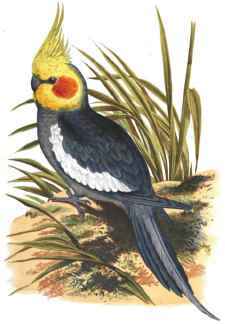
COCKATIEL.
German: Der Nymfensittich. French : La perruche calopsitte.
THIS quietly pretty bird upon whom naturalists have imposed such a multiplicity of names, but which is now very generally designated Cockatiel, a word signifying little Cockatoo, is not, properly speaking, a member of the sub-family of the Plyctolophoe, but rather takes rank with the Grass Parrakeets, themselves nearly related to the Ground Parrots, as is evidenced by the length of its legs, and the facility with which it walks and runs on the ground.
The plumage of the Cockatiel, without being beautiful, is strikingly pretty and effective, affording, as it does, such bold contrasts of colour; the general hue of the plumage is ashen grey, darker on the upper than on the under surface of the body; the shoulders and outer edges of the wings are pure white, the crest, which the bird has not the power of elevating and depressing at will, like the true Cockatoos, and the face are citron yellow in the male, but grey in the female, and on the centre of the cheek, in both sexes, occurs a patch, about the size of a thumb-nail, of brick red; the under surface of the tail is black in the male, but in the female prettily barred and mottled with yellow. The upper surface of the tail and the rump of the female are barred and marked in the manner the French term zebre, with streaks and lines of a lighter shade of the uniform grey of the plumage, giving the bird a mottled appearance, while in the male the same parts present one uniform tint of deep slate grey, so that there is no difficulty in distinguishing the sexes from each other.
The young of both sexes have the under surface of the tail barred like that of their mother, but even when leaving the nest the young males can be distinguished from their sisters by having a perceptible shade of yellow on the head and face.
In their wild state these birds seldom have more than two broods in the season, but in domesticity, when they are relieved of all apprehension on the score of food, they keep on breeding pretty well all the year round, except in the depth of winter; but the young that are hatched late in the autumn, or in the beginning of spring, are not always successfully reared.
The total length of the Cockatiel is eleven inches, of which the tail measures five.
Like all the Parrot tribe, the Cockatiel makes its nest in the hollow bough of a tree, where it lays a considerable number of eggs, seldom less than five, often seven, and not unfrequently nine, which it hatches in twenty-one days from the date of the deposition of the last of the batch. The male is a most attentive father, sitting on the eggs all day, from five or six o'clock in the morning, during summer, to four or five in the evening, seldom leaving them for more than a few minutes occasionally to get a little food; but when he thinks he has done his duty he comes off, and if the hen, as sometimes happens, appears unwilling to take up her position in the nest, a grand scolding match takes place, and now and then a regular fight. "It is too bad!" he screams, "there, I have been sitting all day, and you have been out enjoying yourself in the sunshine, and now, when I am faint and hungry, and the daylight almost gone, you will not do your duty, but let the precious eggs get cold! it is too bad I declare, go in at once, O wife, go in I say," And if madame does not at once take up her post on the eggs, he chases her about, pecking her sharply, and scolding vehemently all the time; until at last, fatigued by his importunities, if not obeying the call of duty, she pops into the box, settles herself down on her eggs, and he, giving a congratulatory chuckle, flies off to the seed-pan, and makes up for lost time by eating voraciously for several minutes, when he repairs to the water-bottle and has a good drink, then he plumes himself for a little while, and then it is time to go to bed.
When the young are hatched, however, the lady spends most of her time with them for the first two or three days, during which period she alone appears to feed them; then, as the youngsters get stronger and bigger, she pays less and less attention to them, and the purveying to their wants devolves more and more upon their father; for usually, sometimes long before they have left the nest, she begins to lay again, and these eggs are actually hatched by their elder brothers and sisters, as much as by the parent birds themselves.
That these birds, as we have said, breed in hollow boughs in their own country is without doubt, but ours preferred a box with half a cocoa-nut husk cemented in it: although capable of giving a severe bite, we have not observed in the Cockatiel that passionate desire for whittling so common in the Parrot family, but, on the contrary, an evident disinclination to burrow and scoop out wood, so that possibly, if solid logs only, though ever so rotton, were given them, that was the reason a recent writer's birds preferred nesting on the ground, to taking the trouble to hollow out a dwelling for themselves, or even to enlarging a burrow that had been partially prepared for them.
The food of this species consists mainly of grass-seeds in their native wilds, and in captivity they seem to prefer canary-seed to any other, but when they have young ones to feed, they will eat, and seem to require, oats and bread-crumbs, soaked in cold water as well as dry, but not hard. The Cockatiel is undoubtedly a lazy bird, at least becomes so under domestication, and will never do for himself anything that he can get his owner to do for him. Thus in the matter of feeding the young ones, there can be no doubt that in their native woods the parent birds forage far and near to provide their progeny with food, but in the bird-room or aviary, unless the food is just to their taste, and placed where they can readily reach it, they will rather let the young ones starve, than take the least trouble to fill their hungry little bellies, for they will not eat enough seed to feed both themselves and their young ones, but prefer to gobble up a quantity of bread,, which does not need much preparation, and if a supply of this food fails, we have found that the young birds suffer.
Although good walkers and quick runners, the Cockatiels are also strong on the wing, and circle round and round their domicile, in a bold and graceful manner, when let out for a fly: this is an accomplishment they learn quickly, but had better be taught in the country than in London, where such multitudes of cats are ever on the look out for a morsel, and have no more scruple in pouncing on the most valuable exotic bird that, unfortunately, falls in their way, than on the dirtiest and most disreputable of cockney sparrows. Cockatiels are healthy and long-lived birds, enduring for quite a number of years; a male that has been in our possession for the last ten years, and we have no idea of his age at the time when he became an inmate of our aviary, appears, as we write, to be in the perfection of health and vigour: married to his third wife since he has lived with us, he is now busily engaged in providing for the wants of a young family, and seems to enter as heartily into the discharge of his important duties as ever he did.
Last summer the poor fellow had a delicate wife that often suffered, and eventually died from egg-binding, to which fell disease his first spouse was also a victim, and took upon himself more than his own share of the onerous duty of providing for the exceptionally large family of seven young Cockatiels, so that he became quite weak and ill, so much so that we were fearful we were about to lose him; but his task accomplished, Richard was soon himself again, and actively preparing to rear another brood, when, one morning after a severe storm, we found the poor invalid wife stretched lifeless on the floor of the aviary.
For days after "Joey" seemed utterly disconsolate, and was incessantly calling for his partner, in tones that sounded exactly like a plaintive imitation of the words "O wife, wife, wife, wife!" until it became so perfectly heartrending to listen to his outcries, that we procured him "another", to whom he was a considerable time before he grew thoroughly reconciled; but "Time", says the proverb, "heals and consoles", and after a few days, he first endured, and then embraced the substitute, who is now the happy mother of his youngest sons, or daughters; it is, as yet, impossible to say to which of the sexes the little yellow balls of fluff in the nest-box belong.
The Cockatiel is a noisy bird, but his notes are not so shrill as those of many of his congeners, though they lack the sweetness of the Red-rump's tones; but his partner is a very silent bird, seldom giving vent to a little ghost of a shriek, or hissing hoarsely, like a young owl, when disturbed from her nest. The young hiss as well as their mother, and that from a very early age.
It is almost superfluous to add here that the young of all the Parrot tribe do not gape, but are fed, as pigeons feed, by the old ones disgorging half-digested food from their own crops into the beaks of the babies, which they take into their own, both old and young making a pumping kind of motion, a bowing and scraping as one might say during the operation. And yet, such is the Cimmerian darkness prevailing, even in high quarters, as to the domestic habits of birds, that, recently, we saw a picture, drawn by an eminent artist too, of a nestful of young Parrots, gaping as widely as a parcel of young thrushes might do, while they were being crammed by their parents with what looked like currant-buns, but was probably intended to represent some kind of fruit!
Taken, when about half-fledged, from the nest, and brought up by hand, or rather by mouth, the young male Cockatiel becomes the most charming pet that can be imagined: in point of fact there is scarcely any accomplishment that he cannot be taught; he will perform all manner of little tricks, such as kissing his mistress, pretending to be dead, flying out of window, and returning at the word of command; and he will also learn to repeat, with great distinctness, not only words, but short sentences, and even to imitate, in a disconnected and rambling fashion it is true, the chattering of his compatriot the Budgerigar, or the warbling of his rival the Canary. It is no use taking the trouble to bring up a hen Cockatiel by hand, for she is not intellectual, which is, no doubt, her misfortune, and never learns any thing; at least such is our experience of her, and we would not willingly say so of any person of her sex, had we not proved the truth of our assertion in several instances: we cannot even say that she is an exemplary mother, for we have never found her so; on the contrary, she seems to think that when she has laid her eggs, sat on them in the dark, and nursed the young ones during the first three or four days of their existence, she has done all that can possibly be demanded of her: and perhaps, after all, she is not so far wrong, for the more people do, the more is expected from them, and if her husband is satisfied, who else has any right to complain?
That he is satisfied with his wife, poor fellow, is very evident, not only by the care he bestows upon their offspring, but by the fuss he makes about the lady herself when she is not very well, and the care with which he combs "her head and crest, when they are courting previous to the deposition of another batch of eggs; and if he does scold, as we have said, when she refuses to take her turn on those valuable productions, it is less from any real resentment against her, than from fear than the precious eggs themselves should take cold.
In warm weather the young fledge very rapidly, leaving the nest in about three weeks fully grown and able, after a day or two of liberty, to provide for their own wants at the seed-pan; but in cold weather, in the short days of spring and autumn, when morning and evening are chilly, and the night too often frosty, they really seem not to grow at all; so that if it be wished to rear the brood, the whole party, old and young, father, mother, and children, had better all be taken indoors together, and placed in an apartment where the temperature is not permitted to fall below 55° Fahr.; and in such a situation, not only will that brood be successfully reared, but another will be hatched, and similarly brought up, before the indefatigable parents think of taking a rest to moult.
Seed, we have Baid, constitutes the principal food of these birds, which are fond also of bread, and all kinds of green vegetables, from the flowering tufts of grass that grow by the wayside, to common lettuce and prosaic cabbage, the flowering tops of which last seem to afford them extreme delight. We may here mention, or rather repeat.
Continue to:


My Books

