


III. Cat Breeding And Exhibiting
Description
This section is from the book "Cats And All About Them", by Frances Simpson. Also available from Amazon: Cats And All About Them.
III. Cat Breeding And Exhibiting
Having referred in the last chapter to the rearing of kittens and the treatment of Queens and Stud cats, I propose now more especially to confine myself to the various matings and crossing of breeds which are generally considered admissible and advisable. A broad rule may be laid down to start with, namely, that Selfs should not be crossed with Tabby-marked cats or vice versa. Take white cats for instance. It is a great pity to cross them with any other variety as probably broken breeds would be the result. Some fanciers have tried them with Silvers in order to get very pale and unmarked kittens, but I have not heard of any satisfactory results. Black cats may be mated with great success to Blues. I know of many instances where anyhow, one kitten of such parents, has proved to be a beautiful Blue with the deep amber eyes so much desired. I have one in my possession which has taken high honours. Then again an Orange or Tortoiseshell may be crossed with a Black. In fact a really good Black, male or female, is a cat to be cultivated by fanciers both for breeding and exhibiting purposes.
It has been the ambition of many a fancier to breed a Tortoiseshell Tom and I believe the most likely mode of succeeding is to pair a strong young black male with a Tortoise-shell Queen of more mature age. 1 have never seen or heard of a Long-haired Tortoiseshell Tom, although we have some short-haired specimens in the Fancy. I have had a good deal of experience in breeding Blues, and if it is desired to have all good Blue kittens, then keep these clear of any other breed. If bred with Blacks, you must be content with perhaps only one or at most two Blues in a litter. A Blue and a Tortoiseshell may be mated together if Creams are desired and, again, a Blue and a Cream can be crossed for the same purpose. You must run the risk, however, of getting an oddity half blue and half cream, commonly called Blue Tortoiseshell. These are useful for breeding Creams, but they are not desirable for exhibition purposes. The experiment of crossing Blues and Silvers cannot be said to be satisfactory; the blue tinge destroys the purity of the silver tone and very often only light Smokes are the outcome of such matings. These nondescript cats can find no abiding-place in the Show pens for some judges call them Smokes and others declare they can only be judged in the "any other colour" class.
Blues mated with Tabbies too often result in Blue Tabbies or the sound solid colour of the blue will be marred by markings. Two Brown Tabbies almost invariably produce a Black in the litter. Very good Brown Tabbies are bred from Tortoiseshells. There is no doubt that Brown Tabbies are amongst the hardiest of longhaired cats and they have more massive limbs and broader skulls. Therefore, if stamina is desired, get some Brown Tabby blood in your strains. A Silver Tabby weak in markings may be crossed with a Black to bring out their density. The great failing in this beautiful breed is too often their blurred appearance and want of distinctness in the tabby marks and this is frequently the result of mating with a Silver. By the way, what a thing of beauty a cat marked like a zebra would be! Silver Tabbies should not be mated with any other variety of Tabby. The Orange or Red Tabby is an attractive cat though finely marked specimens are scarce and, as is generally known, females of this breed are much rarer than males. Breeders of Tabbies should strive to eradicate white chins which are too much in evidence.
Silvers or Chinchillas have had all sorts of experiments tried upon them but I think that in this breed, as in Smokes, it is best to keep the purity of colour so beautiful in the Silver and the white undercoat so desirable in the Smoke Persians. In shorthaired breeds it will only be necessary to draw attention to the Siamese, Manx and Blue as my remarks regarding the mating of Selfs and Tabbies apply equally to the short- and to the long-haired breeds. Siamese are a special breed to themselves and should be kept as such and the same may be said of Manx and Blues. All attempts to cross these cats with other breeds should be discouraged.
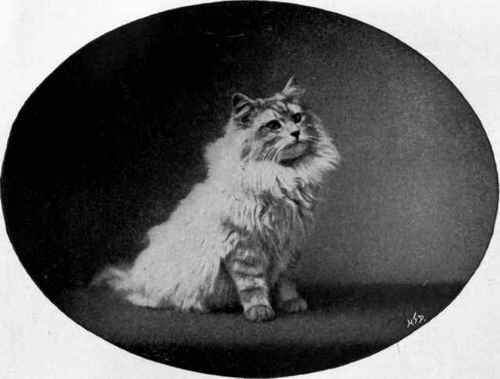
Miss Snell's Silver Starlight Landor, photo, Ealing
It is the laudable ambition of all breeders to become exhibitors, and certainly there is infinitely more honour and glory in winning with a cat or kitten which one has bred than with an animal that money has purchased. I have given some hints in my paragraphs as to the best way of preparing cats for exhibition. There is no doubt that cat fanciers do not pay the same amount of attention to the specimens they are intending to send to a show as do members of the dog, rabbit or pigeon fancy. This is a pity, for condition goes so far to propitiate a judge, and a noted winner with almost perfect points may fail to "catch the Speaker's eye" if his coat is knotted and his tail draggled. We generally speak of a Persian cat being out of condition when it is not in good coat, and certainly I should advise such cats being kept at home. There are so many shows held nowadays, that if your puss is shedding her coat at the time of one show, you may reasonably hope she may be in form for the next.
A word about judging may be of interest. I find the easiest and quickest way to set about making the awards in a large class is to start by first marking the absent exhibits, then placing a cross against those specimens that could not come within the prize list. After this I search for my winners, and having perhaps brought down the number to about six or seven, I proceed to take the cats from their pens, and if arrangements permit to have two out at a time, so as to make comparisons. For this purpose, judging pens are most useful. In Selfs it is soundness of colour that the judge should first consider; in Tabbies, the markings must rank first; in Silvers, according to the dictates of specialists of this breed, paleness of colour is of paramount importance. Some judges, however, will be guided by purity of colour and the general shape of body, limbs and head, and darker shadings and tabby markings will be secondary considerations. The Blue and Silver classes are perhaps the most difficult to judge, and also they are generally the largest.
The many specialist clubs have their standard of points (as given in the concluding chapter), but a good judge will bring his experience and his common sense to bear upon the exhibits, and these definitions therefore are likely to be of more service to fanciers, who should always aim at perfection, though they may not attain to it. For the benefit of novices in the fancy, let me say that, before showing a cat at any of the large shows, the first step is to register it with the Club under whose rules the show is held. At the present time the National Cat Club and The Cat Club are at loggerheads over the question of registration, but without entering further into the matter, I would say that it is the earnest hope of all fanciers that in the future one register should be kept. The forms at present used by the respective clubs are here reproduced. To any one with average intelligence the filling in of these is not a difficult matter. If a schedule of the show is not sent to you, apply to the secretary whose name and address will be published in the cat papers. Then read carefully the exhibition rules, and pay special attention to the classification before filling up the entry form, which together with the fee should be forwarded in good time to the secretary.
I have given several hints in my paragraphs as to the best modes of packing the pussies both in cold and hot weather, so I would only impress on fanciers to do all in their power to mitigate the discomfort and risk which must always attend a cat travelling alone to and from a show.
Continue to:


My Books

