


Practical Hints On Cat Breeding And Mating
Description
This section is from the book "Cats And All About Them", by Frances Simpson. Also available from Amazon: Cats And All About Them.
Practical Hints On Cat Breeding And Mating
In selecting a male cat for stud purposes, you should be guided a great deal by the size of head and limbs. A good sire for future generations should possess a massive, well-formed body with broad head. Take especial notice of the width between the ears, and beware of a long nose and face. Very large and pointed ears are most undesirable. It also spoils the appearance of the cat if the ears are very wide at the base.
Siamese kittens are always white when born, and gradually their ears, legs, tail, and face darken. The denser these points become the more valuable arc the specimens. A kink in the tail is considered a beauty. Blue eyes are very essential. It is a pity that Siamese cats gradually lose the beautiful pale fawn colour, and their coats darken as they grow older. It is quite the exception to see a grown-up Siamese light in body colour. Never try mating a Siamese with any other breed. Experiments have been made in this respect, but no good results have followed.
To novices in the Silver fancy, let me say that they must not be disappointed if after sending their queen to a noted Silver stud, she should produce what appear like very dark smoke, or almost black kittens. These will become lighter every day, and it is often the darkest kittens that turn out the palest Silvers.
The days of pussy's gestation are about sixty-three, but I generally find it is best to calculate for three days extra, this being counted from the last day of mating. It is always safer after the queen has been on a visit to keep her shut up for a few days.
Do not worry if your queens refuse to feed during the time they are mating. When quieted down puss will make up for lost time.
If you have a stud cat and receive queens, it is always courteous and kind to write a line to the sender immediately on the arrival of the traveller. Thus the anxious mind of the owner is set at rest. Then you should give due notice of the time of train by which you are returning the visitor. Avoid despatching a cat on a Saturday.
I am not much in favour of mating Blues and Silvers together, as this cross frequently results in Silver Smokes, a sort of nondescript cat that finds no abiding class at our shows, and is also rather an unsatisfactory cat from which to breed.
In selecting a stud cat we should consider the points of our queens. It is not always the greatest prize-winner that is the most desirable mate for a particular female. We must pair them according to the good points in one and the defects in the other, and thus we may gain the happy medium. If your queen is wanting in breadth of skull and shortness of face, try to remedy and counterbalance these defects by finding a stud cat with these points strongly developed. Two prize-winning cats may not produce even average good kittens.
Of all the breeds of long-haired cats, brown Tabbies may be said to be the strongest. This handsome breed seems coming to the fore. Certainly to a novice in the fancy brown Tabbies are less trouble, by reason of their hardy natures. Two brown Tabbies mated together often produce a black in the litter, and generally a very good specimen.
Do not let your queens mate before they are nine months old, and it is better to wait another three months if possible. I do not think sufficient attention is paid to the desirability of stud cats and queens being in good coat at the time of mating.
It is considered the correct thing to forward your fee for mating at the same time you send your queen. The usual rule in catty circles is to allow a second visit should the first prove unsuccessful, but this cannot be insisted upon, and therefore it is better for the sender to ask if this courtesy will be permitted when writing to announce the despatch of the queen.
I have often been asked if I consider that the litters of a Persian queen who has mismated previously with a common cat are in any way affected afterwards. I believe this question has never been satisfactorily answered, but I know a case in point, and certainly these kittens of a good Persian sire and dam are remarkably poor specimens and are what might be called half-breds. I can only attribute this to the blue female having twice strayed from the paths of virtue previous to the attentions of the prize-winning Persian.
If you are purchasing a self-coloured cat, be careful to examine whether it has a white spot or tuft of white hairs on throat or stomach. This is a decided blemish, and repeats itself in future generations. Our best judges consider a white spot should count as a point against a cat entered in a self-coloured class. This is much fairer to both exhibitor and judge than to relegate a good Blue or Black with the few offending white hairs to the "any other colour class."
One of the most difficult cats to breed is a pale Cream, uniform in colour, and having no markings on head and legs. A Tortoiseshell and a Blue often produce good Creams.
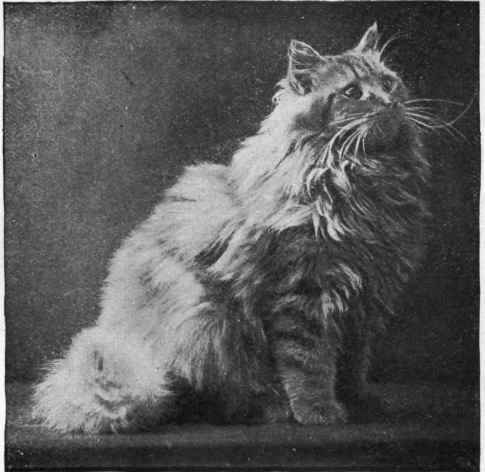
Mrs. W. Vidal's Orange Persian Male Torrington Sunnysides
Do not mate tabby-marked cats with self-coloured ones. For instance, a blue Persian queen should be sent to a stud cat of her own colour, or to a Black, not to a brown or orange Tabby. Breeders have lately been crossing Blues with Chinchillas, or Silvers, and some good results have followed, but this should not be attempted if the Silver is at all heavily marked with stripes. In this case the litter might consist of blue Tabbies, and although these are pretty cats for pets, they are useless for breeding or show purposes.
I have always considered that the mating of a good amber-eyed Black queen with a pale Blue male is most satisfactory in results. I have seen several examples. In one litter two almost perfect blues and two black, in the other, one blue gem and three blacks. The blues were particularly sound in colour and had the round orange eyes, which are so attractive in black cats.
Continue to:


My Books

