


Blue Russians. Part 2
Description
This section is from the book "The Book Of The Cat", by Frances Simpson. Also available from Amazon: The Book Of The Cat.
Blue Russians. Part 2
The three principal breeders at the present time of these cats are Lady Alexander, Mrs. Michael Hughes, and Mrs. Carew Cox. It is at the Crystal Palace shows that an opportunity is given of admiring the fine team of blues from the Faygate cattery. "Brother Bump" has won a first prize whenever he has appeared in the show pen, and, curiously enough, each time under a different judge. He is a full champion, and special prizes have been showered upon him. Besides this handsome fellow, Lady Alexander owns another male - "Blue King" - and two good females.
At Sherdley Hall, in Lancashire, there is quite a colony of blues owned by Mrs. Michael Hughes.
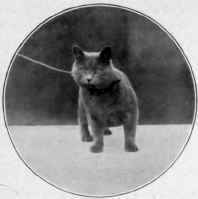
" Sherdley Alexis."
The cats are reared in outside and unwarmed houses, with ample wired-in runs. All the Sherdley cats are prize-winners. I am able to give illustrations of "Alexis Michael " and the two "Sachas." The first named has been quoted as a typical British blue.
Mrs. Carew Cox is a most ardent supporter and successful breeder of short-haired blues. As she has had a long and varied experience, I asked her to send me some notes. I have pleasure in publishing them for the benefit of my readers : "Blue short-haired cats - many of them imported from Northern Russia - make very desirable pets, presenting, as they do, a neat, smart,' tailor-built' appearance all the year round, and possessing the great intelligence usually to be met with in all short-haired breeds. They have the advantage over many other varieties in that they are, as adults, strong, healthy cats - not at all liable, as a rule, to pulmonary attacks. Kittens, however, require both care and patience to rear successfully, and, strange to say, attain sounder constitutions when brought up by healthy English foster-mothers. Females are more difficult to rear than males. A Russian cat should be of an even shade of blue throughout, even the skin itself being often - in fact, generally - of a bluish tinge. There should be no stripes or bars, and - for exhibition purposes - there should be no white patches. Kittens frequently have body markings when very young, also rings on their tails; but in pure-bred specimens these defects generally become effaced before they are many weeks old.
In one case a kitten (now a large neuter) had until five months of age two broad black stripes down his back on either side of his spine; they were so decided in appearance that it seemed very doubtful that they would ever disappear. However, at six months old he was a perfectly self-coloured cat ! This is, of course, most remarkable and unusual, and amongst all the many kittens of this breed that I have reared for the past thirteen years there has never been another presenting a similar appearance.
"The eyes of a Russian should be golden in colour, or deep orange. To procure deep-coloured eyes, experiments have been made in crossing Russians with Persians, but the results - so far as I have seen - have not proved satisfactory, and to an experienced eye the cross is perceptible. I believe there is no really recognised standard of points for this breed, which until quite recently was comparatively little known. I note that there is a very fair demand for Russians at the present time - chiefly, strange to say, from the North of England. The shape of the head in many of those imported is more pointed than round; indeed, some have long, lean, pointed heads and faces, with big ears. The backs of the ears should be as free from hair as possible ; some, I remark, are entirely devoid of hair on the upper parts of their ears - at least, if there is any, it is not perceptible to the naked eye. Others, again, have ears covered with peculiarly fine, close, silky hair. Some imported blues are very round in face and head, with tiny ears, and eyes set rather wide apart.
These are surely the prettiest, and are generally given the preference at shows; but, of course, it cannot be denied that the long-faced variety present the most foreign appearance, more especially when this type also possesses a lithe and rather lean body. The whiskers, eyelashes, and tip of nose should all be dark blue.
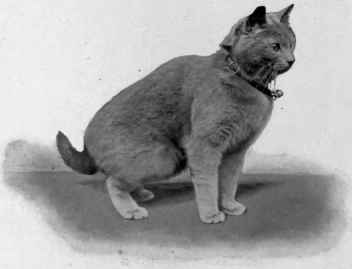
" Maria." Owned by Mrs. Woodcock. (Photo: S. Richardson, Standish.)
"The coat should be short and close, glossy, and silver}'; sometimes it is rather woolly and furry, Nature having evidently provided these cats with their warm, close coats to enable them to resist the severities of their native climates, short-haired blues existing also in the north of Norway, Iceland, and - I am told - in some parts of the United States. Many years ago some blues (with faint tabby markings) were imported from the north of Norway; these were called' Canon Girdlestone's breed.' I owned two very pretty soft-looking creatures. Blue-and-white cats have been imported from the north of Russia, and are particularly attractive when evenly marked.
"Some blues are far paler in colour than others. Amongst my kittens are frequently some very beautiful lavender-blues; I have remarked that these are rather more delicate in constitution than those of darker hue. As these cats advance in years they frequently become a rusty brown during the summer months, or when acquiring a fresh coat ; this discoloration asserts itself principally at the joints of legs and feet. The fur of a very old cat becomes dull and rough, losing the soft and glossy appearance identical with the blue Russian in his prime.
"There are some people who appear to wish to assert that there is an English breed of blues, and I have been told strange tales of unexpected meetings in country villages with cats of this colour, whose owners declared that both parents were English bred. As, however, it is not always possible to identify the sires of household cats, I venture to doubt these assertions. It is sometimes possible to breed blues from a black English female mated to a Russian male. This experiment does not always succeed, as some blacks never breed blues, although mated several times consecutively with Russians. A white English female mated to a blue male simply produces white kittens - at least, this has been my experience. Cats imported from Archangel are generally of a deep, firm blue throughout; the eyes and ears rather larger than those of English cats, the head and legs longer. In many of the Russian peasants' cabins can be seen a curious coloured print (executed in Moscow). It represents the burial of the cat after a dramatic fashion, and derives its origin from a very interesting Russian legend.
The cat is represented as slate-coloured.
Continue to:


My Books

