


Blue Russians
Description
This section is from the book "The Book Of The Cat", by Frances Simpson. Also available from Amazon: The Book Of The Cat.
Blue Russians
I am very interested in the discussion on blue Russians, as years ago I had a perfect type of a blue Russian, which had been imported. When Russians were judged as Russians it won well at shows, so you may like to have a description of the cat - which is, I believe, a correct one, according to several authorities on Russian cats. A real Russian should be longer in the leg than the English blue. The head is pointed and narrow ; the ears large, but round ; tail long, full near the body, but very tapering. According to the English taste, it is not a pretty cat, and only excels over the British blue in the colour and quality of its coat, which is much shorter and softer than the latter. The true colour is a real lavender-blue, of such softness and brilliancy that it shines like silver in a strong light. The eyes are amber. I think it a great mistake to give "Russian " in our show classification now, as these are really almost extinct in England, I believe, and our principal clubs have been wise enough to drop the title for "Short-haired Blues," in the same way that "Persian " has been dropped for " Long-haired Cats." The last time I showed my Russian was at the first Westminster show, in a class for Russians. She was, however, beaten by the round-headed British blue, although she was, 1 believe, the only Russian in the class.
In 1901 the class was altered to " Short-haired Blues," which was more correct, as few of the blues shown then had anything of the Russian about them, either in shape or coat. As hese classes arc now arranged, it would be unfair to judge them except by the standard of our own short-haired cats, and I think that if a club wants to encourage Russians it should give the extra class, " Blue Russian," and let it be judged as such. I must own it is disappointing for a Russian owner, who, seeing " Russian Blue " only given in the schedule, enters his cat accordingly, and gets beaten by a short-haired blue failing in just the points that the Russian is correct in. I know my feelings after Westminster, 1899,' when my Russian was described as " grand colour, texture of coat, failing to winner in width of head and smallness of ears." The blue short-hairs now shown are, I know, far more beautiful with their round heads and shorter legs ; but, unfortunately, the beautiful is not always the correct type. As British cats, however, they are both beautiful and correct, so why not drop the Russian name altogether ? I had a most amusing talk with a blue Russian (?) owner the other day, and a good laugh with him over the ancestors of his " Russian " blues.
Annie P. James.

"Ballochmyle Blue Queen." Belonging to Lady Alexander.
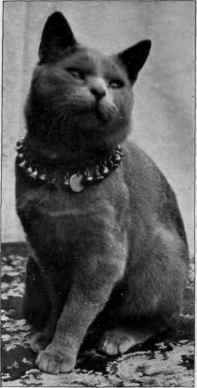
Mrs. Carew Cox's Blue Male "Bayard.'
At the Crystal Palace show of 1902 Mr. Woodiwiss judged the blue classes, and awarded first to a cat having the English type of head. He gave as his reasons that although he considered the long nose and thin head the right shape for a Russian, yet, he added, "I am not here to judge on those lines; I have to judge according to the standard, which gives preference to round head, neat ears, and short nose ; and, although I really believe Mrs. Walker's blue' Moscow' to be the nearest in type to those I have seen in Eastern countries, yet according to our English breeders' standard it is out of it, and I can only give it reserve." Mr. Mason, our ablest judge of all classes of cats, upheld Mr. Woodiwiss in his awards, and makes the following remarks in Fur and Feather of February, 1903, in reporting on the Manchester show : - "I hope exhibitors and breeders of short-haired self-blues will take my remarks in the spirit in which they are written. I am glad to see that the Manchester committee named the classes' Blues (Male)' and' Blues (Female).' To call them Russians is a mistake, seeing that a very large number of those exhibited are crosses from some other varieties. To all intents the self blues, as we find them to-day, have little of the Russian blood in them.
Then why call them Russian ? Why not "self blues," and judge them on the same lines as the British short-haired cats ? What I want to obtain is a uniform type. To go for two opposite types in one class of exhibits cannot be right or advantageous to breeders or exhibitors."
Breeders of short - haired blues have never been manyin number, nor has there ever appeared any start1ingly good specimen in the show pen. Mr. Woodiwiss kept and exhibited several fine specimens - "Blue Boy," "Blue King," and " Blue Queen." The two latter have been passed on to Lady Alexander. Mr. Mariner, of Bath, is an old exhibitor and great enthusiast of this breed. Mrs. Middleton,
Mrs. Herring, Mrs. Crowther, Miss Butler, Mrs. Illingworth, and Mrs. Pownall have all from time to time been possessed of fairly good Russians so called. Mr. Cole used to show a lovely fat-faced cat called "Muff," but she had green eyes. Mr. Dewar's "Firkins" and Mr. McNish's "St. Juan" are blues that have made their name.
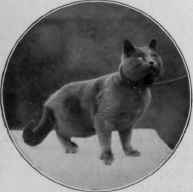
"Shekdley Michael."
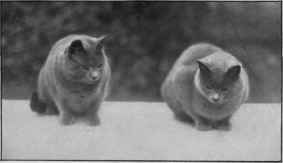
"Sherdley Sacha II." " Sherdley Sacha I."
Continue to:


My Books

