


Cat Photography For Amateurs. Continued
Description
This section is from the book "The Book Of The Cat", by Frances Simpson. Also available from Amazon: The Book Of The Cat.
Cat Photography For Amateurs. Continued
Turning now to the more artistic side of cat photography, we find our real difficulties begin, for in photographing for the showing of points we seldom have to deal with more than one cat at a time. It is when we attempt deliberately to pose two or more cats or kittens, to carry out a preconceived idea, that our real troubles begin, and also that the patient skill of the amateur wins its best reward. Looking through the pages of "The Book of the Cat," we find many good examples of how the cat should be used in picture making. The reproductions of Madame Ronner's charming pictures show how they may be handled with palette and brush ; but, alas ! here we photographers labour under an immense disadvantage. However artistic our taste, however good and pretty our intended composition may be, we cannot, as the artist with pencils and brushes can, make individual sketches of pussies in the different positions needed and bring them together in the finished picture. Whether we use two or more cats, they must each be kind enough to take the pose we desire simultaneously; hence our greater difficulty. However, the illustrations on pages 1, 37, 49, 88, 128, 199, and many others indicate the wide field open to the photographer with a little taste and vast patience.
In this class of photography it is of no use to go to work in a haphazard fashion, snapshotting our cats in all kinds of positions, trusting to mere luck to yield something worth keeping ; then to give a sounding title to it, and so hope to make a picture. Accident does occasionally present us with something worth having, but far more often it offers us results only fit for the waste-paper basket.

Amateur Photographers (Photo: Mrs. S. F. Clarke.)
Before commencing, be sure you have an idea to work out in your picture, and of the lines you hope to follow in giving it expression. If possible, make a rough sketch - no matter how rough - of this idea, showing the position not only of the cats, but also of the accessories needed. Be careful to keep the composition simple and not to overcrowd it. This sketch will greatly assist you in arranging your picture and posing your cats. Before you attempt to pose the cats it is absolutely necessary that all accessories should be fixed so that they cannot be knocked over, or the cats will get frightened and be useless as sitters for a long time to come. That cats are nervous should never be forgotten, and any chance of startling them strictly guarded against. When your background, table, and accessories are all in their places, put your camera in position, arrange the picture on the ground-glass, and see that you get all well within the size of the plate; it is safer to have the picture on the ground-glass a little smaller than the plate will allow, as, if one tries to get it to its utmost size, one may find in developing that one of the models has moved back on the table an inch more, perhaps, than calculated upon, and as a result have half a cat on one side instead of a whole one.
The background, however, should be large enough to fully cover the ground-glass. Focus the foreground and nearer accessories, stop down to F. 8, set the shutter to about 1/30 to 1/50 second (according to light and nature of subject), insert the slide containing the rapid plate, draw the flap under the dark cloth, and if at all windy tie this last to the camera. Now you are ready for the cats and a suitable moment of light.
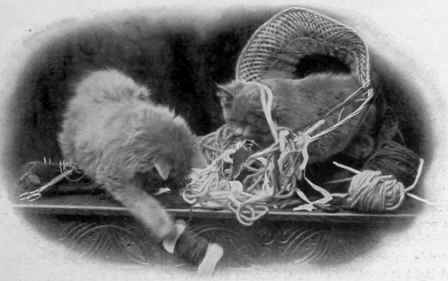
Playing At Work (Photo : Mrs. S. F. Clarke.)
As I have already remarked, I do my photographing out of doors. I therefore choose a bright warm day, when there are plenty of fleecy clouds about; so that by taking advantage of their position in front of the sun, and by the help afforded by my muslin curtains, I am able to modify the harsh contrasts incidental to working in broad daylight.
"The Artist" (page 128) was, perhaps, one of the most difficult subjects I have attempted. Without apparent life and go such a subject would be worthless.
The rough sketch of the cat in the basket was first prepared, and the brush attached to it in such a manner that it would move freely up and down for about an inch or so; then it and the rest of the accessories were firmly arranged upon the table. The cat. in the basket was then made to take her place, but keep in she would not ; as soon as the brush moved to attract the artist paw, out she would jump ; so for the time she was allowed to run, until the artist was posed and an endeavour made to infuse life into him by moving the brush. But it was "no go"; sit down he would, until the introduction of a feather woke him up. His companion was then slipped into the basket; but, alas ! success was not yet. For about two hours we had to begin over and over again, when at last the pose of both kittens was obtained simultaneously and the picture taken in 1/50 of a second. Such a subject with the kitten tamely sitting at the handle of the brush would not in any way have realised my intention.
I must again point out the great convenience, especially in this class of work, of the extra length of tubing, which allows you, while holding the release in one hand, to pose your models with the other, and then expose without the fatal loss of time that would be entailed by having to step back to the camera or by giving the word to an assistant.
A subject suggestive of a picture will often turn up when least expected and, at the time, impossible to take. I always make a note of these, and they come as a basis for future use and to be worked out at leisure. "Thieves" (page 79) was suggested by noting the fondness of two of my kittens for melon, "Amateur Photographers" by a group of kittens playing round some photo frames put out to print, and "Mischief" (page 88) by a frolicsome kitten overturning a small bottle of ink and playing with the little black pool.
Isochromatic plates should be used in all cases where there are mixed colours in the cats' furs, as in tortoiseshells, brown tabbies, etc.; mixtures of red, black, and yellow cannot be truly rendered with ordinary plates. The only extra precaution necessary in their use is absolute freedom from actinic light in the dark room. Double ruby glass in the window, or, if artificial light is used, an extra thickness of red tissue paper round the developing lamp, will answer the purpose and make everything safe. With this little extra care, nice crisp negatives are obtained, while the relative value of the red, yellow, and black seen in our furry friends are well defined in the resulting picture.
Cats used as models should, if possible, be in the pink of condition - the prettier the model the more pleasant the picture. The best time to photograph a cat is about one hour after a light meal. Immediately after a meal most cats want to wash and sleep. A hungry cat or kitten makes the worst of sitters ; its thoughts are too much turned towards the inner man. Never overtax your cats, give them plenty of rest during a sitting, and never lose your temper and attempt by force to secure a pose ; it only frightens the cats, and can never result in satisfactory work. Time and patience should always in the end achieve what you desire.
Artistic photography having been for some years a pleasant and recreative hobby with me, I can assure my friends who keep cats for pleasure, and those who find pleasure in the camera, that by uniting the two hobbies they will discover a field of enjoyment and artistic possibilities which neither pursuit alone can afford. To all such the preceding notes are offered as humble finger-posts, indicating rather than assuring the road to success.
Lucy Clarke.

In The Studio (.Photo: Mrs. S. F. Clarke.)
Continue to:


My Books

