


Chapter XXX. Rearing Of Kittens
Description
This section is from the book "The Book Of The Cat", by Frances Simpson. Also available from Amazon: The Book Of The Cat.
Chapter XXX. Rearing Of Kittens
IT may truly be said that the subject most interesting to cat fanciers is the successful rearing of kittens, and pages might be written on what to do and what not to do in order to bring up a family of kits in health and strength. Experience teaches us many tilings, and certainly during the number of years I have been breeding Persian kittens I have had ample opportunity of judging what food suited the little mites best, and which was the surest method of bringing up a wholesome litter of kittens. I am sure that in the olden days there was less delicacy amongst Persian kittens than at this present time.
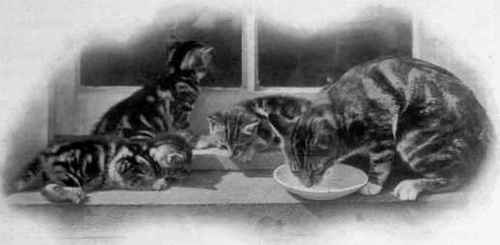
Tabitha's Afternoon Tea (Photo : C. Rent, Wishaw, N.B.)
With the advent of the first family the anxieties of the novice begin. Perhaps a goodly sum has been risked in the purchase of a pedigree queen, or else with much carefulness and taking thought a valuable kitten has been reared to happy matronhood. So far well; the trouble has been slight, but the account book shows all on the debit side. Now, as we gaze upon the tiny blind bobbing atoms, over which the mother croons and purrs with pride, here is the investment that has to swell our credit column. And ignorance here spells loss.
If a large number yearly are successfully raised, a still larger number sadly "pass out," and might claim the baby's plaintive epitaph:
"Since I am so quickly done for - I wonder what I was begun for!"
Neither does the comfortable law of the "survival of the fittest" seem to hold good here. At least, Nature and the exhibitor arc at variance in their ideas of such, for always it is our choicest, our sure and certain champion, that slips our too eager grasp.
Here is our experimental nest of champions ; they are but two days old, and in this early stage of their existence the less they are handled and examined and the mother interfered with, the better.
Attend to two things - darkness and fresh air; and leave them alone till they introduce themselves of their own accord to your notice.
Shift on to a clean nest the second day after birth. It is safer not to do so before, as I have known a belated kitten arrive twenty-four hours after the rest of the family, and in the case of an excitable or inexperienced mother she will by then be more composed, and can be coaxed out to feed while the change of bed is being made. Hay, short and sweet, is the best bedding - much better than blankets or cushions. Many fanciers use boxes turned on their sides and curtained. These, while giving the necessary darkness, are not sufficiently ventilated; the air in them cannot circulate freely, and becomes stuffy and foul, vapours ascend, and the wood becomes unsanitary in a very short time.
Bad eyes follow as a matter of course, and the anxious, worried novice wonders "how they can possibly have taken cold when they have been so guarded" - from fresh air! - and seals them up still more! If, therefore, a box is used, let there be holes for ventilation, or arrange for the covering to reach only partly over the top.
In an outside cattery or attic or room guard against too much light and any draught, but let in the outside air by keeping the window open during the day. If winter kittens are to be reared, heat the room to an average of 55 degrees, and have the window open, taking precautions naturally against rain or snow beating in.
When the kittens reach the age of three weeks, they will require some food beyond that provided by the mother, who, if nursing a large family, is perhaps showing signs of wear. It is when the process of weaning begins that trouble generally arises.
I am inclined to put down the growing delicacy of Persian kittens to the injudicious feeding with solids at too early a period of their existence. I never used to allow my kittens meat until they were about four or five months old, and during the period of weaning from their mothers it is most essential that all food given - such as Mellin's, Ridge's and Benger's - should be made very thinly at first, so as not in any way to try the tender digestions of the little creatures.
I believe that most of the ills that kittens' flesh is heir to, proceed from indigestion. The tendency in fanciers is to overload the stomach of the wee kittens, forgetting that it is not the amount of food eaten that nourishes the tiny creatures, but the quantity they are able to digest, and this must necessarily be small for some weeks after they have learnt to feed themselves. Another mistake that is made is giving milk that is too rich. In large towns we generally get our milk watered for us, but in the country the milk is richer, and needs mixing with warm water. It is not so important in the country as in London and other large towns to have the milk boiled, but it is at all times and in all places a wise precaution. In preference to risking the town dairy milk, flavoured with boracic, and most deadly to the systems of both kittens and babies, I advise a good brand of Swiss milk - such as Nestle's - being employed, or, better still, Plasmon powder, made to a jelly according to directions on packet, and one teaspoonful of this jelly thinned out with hot water and sweetened.
Do not give raw meat till the teeth are fairly through and they can bite sharply; then give it scraped with a blunt knife, not cut; and remember that raw meat is three times as digestible and nourishing as cooked meat - one tiny meal of meat a day, a teaspoonful per kitten to begin with. Do not give them fish while under three months old.
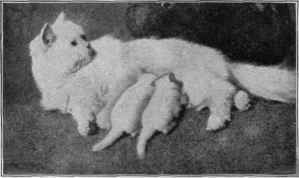
A Happy Mother
Rice is a very indigestible food for kittens, especially cold ; but rice-water, strained from rice boiled to a pulp and given quite cold, is useful in checking diarrhoea. Melox is a most useful food for kittens of ten weeks old and upwards, soaked for an hour or two in a little good gravy, and given crumbly (not sloppy), and a little scraped raw meat mixed with it. For younger ones a tablespoonful of red gravy from a cooked joint, poured over some breadcrumbs, proves an appetising meal.
Continue to:


My Books

