


Chapter III. Care And Management
Description
This section is from the book "The Book Of The Cat", by Frances Simpson. Also available from Amazon: The Book Of The Cat.
Chapter III. Care And Management
IN the care, management, and feeding of cats no hard and fast rule can be laid down, for the dispositions and constitutions of these animals differ just as much as do those of human beings. Fanciers must therefore learn to treat their cats individually and not collectively; they must study then-character and make allowances for the fads and fancies of the feline race. I am convinced that a varied diet is the best for cats, and fanciers should bear in mind the importance of regularity in the hours of feeding, whether two or three or four times a day. Fresh water should always be supplied, and unfinished food should not be left standing about. For one or two pet cats the scraps from the table given with judgment will probably suffice; but in the case of a large cattery with several inmates, some sort of system in feeding is necessary. I would suggest that the chief meal for two days a week should be fish, mixed perhaps with rice or Freeman's Scientific Food, raw meat twice or three times a week cut up into fairly small pieces, horse-flesh (if obtained from a reliable source) twice a week. Lights, liver, or sardines may be given occasionally.
Sloppy food in any large quantity should be avoided; but oatmeal well boiled, cornflour, arrowroot, and several of the well-known foods, such as Neave's or Mellin's, make a nice change. Spratt's biscuits of various kinds, soaked and mixed with stock, are relished by some cats. Vegetables should be given frequently, and grass supplied, as green food purifies the blood and keeps the bowels in good condition. Persian cats require special attention as regards their coats, and should be combed and brushed regularly, and, if the fur becomes matted, the knots should be cut away. Avoid washing your cats; there are other means of cleansing their coats, particulars of which will be given in the chapter on exhibiting.
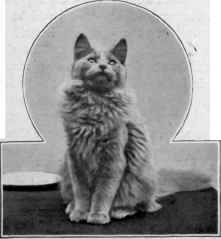
Blue Persian Presented by Miss Patterson to Her Majesty the Queen.
Continue to:


My Books

