


Chapter XI. Blue Persians
Description
This section is from the book "The Book Of The Cat", by Frances Simpson. Also available from Amazon: The Book Of The Cat.
Chapter XI. Blue Persians
A FAMOUS publisher once gave the following advice to a young author: "Never take it for granted that your readers have any previous knowledge of your subject, but credit them with ordinary intelligence." To all feline fanciers the heading of this chapter is a familiar household term, but to novices in the cat world and to outsiders the term "blue" as applied to a cat may sound rather absurd. Truth to tell, the name is misleading, and yet the same is used in describing certain breeds of domestic animals, such as dogs, rabbits, etc. There is also a fur much used for trimmings of ladies' jackets, etc., called blue fox, and this is very much akin to the colour and texture of the fur of the blue Persian cat, which, however, varies in tone from a dark slate to a pale lilac-blue.
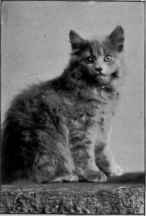
Jack Am (Photo: H. Warsckkarki, St. Leonards-on-Sea. )
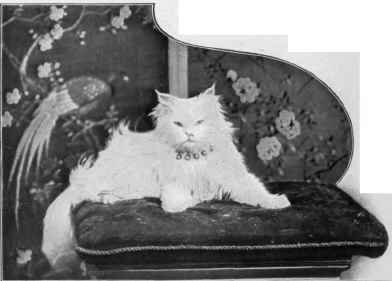
Imported Blue-Eyed Tom, "Musafer. " (Photo: V. R. Clarke, Thisk. )
It is over twenty years ago since I exhibited the first "blues" at the Crystal Palace Cat Show, and they created quite a sensation, for no one seemed to have seen any cats of this peculiar shade before. Some called them grey or lilac, and others London smoke or slate colour. One of my pair of blue kittens was quickly claimed at catalogue price, and I bought in the other, fearing I should lose her also. She, in her turn, became the mother of many celebrated blues. In those early days of the fancy blue Persians were entered in the "any other variety" class, and most of the specimens exhibited were in reality blue tabbies. For some years this state of things continued; but Mr. A. A. Clarke, so well known as one of the pioneers of the National Cat Club, and as a breeder, exhibitor, and judges-agitated with other fanciers, myself amongst the number, to obtain a better classification for the self-coloured blues, and in 1889 the schedule at the Crystal Palace Show contained a class for "Blue - self-coloured without white." For some time this breed of cats was termed "self blues," in contradistinction to the many blues with tabby markings which were formerly so very common in the fancy.
In 1890 it was decided to divide the sexes in the blue cat classes, and let the kittens compete with black and white. The result was an entry of eight in each class, my famous "Beauty Boy" taking first in the male, and Mrs. H. B. Thompson's celebrated "Winks" first in the female division. At Brighton in the same year the "self-blue" class was adopted with success.
The famous blue stud cats of that period were Mr. A. A. Clarke's "Turco," Miss Bray's "Glaucus," and my own "Beauty Boy." Amongst other exhibitors of blues about this time I may mention Mrs. Warner (now the Hon. Mrs. McLaren Morrison), Mrs. Vallance, Mrs. Wells, Mrs. Hunt, Mrs. H. B. Thompson, Mrs. Ellerton, and Miss F. Moore. In 1891 blues came very much to the fore, and the entries at the Crystal Palace numbered 15 males and 17 females. At Cruft's Show in the year 1894 a grand blue, called "Woo-loomooloo," was exhibited by Mrs. W. R. Hawkins, and this cat became one of the most famous of stud cats. Many of the finest blues of to-day are descended from this noted sire. Mrs. H. B. Thompson's "Don Juan" was for many years greatly in request as a stud cat, and many beautiful blues claim him as their ancestor.
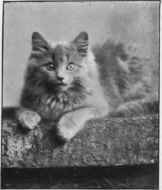
Jill The Property of Miss Bennett. (Photo: H. Warschkarski, St. Leonards-on-Sea. )
A little later "Moko" became famous as the sire of a sensational kitten exhibited by Mr. C. W. Witt at the Westminster Show of 1900. "Moko" was sold at a high figure to Mrs. Barnett, and is now in the possession of Mrs. Singleton, of Yeovil. Mr. A. A. Clarke was considered the best judge of this variety, and at the Palace and Brighton he did much to encourage the breed by offering handsome special prizes in the blue classes.
It is true that the prize-winning cats of ten and fifteen years ago would have had but a poor chance in the present-day competitions, chiefly for the reason that cats of the past could look at a judge with bright green eyes and yet be awarded the highest honours. Nous avons change tout cela, and now a blue cat without the much-to-be-desired orange eyes fetches but a small price, and is at a great disadvantage in the show-pen. An up-to-date judge may, however, be led into giving too great a prominence to this point and thus sacrifice soundness of colour, shape, and form. Then, again, I remember when a white spot on the throat of a blue Persian was not considered a serious defect; now a few straggling white hairs will cause anguish to the owner, and a judge will promptly put down the specimen for this blemish.
Blue cats with white spots used to be relegated to the "any other colour" class; but recently both the National Cat Club and the Cat Club have wisely decided that such cats should be judged in their own classes. However, I think that owners of these specimens would do well to keep them away from the show bench, where the competition in blues is now too keen to give any chance for defective cats to have a look in. I may mention that the nose of a blue Persian is a few shades darker than its fur, and the toe-pads yet a little darker.
As will be seen from the standard of points for blues, which will be found later on in this chapter, the highest marks are given for soundness of colour. There is a tendency to breed very light blues, and popular fancy favours this particular type. I am inclined, however, to prefer a good sound medium blue as being the best and safest for breeding purposes. The lovely pale blues are beautiful to look at, but are seldom absolutely sound in colour. Blues, whether dark or light, should be the same tint throughout, so that when the coat is blown apart the colour at the roots is the same as at the tips. A white undercoat is a serious blemish, and this often appears when silver blood may be traced in the ancestry of a blue cat. We have quite dropped the term of self-blue, and yet this well expresses the uniformity of colour which is so desirable. As tiny kittens blues frequently exhibit tabby markings; but fanciers need not worry over these apparent defects, for as the coat grows the bars and stripes are no longer visible.
Continue to:


My Books

