


Smokes
Description
This section is from the book "The Book Of The Cat", by Frances Simpson. Also available from Amazon: The Book Of The Cat.
Smokes
Smoke cats should bo black, shading to smoke (grey), with as light an under-coat as possible ; light frill and ear tufts : eyes to be orange.
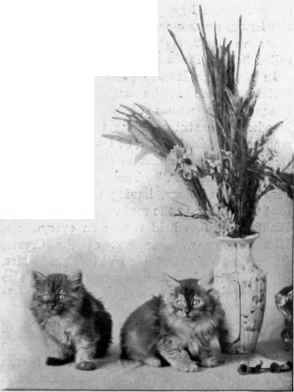
Miss Bartlett's Two Smoke Kittens (Photo: E. Landor, Ealing.)
Value of points : -
Head and expression | 20 |
Colour of eye | 15 |
Colour of under-coat | 10 |
Absence of markings | 15 |
Coat and condition | 20 |
Tail.......... | 10 |
Shape | 10 |
Total | 100 |
I think there are no fanciers or breeders of smokes who feel that any option should be given as to the colour of eyes in this breed, for, as in the black cats, the eyes should be amber or light golden. However, I must confess that brilliant green eyes are to be preferred to the pale yellow, which too often spoil the beauty of many of the smokes now exhibited. I should never place an indifferent smoke with orange eyes over a good specimen with eyes of emerald green. In the early days of the fancy, smokes were entered in the " any other variety" class, and were sometimes called Smoke Blues or Smoke Chinchillas.
In 1891 Miss Manley (now Mrs. Strick) exhibited a fine smoke called " Bayadere." Amongst the names of our oldest smoke breeders who still continue to breed I may mention Mrs. Cartwright, of Upwood. In 1895 this lady showed smokes at Cruft's show bred from her "Timkins." The Upwood cats are very pure in colour, having the dense outer coat very white at the roots. At one time the Lindfield smokes held their own everywhere, Miss Molony winning first at the Crystal Palace in 1893 with "Lindfield Bogie." Mrs. Bluhm, better known as a silver breeder, also owned about this time a famous smoke female called "Smuttie."
Mrs. Robert Little has for years combined the breeding of smokes with blacks. In 1897 "Namouska," a smoke female, won first at the Crystal Palace, and her descendants continue their career as first-class smokes. In more recent times the following are noted winners : Lady Marcus Beresford's "Cossey," Mrs. H. V. James's "Backwell Jogram," Mrs. Sinkins' "Teufel," Mrs. Stead's "Ranji," Mrs. Stillwell's "Victoria," Miss Snell's "Dusky Girl," Mrs. Collingwood's "Minouche," Rev. P. L. Cosway's "Maritana," Mrs. Neild's "Silver Soot," Mrs. Hamilton's "Bulger," Miss Rose's "Judge." Perhaps the most consistent and successful breeder of smokes now in the fancy is Mrs. H. V. James, who started in 1893, and has been faithful to this breed ever since. I have had the pleasure of visiting Mrs. James's smoke cattery, and I felt that the lovely old-fashioned garden surrounding the Grange at Backwell was truly an ideal place for successfully rearing live stock of any kind, and all the pussies were pictures of robust health.
I am glad to be able to insert the following valuable article on smoke Persians from the pen of Mrs. James, who is certainly our best authority on this breed.
"Before entering upon the distinctive points of smokes, I will give a short account of my smoke cattery, and how I first took up this breed. It is curious to look back and see what mere chances govern our actions. I have all my life been devoted to Persian cats of one colour or another, but never intended to go in for any special breed. However, in 1893 I purchased a blue kitten, which, on its arrival, appeared far from well. The man who sold it offered, if it died, to replace it. In a few days I was in a position to accept this offer, for the kitten succumbed, and another - which was also supposed to be a blue - was sent to replace it. As time went on this kitten darkened, and, much to my disgust, turned to a deep cinder colour. In 1894 there was a grand West of England Cat Show held at Bristol, and, to please an old servant who had taken great care of the kitten, I entered 'Jubilee.' I was not much up in cat showing then, but 'smoke' seemed to answer the description of the kitten better than any other colour; so into the smoke class he went, and, to my surprise, carried everything before him. This started my career as an exhibitor.
I showed' Jubilee' again at Cruft's and Brighton the next year, where he again carried off firsts, and was described as the best smoke cat seen since the days of the famous' Mildew.'
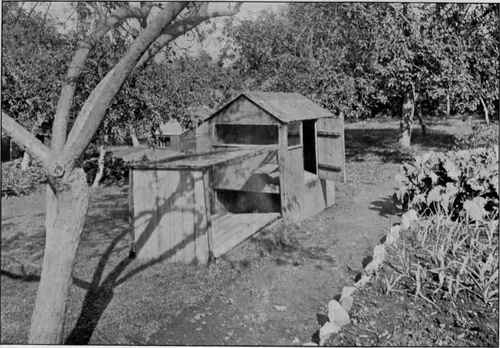
Mrs. James's Cat Houses At Backwell (Photo : F Holmes, Clifton, Bristol)
"At the Palace in 1894, I bought a smoke female kitten from Miss Bray as a mate for 'Jubilee.' This mating proved successful, and I had several grand litters of smokes, most of which, I am sorry to say, went to swell the ranks of neuter pets, being given as presents to my friends. In time I learnt wisdom, however, and kept my smokes myself. 'Jubilee's' career as a show cat was unfortunately cut short after his Brighton win in 1894. He escaped one night, and in a fight with another cat had his ears so torn that I was unable to exhibit him again. A year later, when I was away from home, he was let out one day, and never returned, having, I expect, been trapped in the woods. At that period my smokes nearly died out, as I had only one litter a few weeks old by 'Jubilee.' Of the two smokes one was promised, and the other I kept, and he is still alive as 'Champion Backwell Jogram.' So I think I may consider I have had my share of luck, though, like most breeders, I have had my bad times, and have lost sometimes as many as twelve cats and kittens in a few days from distemper, and once or twice a very promising female has strayed into the woods and been seen no more.
I hope, however, that for some years, at least,' Jubilee's' descendants will continue to flourish, as there are a number of'Jogram's' kittens scattered over England, and several have left these shores for America.

Mrs. A. M. Stead's Smoke Persian "Ch. Ranji." (Photo: E. N. Collins, S. Norwood.)
"In mating my smoke queens I have several times tried a black sire, and have always been successful in getting good smokes from this cross. 'Jubilee II.' is an example, being by 'Johnnie Fawe,' Dr. Roper's famous black Persian. I have only once - years ago - tried a blue cross, but the result was a mixed litter of blacks and blues. I have found that all the blue queens mated with'Jogram' have had chiefly blacks. Smokes may be considered a very hardy breed, perhaps from the fact that there has been little in-breeding so far.
'Jogram' lives in an unheated wooden house all the year round, and has never even had a cold. Kittens will also stand the same treatment.
"And now I will endeavour to give my ideas as to the points which go to make up a perfect smoke. A good smoke is perhaps one of the most beautiful of the many beautiful breeds of long-haired cats, a bad smoke one of the plainest. The novice - for whom this article is principally written - may therefore be glad to have a clear definition of a smoke to start with.
Continue to:


My Books

