


Chapter IX. Black Persians
Description
This section is from the book "The Book Of The Cat", by Frances Simpson. Also available from Amazon: The Book Of The Cat.
Chapter IX. Black Persians
NEVER have these truly handsome cats received the amount of admiration and attention which they deserve. There are fewer breeders of black Persians than of any other variety, the two most noted fanciers being Dr. Roper and Mr. Robert Little. Both of these gentlemen have owned and exhibited very handsome specimens; Miss Kirkpatrick has also bred some lovely black kittens. The entries in the black classes at our shows are almost invariably the smallest; but as a specialist club for black and white Persians has been started, it is hoped more encouragement will be given to the breeders of these handsome self-coloured cats.

Black Persian" "Johnnie Fawe, " Owned By Dk. Kopek (Photo: Lavender, Bromley. )
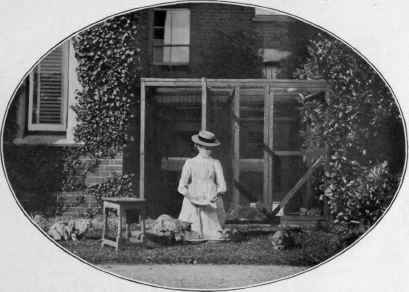
A Morning Meal At Bossington (Photo: A. J. Anderson & Co., Luton. )
As in the other self-coloured cats, the chief point is absolute uniformity of colour throughout. It is fatal for a black cat to have a brown, rusty tinge; it should be a glossy jet black, betraying no bands or bars in the full light, and having no undercoat of a lighter shade, and, above all, no spot or tuft of white hairs on the throat. This latter is a very common fault amongst black cats, and it is one which takes away enormously from the value of the specimen, for either show or breeding purposes. In some other varieties of Persian cats two, or even three, colours for eyes are permissible; but a really good black cat must have the full round eyes of deep orange, and very attractive are these gleaming orbs, shining forth from their dense black surroundings. When black cats are changing their coats they often present a very rusty appearance, and newly born kittens are sometimes like balls of brown fluff. These, however, frequently grow up the very best-coloured blacks. This breed is very strong and healthy, and often grow into large, massive cats. A tortoiseshell female is a splendid mate for a black male, and some of the most noted blacks have been bred in this way.
Two brown tabbies will generally produce one, if not more, good blacks in a litter.

Black Persian. (Painted specially by Madame Henriette Ronner. )
Black cats have been found very useful to breeders of silver tabbies and smokes for this reason - that these two breeds require to have their markings and colourings intensified. That is, a silver tabby with dark grey markings is not a true type, and a smoke with an upper coat of cinder colour does not represent the true smoke. Therefore the introduction of a black cross is often a great advantage to these breeds. There is certainly not much demand for black kittens, and we never hear of very high prices being asked or given for these, or, indeed, for full-grown cats. But as " every dog has his day, " so, perhaps, there is a good time coming for blacks; and certainly beginners in the fancy might do worse than to provide themselves with a thoroughly good black queen, for, anyhow, in exhibiting the chance of honours is very much greater than when competing in classes in which there are so many entries, as in the case of blues and silvers.
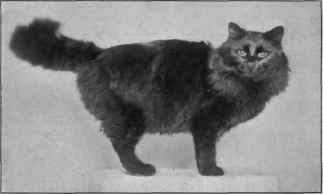
Champion "Menelik III. " (American) The Property of Mrs. Bond, Washington.
For very obvious reasons black cats are the very best animals for those living in London or near large towns. They can never present a dirty appearance, and, therefore, in this particular they will always score over the whites, creams, and silvers. To keep their coats glossy and bright black cats should be well brushed and groomed. They will repay tor this care and attention. Our American cousins call self-coloured cats "solid," and as applied to blacks this is especially expressive, for a black should not have a suspicion of any other colour than a dense black. If, when the coat is blown apart, a shading of grey or blue is seen it is a great defect. The nose should be black, and the pads of the feet also.
I do not remember having seen or heard of an imported Persian black cat. In an article on imported cats in Our Cats the writer (whose name is not given) says: - "White cats with blue eyes are not often to be obtained from abroad, neither are the blacks warranted to possess the amber eyes voted correct by up-to-date cattists. I know of a black queen straight-frem the land of cats and the palace of the Shah himself; it had the most glorious emerald eyes it is possible to imagine - as different from the ordinary run of green as flaming amber is from faded yellow. This cat, a Persian among Persians, had a coat as black as the proverbial jet - perfectly black throughout - long and straight, of fine, silky texture, but not giving one the impression of massiveness that is such a prominent feature of the type of imported cat. Moderate in size, slightly built, with an expression so foreign that it amounted to weirdness, this cat could with a dash of imagination have been worked up into the incarnation of a spirit, a soothsayer, the veiled beauty of a harem, a witch, snake charmer - what you choose; but always remain something far apart from prosaic England, something tinged with romance and the picturesqueness of the mystical East. This black cat was undoubtedly a typical Persian. "
As there is such a dearth of good black cats in England, it is a pity some enterprising breeder does not try to import a really splendid specimen, which might bring luck to himself and the fancy.
In looking back to the old catalogues of Crystal Palace shows, I find the same scarcity of blacks exhibited as at the present day. In 1886 the black male class is marked "no entry," and in 1889 Mrs. H. Warner (now the Hon. Mrs. McLaren Morrison) makes the sole and only entry of "Imp in the black class. It was in the following year, however, that this same well-known lady fancier exhibited "Satan," a black that was never beaten whilst it lived. It was the most remarkable of unapproachable excellence I can remember - a veritable triton among minnows.
Continue to:


My Books

