


Black Persians. Continued
Description
This section is from the book "The Book Of The Cat", by Frances Simpson. Also available from Amazon: The Book Of The Cat.
Black Persians. Continued
In many of the accounts of our largest shows I remark such paragraphs as these: "Good blacks with orange eyes were conspicuous by their absence." Or again: "The black classes, as usual, were poorly filled." It is, therefore, high time that this beautiful breed should receive more attention at the hands of fanciers, and that not only beginners but those who are well known in the cat world should take up blacks, and, as the expression goes, "run them for all they are worth." At present Dr. Roper's and Mr. R. Little's black Persians have it all their own way. Mrs. Lenty Collins frequently has a look in with her wonderful big-eyed "Forest Beauty," and Mrs. Crowther, in the North, is faithful to this her favourite breed of cats; but we want some more dusky beauties to swell the ranks of black Persians.
As everyone knows, a vast deal of superstition is connected with a black cat. This is what Harrison Weir has to say on the subject: - "It is often said, 'What's in a name?' The object, whatever it is, by any other would be the same; and yet there is much in a name. But this is not the question at issue, which is that of colour. Why should a black cat be thought so widely different from all others by the foolish, unthinking, and ignorant ? Why, simply on account of its colour being black, should it have ascribed to it a numberless variety of bad omens, besides having certain necromantic power? In Germany, for instance, black cats are kept away from children as omens of evil; and if a black cat appealed in the room of one lying ill, it was said to portend death. To meet a black cat in the twilight was held unlucky. In the ' good old times' a black cat was generally the only colour that was favoured by men reported to be wizards, and black cats were said to be the constant companions of witches; and in such horror and detestation were they then held that when the unfortunate creatures were ill-treated, drowned, or even burned, very frequently, we are told, their cats suffered martyrdom at the same time.
It is possible that one of the reasons for such wild, savage superstition may have arisen from the fact of the larger amount of electricity to be found by friction in the coat of the black cat than of any other; experiments prove there is but very little either in that of the white or the red tabby cat. Be this as it may, still the fact remains that, for some reason or other, the black cat is held by the prejudiced ignorant as an animal most foul and detestable, and wonderful stories are related of their actions in the dead of the night during thunderstorms. Yet, as far as I can discover, there appears little difference either of temper or habit in the black cat distinct from that of any other colour, though it is maintained by many even to this day that black cats are far more vicious and spiteful, and of higher courage. and this last I admit. Still, when a black cat is enraged and its coat and tail are well ' set up, ' its form distended, its round, bright, orange eye all aglow with anger, it certainly presents to even the most impartial observer, to say the least of it, a most 'uncanny' appearance.
But, for all this, their admirers are by no means few; and, to my thinking, a jet-black cat, fine and glossy in fur and elegantly formed, certainly has its attractions."
But although black cats are supposed to be harbingers of evil under some conditions, yet in others they are credited with miraculous healing powers. In Cornwall, sore eyes in children are said to be cured by passing the tail of a black cat nine times over the part affected; and in some parts of the country the presence in the house of a black cat is both an antidote and a cure for epilepsy.
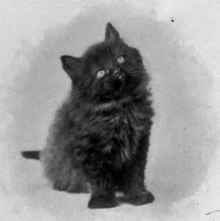
Kitten Bred By Miss Kirki'Atrick (Photo: E. Landor, Ealing. )
1 think that most cat fanciers are inclined to believe in the possible luck that a stray black cat may bring them, and perhaps be more inclined to take in a stranger of this particular breed than one of another colour.
There is an old Scotch proverb that says:
"Whenever the cat o' the house is black, The lasses o' lovers will have no lack. "
The celebrated "Fawe" strain of black Persians is well known in the fancy. Dr. Roper has sent me some notes on his famous prize-winning cats, together with some useful information regarding the breed with which his name has become associated:"For many years black Persians were a most popular breed; but, like fashions, for the time being other colours, I regret to see, are obtaining more notice from fanciers. For years I plodded away to breed what I considered a perfect black Persian; at last my labours were crowned with success. What can equal a richly coloured, heavily coated, deep orange-eyed black?
"In breeding blacks, like any other colour, it is essential you should procure the best of stock, and be prepared to give a fair sum for such, otherwise you are almost sure to be disappointed in your results, and, maybe, retire as a fancier of this colour and try some other; but you will meet with the same fate if you hold the same views as to expense. A black Persian should be perfect in colour, with absence of white hairs, cobby in shape, short in leg, tail bushy and not too long, eyes large and deep-orange, a good broad head, ears short with tufts and well set apart, short face, coat long and silky.
"Having stated the points, I will now give my experience of breeding.
"In my opinion, it is most important the sire should be a black, and one of his parents a black, whatever colour the queen is. I have had greatest success in breeding from a black sire and a tortoiseshell queen. Through this cross you may get either blacks or tortoise-shells. As an instance I quote 'Johnnie Fawe' (black) and Champion 'Dainty Diana' (tortoiseshell). From these I have bred many-good blacks, amongst them 'Dick Fawe,' 'Lady Victoria,' and other good ones; also good tortoiseshells, three of them having taken championships. Blacks may also be bred from a black and a blue, or two blacks - in this case, cross the sire with one of his progeny, which I have found very successful. I admit there are other ways of breeding blacks, but in my experience the three ways I have suggested have proved to be the most satisfactory.
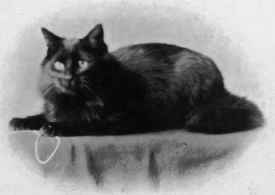
Mrs. Llttle's Bilack Persian " Colleen. " (Photo: D. nottle, bEckenham. )
"In breeding, to be sure of success so far as the eyes are concerned, if possible it is better that both parents should have orange eyes, the deeper the better; but it is most essential the sire should have good orange eyes. Notwithstanding the queen's eyes being light amber, by crossing with a good orange-eyed sire the kittens are very likely to have good-coloured eyes, but not vice versa. As an instance, I once purchased a very handsome black queen, perfect in all points with the exception of the eyes, which were very light amber. I mated her to 'Dick Fawe,' who had the deepest orange eyes I have yet seen in a black; the kittens developed orange eyes. I have mated in the opposite way, and the result has been unsatisfactory so far as the eyes have been concerned, and if breeding for show the colour of the eyes is most important. The late Mr. Welburn, a well-known judge, once said in one of his reviews of blacks at a large show (I think it was the Crystal Palace), 'I scarcely think that eyes alone should carry an award, yet it is always best to uphold the desired properties so hard to obtain.'
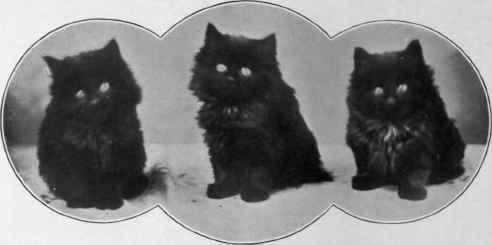
The Carol Singers (Photo: E. Landor, Ealing. )
"Having bred a litter of black kittens, it is unwise to make up your mind what colour they are going to be until they have attained the age of six months. I remember once giving away a kitten at three months old which I called iron grey and thought would or could never be black. Six months after I saw my friend, who thanked me very much for the lovely black kitten. Two months after seeing him I saw the cat: there were no white hairs, and the colour was a perfect black. This last Richmond show I showed a black kitten, aged seven months; it took a first, a second, and a special. At three months old I thought it was going to be a smoke. It was claimed by the Hon.
Mrs. McLaren Morrison. I have a kitten now, aged three months, perfectly bronze in colour and a grey frill. I have no doubt at seven months old it will be a perfect black. I have given these illustrations in order that -those who are thinking of going in for blacks should not give up all hope of the kittens becoming black until the age I have stated.
"I breed my kittens from January to July, and find they do much better in the catteries, all of mine being separate; and I find Spratt's movable runs most useful. In showing blacks they should be brushed and rubbed with a Selvyt cloth daily one month previously and kept free of matted hair. The application of Brilliantine or American Bay Rum in small quantity brushed on gives a perfect gloss to their coats."
Continue to:


My Books

