


Silver Tabbies
Description
This section is from the book "The Book Of The Cat", by Frances Simpson. Also available from Amazon: The Book Of The Cat.
Silver Tabbies
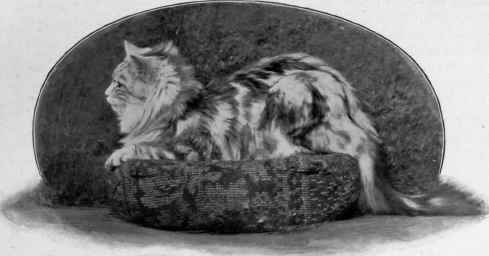
"The Marquis Of Dingley." Silver Tabby, Owned by Miss Anderson Leake. (Photo: Cassell & Company, Limited.)
At the meeting of the Silver Society, discussion arose as to whether the markings on silver tabbies should be broad or narrow. Lady Marcus Beres-iord proposed that Miss Leake and Mrs. Herring should be asked to express an opinion, both being breeders of prize winners. Miss Leake said she thought there were two distinct types of cats, the one with broad markings, the other with narrow stripes, and that both were correct silver tabbies, the superior beauty of either being a matter of personal opinion. Mrs. Herring agreed, and said the markings should be a dense black. Miss Leake considered they should be black at the tips, but shading to light at the roots. Mr. Abbott objected to the word "dense," as black was black, and the word "distinct" was substituted. Finally the following was resolved : - The colour of a silver tabby should be a pale clear silver, with distinct black markings, any brown or cream tinge to be considered detrimental. The eyes should be orange or green :
Head and expression | 25 |
Colour and markings | 25 |
Colour of eyes | 5 |
Coat and condition | 20 |
Shape | 15 |
Brush | 10 |
Total ...... | 100 |
The adoption of the preceding descriptions and scale of points as a whole was carried unanimously.
As regards the eyes of a silver tabby, Harrison Weir says "deep bright yellow." The Silver Society gives an option of "orange or green"; but the mandate of present-day fashion and personal bias is in favour of green eyes for silver tabbies. From an artistic point of view, there is no doubt emerald green is a better contrast to silver than yellow or orange.
The Rev. R. Maynard, whose name has for many years been connected with silver tabbies, recently complained in the papers of the tendency to breed green eyes in this variety. He writes : "In former days we never had anything to do with a cat that had green eyes, and now that so much is being done to improve the feline race, why should we try to think the green eye right and even desirable?" Another authority says : "The fiat has gone forth that silver tabbies are to have green eyes. Happily there still remains room for a difference of opinion on the subject, for the oldest and most perfect breeds of silver tabbies have always been distinguished by their deep hazel eyes."
This vexed question of eyes, certainly outside the "self" classes, ought not to be one of such vast importance. As Louis Wain aptly writes when complaining of this undue proportion of points, "Everyone, judges and exhibitors alike, are bitten by the craze for the correct coloured eyes.'" It is a fault that judges are prone to commit, and truly one point ought not to be allowed to outweigh others, and it is just this balancing of merits with a mingling of common sense that makes the good all-round judge, whether of self or tabbies, of long- or short-haired cats. In judging a class of tabbies, first and foremost in the judge's estimation must rank the markings, and in Persian tabbies coat must next be taken into consideration. I have always thought that judging long-haired tabby cats in a ring class would be specially welcomed both by judges and exhibitors, for it is when a good cat of this breed runs or walks the beauty of his markings can be seen and admired -Then the dark spine lines will show up to advantage, the side markings will stand out, and the bars on the legs and the rings round the neck may be clearly discerned. I think it is not to be wondered at that fanciers who have bred tabby cats are not easily satisfied as regards selfs and silvers.
A friend of mine declared, "I always miss the stripes which give a tabby cat such a sweetly expressive countenance." Yet in spite of the beauty of the silver tabby, there are very few fanciers of this variety, and to those wishing to take up Persians I could not recommend a more interesting field for speculative breeding.

Silver Tabby Kittens Owned By H.H. The Princess Victoria Of Schleswig-Holstein (Photo : E. Lamdor, Ealing.)
The number of good show specimens can be counted on the fingers of one hand. Silver Tabby classes at our shows are full of nondescript cats with shaded silver bodies and markings only on legs and head.
When judging the silver tabbies at the Crystal Palace in 1902, I was greatly struck with the number of cats and kittens which ought really to have been marked " Wrong Class," for some of these were absolutely wanting in any definite marks at all; some had faint grey pencilling on the head and legs, but not a sign of the dense mottling on the sides. It is, no doubt, disappointing to exhibitors to have their specimens labelled " Wrong Class," or for really lovely kittens to be passed over without even a card ; but it is only by thus treating exhibits so lacking in the essential point of the class for which they are entered that fanciers will learn to discern between the genuine article and what may be called a spurious one. These pretty nondescript silvers, which are neither one thing nor the other, should be disposed of as pets ; but to enter them at our shows in classes for tabbies is only throwing away money and risking the animals. No cat has come nearer to the perfect ideal of a silver tabby in our day than Lady Pink's "Shrover II.," now gathered to his fathers. He possessed the wonderfully clear silvery white ground with distinct dark markings, and was always the admired of all admirers at our leading shows.
Lady Pink is not without some worthy descendants of her famous "Shrover II.," and writes to me thus : "I have a smoke male by 'Shrover II.,' and hope to show him at Westminster.
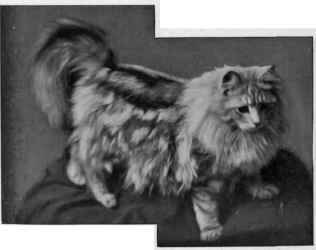
"Beautiful Duchess." Owned by Mrs. G. H. Walker.
'Shrover III.' is just like his father'Shrover II.,' but I shall not exhibit him, as I am too afraid of losing him. I have suffered many losses after shows.' Shrover III.' is a fine, big fellow, even better marked than his father, with long silky, wavy coat, lovely eyes, and a perfect temper."
Continue to:


My Books

