


Shaded Silvers. Part 9
Description
This section is from the book "The Book Of The Cat", by Frances Simpson. Also available from Amazon: The Book Of The Cat.
Shaded Silvers. Part 9
"May I, at this point, plead that the little kittens taken from their mother for your benefit should not be drowned ? If they must be sent along the silent road to the Quiet City, let it be done mercifully and by chloroform. Such wee things may rest easily in a big biscuit box, the lids of which usually close tightly, and about 1 oz. of chloroform poured on a piece of flannel or sponge laid on a small saucer by their side will send them painlessly to sleep.
"The reason I strongly advise that the English foster should nurse the best of the litter is but an echo of the old cry,' Want of bone.' Fed by the sturdy British puss, the delicate tiny balls of silver fluff will gain greater strength, and be mothered for a longer period than would be possible with their real parent.
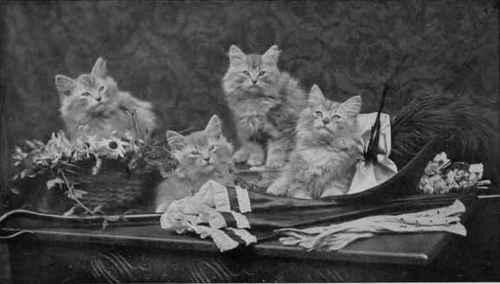
"fur and feather." (Photo : Mrs. S. F. Clarke )
"It is necessary to remember that, although the foster mother needs extra food when nursing - just as in the case of the silver mother - more caution must be exercised when beginning the more liberal diet, for very probably, if this is forgotten, a liver attack - which will also affect the precious kits - will be the result of her unusually liberal fare. Remember, also, to inquire of the owner of your foster as to how she has been fed. With this knowledge, common sense and careful watching of cat and kittens will quickly show if it would be better to increase or diminish her meals either in quantity or quality. It is of enormous value to bespeak the foster mother, if possible, four or five weeks before the birth of the kittens, for then it will not hurt to give her what is almost certain to be necessary - i.e. a worm powder.
" I always allow my mother pussies as much milk as they like (although, as a rule, my cats drink water), but it should be boiled, and one tablespoonful of lime-water added to each half-pint. When I once urged this care of the foster mother to a friend who owned two kittens she was extremely anxious to rear, I was laughed to scorn, and assured that such fussiness about a strong English cat was more than foolish. Yet I would remind breeders who are inclined to agree with the above opinion that on the perfect health of your head nurse rests the future of your much-prized litter. On her depends their growth, their first chance of throwing off their natural delicacy. Mr. House, in one of his articles lately published in Fur and Feather, advises that kittens should be kept with and fed by their mothers as long as sixteen weeks. In my humble opinion this is too great a strain on any Persian cat, but there may be great wisdom in keeping the kits with the mother or foster for as long as it is possible without overtaxing the cat.
The same authority speaks of a relay of foster mothers.
I confess this puzzles me, for I should imagine that the food supplied by the second mother would be too weak in quality (as Nature provides it shall be of different quality to suit the age of all and every kind of baby) for the big kits after that of the first foster, and I should have also imagined the second foster would refuse to nurse kits so much bigger than those she had just left.
" When my kits are four weeks old I give them raw lean beef - scraped, not chopped - beginning with half a teaspoonful daily, then the same quantity twice daily, then three times a day; and at the same time teach them to lap, using a plate, which, being shallower than a saucer, causes less choking and fear to the little things."
Mrs. G. H. Walker, of Woodheys Park, is the chief supporter of the Northern Counties Cat Club, and is a member of the National Cat Club Committee. For several years she has been a well-known breeder and exhibitor of silver Persians, and has a most excellently planned cattery, which I had the pleasure of seeing when on a visit to Woodheys Grange. Mrs. Walker kindly had some views taken, specially for reproduction in these pages. I consider the arrangements for the pussies' comfort and well-being as complete as it is possible to make them. The floors of the outside catteries, which face south, are cemented, so that they can be washed over every day. The roofs are boarded, and then covered with galvanised iron, so that all the rain runs away easily. The spacious apartments are fitted with benches and ledges, and trunks of trees and leafy shrubs are planted in the ground for the cats' special amusement and exercise. The kennels - which, for the purpose of photographing them have been placed outside - are the cosy sleeping dens of the pussies.
There is a maid in attendance on these fortunate cats, and the man who looks after the kennels, of dogs also gives a helping hand.
In one of the pictures will be seen a staircase, and this leads to three charmingly arranged rooms. All the appliances and utensils connected with the animals are kept in one of these apartments. Another is set apart for mothers and their families, and a third is kept in case of illness for an isolation ward. In one of the loose boxes near at hand the cooking for the pussies is carried on, and there is a larder specially for the cats' food. Mrs. Walker devotes much of her time to looking after her pets, and great has been her sorrow over the untimely death of some of her treasured pussies. After one of the large shows, infection crept into her cattery, and worked most cruel havoc. Such losses as Mrs. Walker sustained were enough to damp the ardour of the most enthusiastic cat lover and fancier; but the lady of Woodheys Grange bravely faced the situation, and after a period of sad reflection she once again resumed her hobby with renewed interest. At the Northern Counties Cat Show at Manchester in 1902
Mrs. Walker exhibited a really wonderful silver kitten. I say wonderful, for this youngster, bred from the owner's "Wood-heys Fitzroy" and "Countess," was the most unshaded and unmarked specimen of a silver I have ever seen. This unique specimen will be watched with interest by silver fanciers. May his shadings ever grow less !
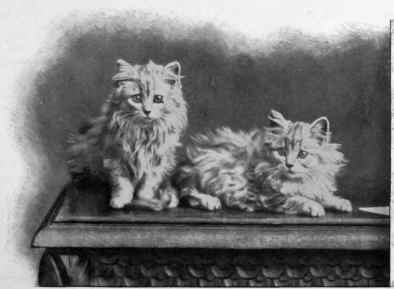
"The Silver Lambkins." By "Rahman" ex "Beauty."
Continue to:


My Books

