


Shaded Silvers. Part 10
Description
This section is from the book "The Book Of The Cat", by Frances Simpson. Also available from Amazon: The Book Of The Cat.
Shaded Silvers. Part 10
The average number of inmates of this cattery is about thirty, but at one period of Mrs. G. H. Walker's catty career the silver fever ran high, and there were sixty-three cats and kits within the precincts of the spacious and luxurious catteries of Woodheys Grange.
Mrs. Martin, of High Wycombe, who has often acted as judge, has been a most successful breeder of silvers, and the progeny by " St. Anthony," her noted sire, have distinguished themselves by winning over one hundred prizes. "St. Anthony " has retired into private life, but he will always be remembered if only by his two children " Silver Dove " and " Fascination." Mrs. Martin says, " I am all in favour of the male being older than the queen in breeding silvers ; also select a good-coated stud cat, short in the legs. Eyes are a worry just now. Of course, I like green best, but if a cat is good in all points but colour of eye, this should not upset an award. I find that if a kitten is born almost self silver, it will develop into an indifferent silver tabby later ; but if the body is dark, and head and legs light and clear, you may hope for a very unmarked specimen in due time."
Mrs. Wellbye's silver cats "Dossie," "Silver Lotus," and "Veronica" were at one time well-known winners, and for length of coat and beauty of eye have seldom been surpassed. Mrs. Wellbye is a most astute judge of silvers, and her remarks on this her favourite breed will be read with interest : "This handsome variety of the Persian ranks high in the estimation of cat lovers; indeed, its ardent admirers consider it the creme de la crime of the cat world. And why not ? Surely there is nothing to compare with a lovely young chinchilla Persian in full coat. Its very daintiness and seeming pride in itself is quite charming. One is reminded of a pretty child dressed out in its party frock, for puss appears to know it is well dressed and desirous to show her charms to the best advantage. She dances, pirouettes, and throws herself into the most graceful and entrancing attitudes, until we feel in sympathy with the Egyptians of old and are willing to fall down and worship our adorable pets. We all love beauty, but to those who love cats there is something beyond even beauty, for only they who keep and care and treat them well know the comfort these little creatures are, and the happiness they can bestow by their sweet caressing ways, perhaps more especially to those whose hearts are starved of human love, but still to all whose sympathies are wide of the varieties of silver cats.
I will first treat of the chinchilla.
"The Crystal Palace show of 1895 or 1896 was the first I remember with a class for chinchillas; previous to that, I believe, they were not recognised as such, but were shown with the silver tabbies. Strictly speaking, the name chinchilla is a misnomer as applied to these cats. The soft grey coat of the little animal called the chinchilla, whose lovely fur is so much prized as an article of ladies' dress, differs diametrically from the cat so called.
"The fur of the chinchilla is dark at the roots, and shades quite pale grey at the tips. The cat's fur, on the contrary, is absolutely pale grey, almost white at the roots, but tipped with black at the outer edges.
"The points as laid down by the Silver Society are as follow :' Chinchillas should be as pale and unmarked silver as it is possible to breed them.'
"The aim of the breeder of this variety, therefore, is to obtain a cat with none of the markings of the original stock (the silver tabby), the dark tippings to be slight and faint.
"Breeders have found this ideal most diffi-cult to obtain; although some kittens are born pale all over, with no markings; in a few weeks - or maybe months - the hope of the family is no more, for the lighter the kitten the more delicate. 'Whom the gods love, die young.' Or, again, if the cherished one lives over its baby troubles, and starts on the change from its first, or kitten coat, to the second coat, too often do the markings appear, the shadings get darker, or fine black hairs are seen amongst the pale grey. Some of the best chinchilla kittens have been born quite dark, and with tiny stripes all over. At a month or six weeks these marks have disappeared, and later the coat has become an even silver.
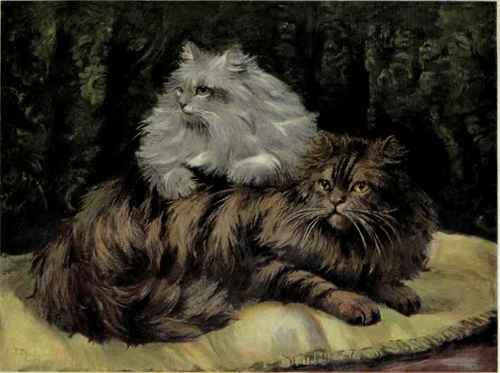
Brown Tabby And Silver Persians (From a Painting by Miss F Marks.)
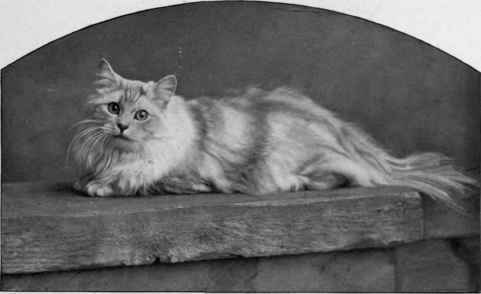
"Jupiter Duvals." Owned and Bred by Miss S. Meeson. (Photo : F. Parsons, Southend-on-Sea.)
"The breeder must not even then build high hopes. Again change may occur. There is no cat which varies so much; it is quite chameleon-like in this respect.
"A few years ago the Cat Club adopted the name of 'self silver' as applied to the chinchilla - another misnomer, as a self silver should have no tippings or shadings, and the silver cat has not been bred that had fur the same shade throughout from roots to tips.
'The slight dark edging to the fur constitutes to most people the charm in these silvers. Sometimes it is almost imperceptible to the casual observer; or when the cat is in full coat (the fur being from three to seven inches long on the tail - sometimes as much as nine inches) the tiny fleckings are lost in wavy, tossing, billowy coat. But let the coat become damp, however slightly, it will be seen that the dark edges are clearly in evidence.
"As, however, breeders could not always produce the pale shade of silver, the litters, even with the most careful mating, being generally assorted in good, bad, and indifferent so far as colour was concerned, many fine cats - dark silvers - had no place assigned to them.
"It was then suggested that a class should be given at the shows to be called' shaded silver,' the points according to the Silver Society being as follows:"'Shaded silvers should be defined as pale, clear silver, shaded on face, legs, and back, but having as few tabby markings as possible.'

The Elder Miss Blossom Silver, Owned by Miss Horsman.
Continue to:


My Books

