


Chapter XIV. Brown Tabbies
Description
This section is from the book "Everybody's Cat Book", by Dorothy Bevill Champion. See also: Your Cat: Simple New Secrets to a Longer, Stronger Life.
Chapter XIV. Brown Tabbies
Brown tabbies were thought little of in the early days of cat showing, probably because there were many of this variety among the short-haired cats.
Latterly they have been bred with the most superb colour and markings, thereby presenting a vastly different appearance from the ordinary grey-brown tabby one used to see.
A good, rich-coloured brown tabby is very beautiful, but like other varieties a good one is still rare.
The ground colour of the brown tabby should be of a rich tawny tint; this should be as even as possible, extending to the extremities, especially the lips and chin, which are so often white or shaded to dirty white; this latter fault has been hard to eradicate, but it has been done by a few breeders.
The next important point is the markings; these should be of a dense black; the broad stripes are the most admired.
The legs and tail should be well barred as well as the chest and neck, giving the appearance of necklaces.
There should be a distinct tawny down the centre of the back, and with a black line on either side of the back, and with a black line on either side of it.
The body markings should be well defined and the leg markings should come high up the legs to meet these, the head and face should also be well marked, the lines from the corners of the eye to the cheek being called "cheek swirls," the marks up the face should continue between the ears and down to the shoulders, where the "butterfly" mark will be found, which divides the head lines from the spine lines.
Perhaps no more perfect definition of these markings could be found than those of the short-haired silver tabby on opposite page; they should be the same in the long-haired varieties, but unfortunately the long hair prevents such distinctness, and only when the hair is smoothed down with the hand can the markings be properly traced.
Brown tabbies should be heavy and thick in build and have large broad heads; they should have orange or golden eyes; the coat of the brown tabby is often inclined to be short and thick, but to be perfect they should show as much quality as the silvers or blues.
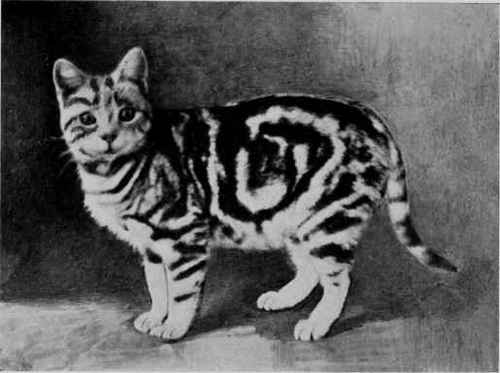
Champion The Buzzing Silver.
The principal points to be bred for are soundness of chin (by that I mean a deep fawn or cream, not nearly white), eye-colouring, richness of ground colour and distinctness of markings. In obtaining these much desired points be careful not to sacrifice shape and strength.
Brown tabbies mated to brown tabbies always do well, but should the rseulting kittens lack the desired richness of colour, mate the best one to a deep-coloured orange tabby, being sure that the orange tabby has a deep chin, if the tabby is not procurable try a solid orange.
If you happen to get one too red in colour and not well enough marked try crossing with a black, one bred from brown tabbies, tortoise-shells or oranges preferred.
It is wonderful how well marked some cats are from black and brown tabby crosses.
Brown tabbies should be mated to blacks, oranges from orange tabbies, tortoise-shells, or even blues, but the latter cross is the least desirable, as it destroys the colour of the blues, and leaves traces of tabby markings; although many of the old-time blues had brown tabby in their pedigrees.
Avoid any greyness in ground colour or light tickings on the dark markings. The ground colour and markings should be as distinct from one another as it is possible to have them.
Continue to:


My Books

