


Early Dogs. Part 2
Description
This section is from the book "British Dogs, Their Points, Selection, And Show Preparation", by W. D. Drury. Also available from Amazon: British Dogs: Their Points, Selection And Show Preparation.
Early Dogs. Part 2
The fashion of hunting led in all probability to the separation of Domestic dogs into two distinct groups - those that hunt by sight as distinguished from those that hunt by scent; for there can be no doubt that at a very early period dogs were used in the chase of wild animals. . . . The utility of dogs being established at a very early period would naturally lead to great care being bestowed upon them, and doubtless to the breeding of them in a domestic state. This would lead to the production of the many breeds and varieties that have been developed, and thus varieties may have been perpetuated by the mixing and crossing of breeds originally obtained from distinct wild animals."
Mr. Bartlett then goes on to give his experiences in regard to the crossing of wolves and jackals with Domestic dogs, and states that when suitably mated he never had any difficulty. He also refers to the fact that the Esquimaux frequently allows his dogs to breed with wolves in order to maintain strength, endurance, and courage. He also relates, what is most interesting, that, he never met with a well authenticated instance of a hybrid between a fox and a dog.
In habits the wolves and the jackals present so much in common that Mr. Bartlett is unable to point out any marked differences between them. Domestic dogs, he says, "exhibit many of the habits of wolves and jackals, such as the scratching up of earth with the front feet, and the pushing of it back with the hind feet, in order to hide the droppings. Again, when about to rest, the turning round two or three times with the object of forming a hole may be noticed in pet dogs about to lie down - a habit evidently inherited from their wild ancestors."
As to the whining, howling, and growling of wolves, jackals, and dogs, these are so much alike, Mr. Bartlett considers, as to be indistinguishable; but barking, he says, is undoubtedly an acquired habit, and doubtless due to domestication. Wolves, jackals, Esquimaux, and Dingoes in a state of nature never bark; but if either be associated with barking dogs, these in many instances acquire the habit.
The above constitute in brief some of the more important suggestions of latter-day naturalists with regard to the very vexed question of the origin of the Domestic dog. Whatever grounds there may be for widely divergent opinions as to this, there cannot be two opinions with regard to the dog's early association with man. In fact, it may be said with certainty that in every age of which we have history, and even in prehistoric times, man had, if not as his best friend, at least probably as a most useful auxiliary, the dog.
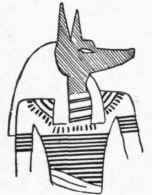
Fig. 1. - Anubis, God of the Setting Sun.

Fig. 2. - Early Egyptian Dog.
So far as historic dogs are concerned, it is hoped to be able to show the various changes in type that have taken place, by means of illustrations from monuments and other records, from the time when a dog (or, more correctly, a jackal) was sacred to Anubis, the God of the Setting Sun (Fig. 1). The earlier presentments of the dog upon the Egyptian monuments show a decidedly wolf-like animal (Fig. 2), with erect ears and a thin and apparently tapering tail. Such a dog, though doubtless but a remove from the wolf or the jackal, was at any rate common. This dog evidently gave place to a more compact-habited animal, not so long in head or in body, though still with prick ears, but with what may be described as a double-curled if fine tail (Fig. 3) and decidedly terrier-like.
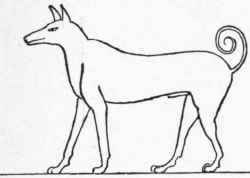
Fig. 3. - Terrier-like Dog of the Egyptians.
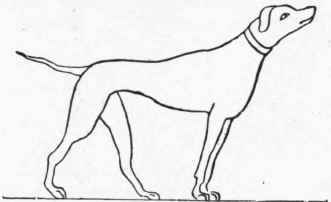
Fig. 4. - Egyptian Hound.
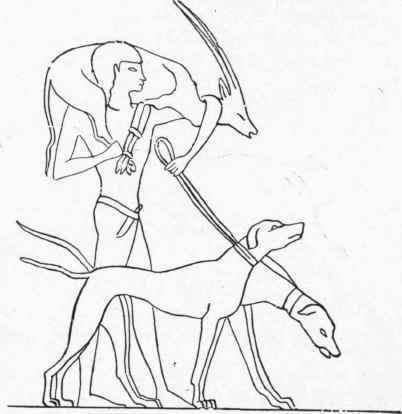
Fig. 5. - Egyptian Hounds in a Leash.
As time went on, further changes were met with, as shown in Figs. 4 and 5. It does not require a very vivid imagination to conjure up the chief characteristics and work of these Egyptian hounds, that were, as Fig. 5 suggests, employed to hunt the deer and such-like animals of that time. The hounds held in the leash by the huntsman, with the dead body of the antelope carried on the shoulders, plainly tell their tale. Nor were the ancient Egyptian ladies without their dogs, and thus early we are led to believe that lapdogs - and lapdogs, too, with a resemblance to the Dachshund - were popular (Fig. 6). True, the ears are upright, as doubtless were those of the original dogs, and one can even at this very remote period of history see how an intelligent fancier might very well have modified by selection those traces of the wild ancestors, and evolved from the material at command a not very bad representation of a twentieth-century Dachshund.
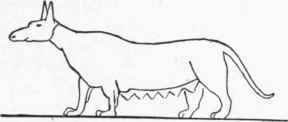
Fig. 6. - Dachshund-like Pet Dog of the Egyptians.
Passing from the Egyptian to the Assyrian monuments, we find still further interesting sculptures of the dog of the period, but especially between 1273 B.C. and 747 B.C. These introduce us to a type of dog of far more formidable proportions than any met with previously (Figs. 7 and 8). These are of Great Dane-like appearance, and were employed for hunting large wild animals, from the lion and the bull down to the very abundant wild ass, the last-named being a favourite quarry.

Fig. 7. - Assyrian Hunting Dog.
Kings had their canine favourites in those days, as they had many centuries later in the times of good Queen Bess and of the "Merry Monarch." The dog shown in Fig. 8 is one of these royal favourites, and the cuneiform characters extending from the top of the shoulder to the hindquarters represent the name of the animal.
Continue to:


My Books

