


Early Dogs. Part 3
Description
This section is from the book "British Dogs, Their Points, Selection, And Show Preparation", by W. D. Drury. Also available from Amazon: British Dogs: Their Points, Selection And Show Preparation.
Early Dogs. Part 3
As well as the huge dogs just described, there existed a variety that was its very antithesis in conformation - a Greyhound-like dog. This was employed for coursing the hare, or it may be for hunting the timid deer. However, to judge by the records, it does not appear to have found anything like the favour with the Assyrians that we are led to believe was the case with the more savage and bulkier dog already noted.
Students of ancient Grecian history are aware that several varieties of dogs were identified with the different races; while even the schoolboy struggling with his Odyssey or his Virgil has at least a faint idea of the fearful dogs that tradition has handed down. Cerberus, the many-headed dog that Hesiod named, and whose existence Homer hinted at, is undoubtedly the most noteworthy of these latter. Of the former, some were used in the more peaceful pursuit of the chase, and others in the arts of war. The war dogs, which were also big game dogs, were alike formidable in appearance (Fig. 9) and fierce as to temperament; added to which they were provided with spiked collars and not infrequently armour-clad, so that their capture or their despatch was not easy of accomplishment. They were divided into two groups - Pugnaces and Sagaces. Apart from the coursing dog proper, or Gallic Greyhound, there was a long-legged Bull-terrier-like animal occasionally used against the hare; but to judge from the methods employed to circumvent the timid animal, about as much credit ought to have attached in those days to a kill as should in the case of present-day dogs employed to hunt the rabbit in an enclosed ground. Fig. 10 shows both the war dog and the coursing animal proper with the huntsman, spear in hand, in the act of encouraging them. In the earlier type of Gallic Greyhound the ears were erect, while in the later ones they were disposed probably much as they are to-day.

Fig. 8. - Assyrian Hunting Dog, as used by the King.

Fig.-9. Grecian War And Hunting Dog.

Fig. 10. - Grecian War or Hunting Dog and Coursing Dog.
From each of these three principal varieties there were many sub-varieties, from the fierce Mastiff (an altogether heavier type of dog than the war-dog) to the lapdogs like the Maltese, though history is strangely silent as to the general appearance of these latter. Nor is the Mastiff of the time described specifically enough to admit of present-day dog-lovers forming a comparison between their dogs and those, say, of the Assyrian or the Grecian periods. What is recorded is the fact that the Assyrian war-dogs stood as high at shoulder as 35m., that the Mastiff of Epirus in Grecian times was at least heavier, and that the early British dog, in both size and ferocity, eclipsed either. Rome also had her boar-hounds (Fig, 11), her Greyhounds, perhaps her Italian Greyhounds, and her long-haired and other Terriers, though for lack of specific detail on the part of the writers of those days and of sculptures, the actual conformation of the last named is left practically to conjecture.
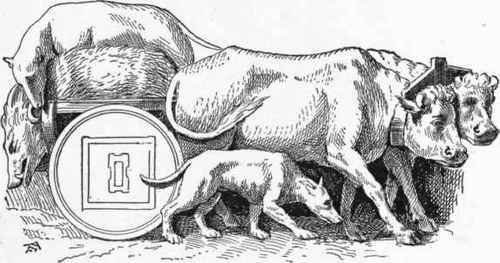
Fig. 11. - Roman Boarhound.
The early Romans classified the dogs in accordance with their utilitarian properties. Thus we have Canes villatici, or House-dogs, Canes pastorales, or Shepherd-dogs ; and Canes venatici, or Sporting dogs. The last were again subdivided into Pugnaces, or Fighting dogs, like the Mastiffs, Bulldogs, etc., and the Sagaces, or Hunting dogs, like the Greyhounds.
As already hinted, the early Britons had a most formidable Mastiff-like animal that, history says, was exported to Rome to give battle in the arena of the amphitheatre with the bulls. There were, too, the Greyhound, which does not appear to have undergone any great modification ; and the Gazehound, that Op-pian describes as a small hunting dog with a good voice, crooked-legged, slight, and shaggy, but possessing feet armed with formidable nails. This last statement is somewhat peculiar, as one would imagine a dog that was used for hunting could not very well possess long toenails.
In the tenth century mention is made of Bloodhounds, Spaniels, Shepherd-dogs, and House-curs, and of course Mastiffs; but neither coins, sculptures on monuments, nor pottery of the period, give anything like a true representation of the dogs. All show a more or less exaggerated type (Fig. 12).
Coming to more recent times, we find the dearth of specific information with regard to dogs quite as great as that which characterised pre-mediaeval days; while the representations of dogs upon monumental tombs are often so rude as to give but the slightest clue to the identity of the animals thereon depicted. Sometimes it is the Greyhound that is thus selected as an emblem of fidelity; at others a spotted dog, it may be a Dalmatian of the period (Fig. 13), and at yet others a lapdog (Fig. 14), by some considered to represent a Pug of the period - namely, the latter part of the fourteenth century.
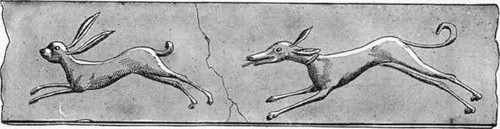
Fig. 12. - Coursing Hound of the Tenth Century.
When Dr. Caius wrote his famous work, translations of which have appeared from 1576 to our own day, we get the first attempt at anything like a system of classification of the breeds that then were known. Unfortunately, however, we have to rely purely upon description, the work in Latin and its translations being devoid of illustrations. Caius, or Kaye, refers to eight distinct varieties of hunting dogs - Harrier, Terrier, Bloodhound, Gazehound proper, Greyhound (a very swift Gazehound, slim of body, and both rough and smooth coated), Leviner (a kind of Lurcher, a cross between the Harrier and the Greyhound), Tumbler (a small kind of Greyhound, remarkable for its duplicity), and Night Cur, or Stealer.
Continue to:


My Books

