


Chapter XI. The Otter-Hound
Description
This section is from the book "British Dogs: Their Varieties, History, Characteristics, Breeding, Management, And Exhibition", by Hugh Dalziel. Also available from Amazon: British Dogs.
Chapter XI. The Otter-Hound
Although many writers describe the Otter-hound as a dog of mixed breed, all refer him back to the old southern hound, or the bloodhound, for his origin, whatever crosses may have been resorted to to produce the dog we now recognise as the legitimate hound to pursue the " Fish-slicer." Blaine says he is the old southern hound, crossed with the water spaniel, and that those with a dash of the bulldog in them are the best, the water spaniel being supposed to supply the roughness of coat - for water spaniels of last century were very different in coat as in other points to those dogs of to-day called by that name - and also to give or increase the aptitude for swimming, whilst the bulldog cross is supposed to have infused the necessary hardiness, courage, and tenacity.
Both Youatt and Richardson suppose him to be the result of a cross between the southern hound and the rough terrier, and by others the rough deerhound has been held to have had a share in the production of the otter hound. I am strongly of opinion, however, that if any such crosses have ever occurred, either by accident or design, it is so remote and slight as to be now quite swallowed up, and as a stream lost in the immensely larger volume of the river to which it is a tributary, so has any infusion of alien blood been absorbed by the true old English hound blood of the genuine Otter-hound.
The hunting of the otter is one of our most ancient sports. Jesse, in his researches into the history of the dog, gives many interesting quota tions from ancient documents showing the pursuit with hounds of This subtle spoiler of the beaver kind to have been a royal pastime with many of our English kings. In July, 1212, the Sheriff of Somerset received commands from King John to "provide necessaries for Ralph, the otter huntsman, and Godfrey, his fellow, with two men and two horses and twelve otter hounds as long as they find employment in capturing otters in your shire." And John, the otter hunter to King Edward I., had twelve otter dogs under his charge. An annual payment, called "Kilgh Dourgon," was made in Wales for the king's water dogs with which they hunted otters; and James I., an ardent sportsman, had for his master of Otter-hounds John Parry to superintend the hunt and provide for the king's diversion, and so on from reign to reign, otter hunting has, with varying patronage and popularity, remained a British sport, and at the present day there are, on the authority of "Stonehenge," at least nine packs hunted, of which the following is a list: "Subscription packs at Carlisle, under the mastership of Mr. Carrick; in Northumberland, near Morpeth, under Mr. A. Fenwick; and at Cockermouth, hunted by a committee.
In South Wales, Colonel Pryse and Mr. Moore have each a pack; while in England the Hon. Geoffrey Hill hunts the otter from his kennels at Hawkestone, Salop, and Mr. Collier's, from Culmstock, near Wellington. In the west, Mr. Cheriton and Mr. Mildmay also pursue the sport." It is neither my province to describe otter hunting nor my purpose to attempt it; but some reference to it I have considered necessary that the hound engaged in this sport and the qualifications required in him may be better understood. From the time when he is driven from his "wicker couch," contrived " within some hollow trunk, where ancient alders shade the deep still pool," until Pierced through and through, On pointed spears they lift him high in air.
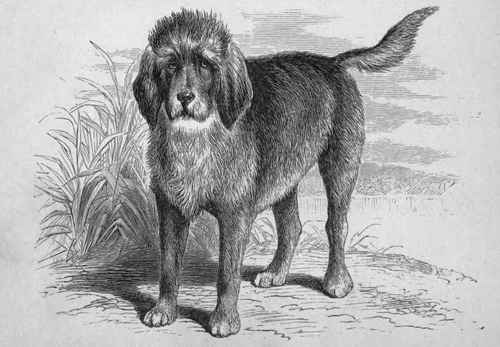
MR. J. C. CARRICK'S OTTERHOUND "CHARMER" (K.C.SB., 365). Sire Wellington, by Bruiser out of Rough Rally - Dam Countess.
The mephitic otter gives his pursuers plenty to do, and when it comes to close quarters, be it with terrier or hound, makes, as opportunity offers, good use of his teeth. Traced by his spraints and seal, and unharboured from his kennel or couch, he finds hard work for men and dogs, as the latter follow him up from holt to holt and pool to pool, and the huntsmen eagerly watch for his vents.
In recent times otter hunting has been modified to suit different circumstances, and practices in vogue in one hunt are tabooed in another. The spear is discontinued, and the practice of tailing the otter - that is, rushing in on him when worn and pressed, seizing him by the tail, swinging him round in presence of the hounds to excite them, and finally throwing him among them - whilst treated as an act of prowess in some otter-hunting districts, is strictly forbidden in others.
A breed of dogs selected and kept to this game, even if originally of the identical stock of our modern bloodhounds, would naturally diverge in some characteristics, and the wet-resisting coat, so necessary to a dog so much in the water, would be developed; whereas, on the contrary, the treatment the companion bloodhound is subjected to tends to fine and soften his coat, or there may have been, and I think it highly probable, if not capable of absolute proof, that there were rough-coated hounds of the bloodhound type from which the otter hound has sprung, and, according to Caius, bloodhounds were used for this sport, but whether either of these suppositions is correct or not, he is in shape and voice and style so truly a hound that I cannot think he is indebted to a strain of either spaniel, terrier, or deerhound blood for his rough and wet-resisting coat.
In general appearance - always excepting the coat - he much resembles the bloodhound; he should be perfect in symmetry, strongly built, hard and enduring, with unfailing powers of scent, and a natural antipathy to the game he is bred to pursue. The head should be large, broader in proportion than the bloodhound's, the forehead high, the muzzle a fair length, and the nostrils wide. The ears are long, thin, and pendulous, fringed with hair. The neck is not naturally long, and looks shorter than it really is from the abundance of hair on it; the shoulders should slope well, the legs be straight, and the feet a good size, but compact; the back strong and wide, the ribs, and particularly the back ribs, well let down; the thighs should be big and firm, and the hocks well let down; the stern well and thickly covered with hair, and carried well up but not curled; the colours are generally grizzle or sandy, with black and tan more or less clearly defined. The subject of our engraving is Mr. J. C. Carrick's Charmer; the drawing was made out of the hunting season, and when she was fat, and the position adds to that appearance, which must consequently be allowed for; but her head and front are wonderfully well done, and the artist has caught the expression well.
The following are the weights and measurements of two of Mr. Carrick's best hounds:
Mr. J. C. Carrick's Lottery: Age, 3¼ years; weight, 76½lb.; height at shoulder, 24in.; length from nose to set on of tail, 39in.; length of tail, 17in.; girth of chest, 30in.; girth of loin, 24in.; girth of head, 17in.; girth of forearm, 7in.; length of head from occiput to tip of nose, l0½in.; girth of muzzle midway between eyes and tip of nose, 11in.; ear, 8½in.
Mr. J. C. Carrick's Danger: Age, 1½ years; weight, 731b.; height at shoulder, 25½in.; length from nose to set on of tail, 40½in.; length of tail, 18in.; girth of chest, 31in.; girth of loin, 23in.; girth of head, 18in.; girth of forearm, 7in.; length of head from occiput to tip of nose, 11in.; girth of muzzle midway between eyes and tip of nose, 11½in.; ear, 9in.
Continue to:


My Books

