


Chapter XXXIII. The Black Curly-Coated Retriever
Description
This section is from the book "British Dogs: Their Varieties, History, Characteristics, Breeding, Management, And Exhibition", by Hugh Dalziel. Also available from Amazon: British Dogs.
Chapter XXXIII. The Black Curly-Coated Retriever
There are few handsomer dogs than a good specimen of this breed, such, for instance, as Toby, True, X L, Muswell-Butterfly, or Chicory, with their compact forms, neat clean legs, and coats of jetty black, perfectly regular crisp little nigger curls, level, thick, and clustering over every part from ears to end of tail, as though clothed with the heads of so many prize piccaninnies.
How the variety originated I do not pretend to say with any degree of certainty, for if we turn to the pedigrees of our most noted specimens we find ourselves very soon at the end of 'a blind alley, even their immediate progenitors being, as a rule, identified by their owner's name, and not by pedigree.
That they are compounded of several elements that are only just becoming so thoroughly commingled as to breed with any certainty of result, I have the experience of breeders to warrant me in believing; for, however good two specimens may be in that great desideratum - coat, for instance - the percentage of their produce equally good in that respect has been small. This, however, the further we get from the different sources originally resorted to, and the closer we keep to those having in a high degree the properties in common which we desire to propagate, becomes altered, and soon, if not now, we will be able to rely on securing good and level litters, with merely an occasional pup throwing back, which should in all cases be carefully weeded out.
I am of opinion that the crisp curly coat has been obtained from the old close-curled English water spaniel, which one looks for in vain now in the classes set apart at our shows for this breed. Their place is now usurped by a class of dog with a coat I should call "irregular " for want of a better term, for it is neither flat, wavy, nor curled, and in other points as well as coat widely differing from the old English water spaniel as described by Youatt and "Stonehenge." The latter in body, carriage, as well as in coat, much resembling the modern curly retriever, making due allowance for the improvements produced by careful breeding for competition for twelve or fifteen years.
There are, I know, many who think the retriever owes his remarkably curly coat to the Irish water spaniel; against this we have the recorded opinion of that high authority on Irish spaniels, Mr. McCarthy, that these dogs will not bear a cross with other breeds, and that the cross with the setter, spaniel, Newfoundland, or Labrador, which would be the most likely to be resorted to to produce the retriever, "completely destroys the coat, ears, tail, and symmetry."
From Mr. McCarthy's experience his opinion must have great weight, and yet against that a case came under my personal notice which, as far as a single case can, controverts that opinion. About thirteen years ago I sent to my brother, a farmer in the west of Scotland, a pure-bred Irish spaniel maiden bitch; she proved a most excellent all-round dog, good alike at questing and retrieving, and just the thing for a one-dog sportsman, and that led to the desire to breed from her; but as there were no dogs of the same breed in the locality she was sent to a retriever with a considerable amount of Gordon setter blood in him. I some years afterwards saw two of the produce; both were jet black, and with most perfect curly coats, and one kept and worked by my brother was as clever as he was in some points good looking; but I cannot claim for him excellence in symmetry - a point which, with all respect to my friend Mr. J. S. Skidmore and other partisans of the Irish spaniel, I think that dog remarkably deficient in.
Among the exhibitors of this retriever that have been prominent as winners of late years are: Mr. J. W. Morris, Rochdale; Mr. F. J. Staples-Brown, Brashfield; Mr. J. H. Salter, Tolleshunt D'Arcy; Mr. G. Thorpe-Bartram, Braintree; Mr. W. Arkwright, Sutton Scarsdale; Mr. E. Ellis, Doncaster; Mr. S. Darby, Tiverton; and Mr. W. A. How, Whitwick, all of whom possess first-class specimens. Mr. Morris's True and X L have often properly figured at the head of their respective champion classes. True is closely matched by Mr. How's champion Toby, the subject of our illustration, and Mr. Thorpe-Bartram's Nell is, in the opinion of many judges, quite equal, if not superior, to X L, and Mr. Tom B. Swinburne's young bitch Chicory, by Mr. Salter's King Koffee, bids fair to surpass both, having youth on her side, and being, in my opinion, a model retriever. She is a nice size, well built, without waste or coarseness, well ribbed, with excellent back and loins, a good cshest, and legs that are simply faultless; her coat, too, is first-rate, and even her tail to its end, both upper and under side, is thickly covered with small perfect curls.
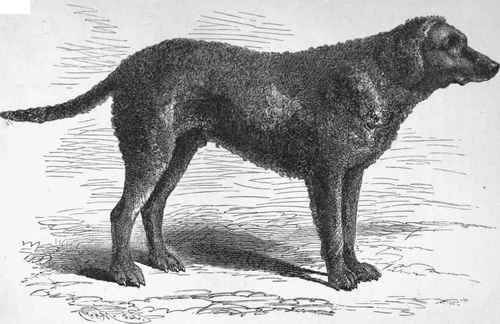
MR. W. H. HOW'S CURLY-COATED RETRIEVER "TOBY.' Sire Sweep (K.C.S.B. 1876 - Dam Mr. Cotton's Nell.
Mr. How's Toby has been before the public since 1874, when he began what has proved to be an extraordinary successful career by taking first at both the Nottingham and the Birmingham shows. He was described in the "Country" report of Brighton Show, 1876, in these terms: "His head is nearly faultless; he is good in limbs, well formed in body, and seems just made for his business, being neither too light for hard work nor too clumsy to clear a dyke or a gate with a hare in his mouth, and to this I may add that his coat is very good."
The value of the points differs from the wavy-coated as follows:
In the head the skull is less wide thoughout and the muzzle rather narrower at the nose.
The coat is entirely different, consisting of short crisp curls all over the body and tail; the face covered with short smooth hair - there must be no topknot. The eye should be hazel brown or darker, a yellow eye which we have seen in otherwise good specimens mars the appearance of the dog and is very objectionable.
The tail should be thick at the root and tapering to a fine point, carried straight and stiffly and covered with small curls, not feathered or bushy; but many good dogs of the breed have this fault.
The colour must be all black, but a small white spot on the chest ought not to disqualify.
With the exception of coat and the fact that the muzzle is narrower, the points of the wavy-coated apply to this; the face, forehead, and muzzle is covered with short hair only, the curls beginning from the occiput, and they should be free from any trace of the Irish spaniel topknot. There should be entire freedom from flew, and a yellow or light eye is objectionable.
In all retrievers temper and tractability are to be considered, but indications of the first only can be seen in the show ring, and to test their ability in seeking and retrieving, in which a good nose, with perseverance, pluck, and a soft mouth, are requisite, we must see him in the field.
The following are particulars of the measurements of Toby and other good specimens of the breed:
Mr.W. H. How's Toby: Age, 5¾ years; weight, 891b.; height at shoulder 24½in.; length from nose to set on of tail, 40in.; length of tail, 17½in. ; girth of chest, 35in.; girth of loin, 30in.; girth of head, 19in.; girth of forearm, 9½in.; length of head from occiput to tip of nose, ll½in.; girth of muzzle midway between eyes and tip of nose, 12in.; length of ear, 4in.; width of ear, 3in.
Mr. W. H. How's Soot: Age, 2¼ years; weight, 811b.; height at shoulder, 23in.; length from nose to set on of tail, 39in.; length of tail, 15½in.; girth of chest, 33in.; girth of loin, 29in.; girth of head, 16in.; girth of forearm, 8in.; length of head from occiput to tip of nose, 9½in.; girth of muzzle midway between eyes and tip of nose, 10½in.
Mr. Thorpe-Bartram's Lulu: Age, 6 years; weight, 751b.; height at shoulder, 26½in.; length from nose to set on of tail, 40½in.; length of tail, 17½in.; girth of chest, 33in.; girth of loin, 28in.; girth of head, 20½in.; girth of forearm, 8½in.; length of head from occiput to tip of nose, 11in.; girth of muzzle midway between eyes and tip of nose, 10 in.; length from corner of eye to end of nose, 4¾in.; length from elbow to top of shoulder blade, 13½in.; length of ear from tip to set on at skull, 5½in.
Mr. Thorpe-Bartram's Nell: Height at shoulder, 22½in.; length from nose to set on of tail, 36½in.; length of tail, 15in.; girth of chest, 28in.; girth of loin, 23in.; girth of head, 17in.; girth of forearm, 8in.; length of head from occiput to tip of nose, 10in.; girth of muzzle midway between eyes and tip of nose, l0½in.; length from corner of eye to end of nose, 4in.; length from elbow to top of shoulder blade, 12½in.; length of ear from tip to set on at skull, 5½in.; girth of neck, 16in.
Mr. S. Darby's Pearl: Age, 3 years; weight, 801b.; height at shoulder, 24½in.; length from nose to set on of tail, 43in.; length of tail, 16½in.; girth of chest, 31½in.; girth of loin, 25½in.; girth of head, 18½in.; girth of forearm, 8in.; length of head from occiput to tip of nose, 12in.; girth of muzzle midway between eyes and tip of nose, 10in.
Mr. Tom Swinburne's Chicory: Age, 2 years; weight, 761b.; height at shoulder, 24½in.: length from nose to set on of tail, 41in.; length of tail, 15¾in.; girth of chest, 30½in.; girth of loin, 22in.; girth of head, 15in.; girth of forearm, 7in.; length of head from occiput to tip of nose, 10¾in.; girth of muzzle midway between between eyes and tip of nose, 9½in.
Mr. J. H. Salter's champion King Koffee: Age, about 5 years; weight, 751b.; height at shoulder, 27in.; length from nose to set on of tail, 39½in.; length of tail, 18in.; girth of chest, 33¾in.; girth of loin, 26in.; girth of head, 18¾in.; girth of forearm, 7¾in.; length of head from occiput to tip of nose, 10in.; girth of muzzle midway between eyes and tip of nose, 10½in.
Continue to:


My Books

