


The Black And Tan Terrier. Continued
Description
This section is from the book "British Dogs: Their Varieties, History, Characteristics, Breeding, Management, And Exhibition", by Hugh Dalziel. Also available from Amazon: British Dogs.
The Black And Tan Terrier. Continued
The head must be long and narrow, clean cut, tight skinned, with no bulging out at the cheeks; the skull flat and narrow.
The muzzle should be long, lean, and tapering, with the teeth level, or the incisors of the upper jaw just closing over the under ones. The nose must be quite black.
The eyes are black, bright, and small, neither sunk in the skull nor protruding.
The ears are, for exhibition purposes, invariably cut, and much importance is attached to the result of this operation. It is required that the ears correspond exactly in shape and position with each other. They must be tapered to a point, stand quite erect, or slightly lean towards each other at the tip. This is a practice I strongly deprecate, and never miss an opportunity of protesting against; and I believe there is a general feeling arising against it. Among others who strongly condemned it I may name the late Mr. S. Handley. The supporters of the practice cannot offer a single valid argument in its favour, whilst there are many strong reasons against it. It is sheer nonsense to say the dogs look better cropped. It is not many years since people thought pugs looked better with their ears shorn off by the roots, but nobody thinks so now; and the practice as regards terriers could be effectually stopped by a resolution of the Kennel Club to the effect that no dog with cut ears would be eligible to compete at any of their shows after 1879. There is this practical evil, too, in cropping, that it places the dog with naturally defective ears on an equality in competition with the dog born with perfect ears, if they have been equally skilfully manipulated.
The natural ear is of three kinds - the button or drop ear, like the fox terrier; the rose ear, that is half folded back, so that the interior of the ear can be partially seen; and the prick or tulip ear. But I have never seen the last-named kind, except in coarse specimens. The leather of the ear is thin, and generally finest in the best bred dogs.
The neck must be light and airy, well proportioned to the head, and gradually swelling towards the shoulders; there should be no loose skin or throatiness. The shoulders are not so muscular as in some breeds, but nicely sloping.
The chest must be deep, but not wide; the latter would indicate a bull cross, which would also be shown in the head and other points. The body is short, the ribs rather deep than round, the back ones pretty well let down.
The loins are strong and muscular; with this formation there is an absence of the cut-up flank which the whippet and Italian greyhound crosses give.
The legs are straight, light of bone, clean as a racehorse's, and the feet long, with the toes well arched, and the claws jet black.
The coat must be short and close; it should look fine and glossy, but not soft in texture.
The colour and markings are in this breed - which is now essentially a fancy dog - important. No other colour than black and tan or red is permissible, the least speck of white is fatal to winning chances, and it is in the richness, contrast, and correct distribution of these that excellence consists. The black should be intense and jet-like, the tan a rich warm mahogany; the two colours in all points where they meet being abruptly separated - not running into each other. On the head the tan runs along each jaw, on the lower jaw running down almost to the throat; a bright spot on the cheek, and another above the eye, each clearly surrounded with black, and well defined; the inside of the ears slightly tanned, spots of tan on each side of the breast, the forelegs tanned up to the knee; feet tanned, but the knuckles with a clear black line, called the "pencil mark," up their ridge; and in the centre of the tan, midway between the foot and the knee, there must be a black spot called the "thumb mark," and the denser the black, and the clearer in its outline, the more it is valued. The insides of the hind legs are tanned, and also the under side of tail; but tan on the thighs and outside, where it often appears in a straggling way, producing the appearance called "bronzed," is very objectionable.
The vent has also a tan spot, but it should be no larger than can be well covered by the tail when pressed down on it.
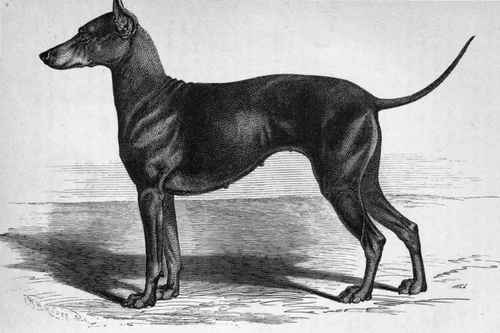
MR. F. W. PARRY'S BLACK AND TAN TERRIER BITCH "SAFF " (K.C.S.B. 8650).
Sire Mr. Harling's Tittler - Dam Mr Bourne's Gipsy.
The tail must be long, straight, thin, and tapering to a point. Its carriage should be low, and any curl over the back is a great defect.
The symmetry of this dog is of great importance, as this point is developed to as great an extent as in any other breed, not even excepting the greyhound.
The subjects of our engravings are Mr. F. W. Parry's Saff, acknowledged by most judges to be the best bitch of the breed living. Saff is perfection in symmetry, possesses all the points of the breed, and is remarkably rich in colour. In the engraving the head is depicted as carried rather high; in a lower position the neck would have shown to greater advantage, but, on the whole, Mr. Moore has most successfully portrayed Saff, who well represents the breed.
Our other engraving represents Mr. Howard Mapplebeck's (now Mr. Vicary's) Wasp, a good specimen, and fairly successful in the show ring.
The following will show size and dimensions of a few good specimens:
Mr. F. W. Parry's Saff: Age, 2 years 9 months; weight, 19ilb.; height at shoulder, 15in.; length from nose to set on of tail, 24in.; length of tail, 9in.; girth of chest, 20in.; girth of loin, 15½in.; girth of head, 11in.; girth of arm lin. above elbow, 6⅛in.; girth of leg lin. below elbow, 4⅛in.; length of head from occiput to tip of nose, 7f in.; girth of muzzle midway between eyes and tip of nose, 6¼in.; colour and markings, black and tan.
Mr. W. K. Taunton's Swift (K.C.S.B., 8631): Age, 2 years; weight, 241b.; height at shoulder, 16in.; length from nose to set on of tail, 27in.; length of tail, 9in.; girth of chest, 21in.; girth of loin, 16in.; girth of head, 13in.; girth of leg lin. below elbow, 5in.; length of head from occiput to tip of nose, 7½in.; girth of muzzle midway between eyes and tip of nose, 6½in.
Mr. W. K. Taunton's Black Bess (K.C.S.B., 8635): Age, 2 years ; weight, 16½lb.; height at shoulder, 13in.; length from nose to set on of tail, 25in.; length of tail, 8in.; girth of chest, 17iin.; girth of loin, 13in.; girth of head, 11in.; girth of leg lin. below elbow, 4½in.; length of head from occiput to tip of nose, 7½in.; girth of muzzle midway between eyes and tip of nose, 5¾in.
Mr. W. K. Taunton's Stella, by General (K.C.S.B., 2943) - Saff 11. (K.C.S.B., 3024): Age, 2 years and 2 months; weight, 181b.; height at shoulder, 14½in.; length from nose to set on of tail, 26in.; length of tail, 7½in.; girth of chest, 19½in.; girth of loin, 15½in.; girth of head, 11½in.; girth of leg lin. below elbow, 4½in.; length of head from occiput to tip of nose, 7in.; girth of muzzle midway between eyes and tip of nose, 6in.
Continue to:


My Books

