


The Esquimaux Dog. Continued
Description
This section is from the book "British Dogs: Their Varieties, History, Characteristics, Breeding, Management, And Exhibition", by Hugh Dalziel. Also available from Amazon: British Dogs.
The Esquimaux Dog. Continued
"The head is wolf-like, with the same pointed muzzle, and, more or less, the oblique eye, which gives the dog a treacherous appearance; ears small, rounded, erect, and pointed forward; short thick neck, deep chest, body long; legs well made, without any feather, feet round, tail very bushy and carried curled over the back. The coat is dense and thick, standing out from the body, and is stiff on the outside like bristles, especially so along the back, whilst the undercoat is a soft wool, much resembling down, and admirably adapted to keep out the cold and wet. The nearer approach in appearance to the wolf the more typical of the breed I should consider it. The colour varies, being sometimes pure white, sometimes, as in Towser and Sir John Franklin, a silvery grey, and other colours. In size they vary, those which are reared where fish is plentiful making, I am informed, larger dogs than those bred further away where food is scarcer. The average height, as far as I am able to ascertain, would be 22in. to 24in."
Dogs of this class are of the greatest service drawing sleighs, and, as descriptive of several varieties so used, we quote the following description from a letter on the subject, and accompanied with sketches of the heads of several taken from life by a correspondent, Mr. Adrian Neison, of Manitoba. The heads of the two named the Toganee and the Timber wolf dog, the latter especially, greatly resemble that of Garry. The Hoosque is in the drawing shown with a prominent skull, which the position and the amount of upstanding hair on it accounts for.
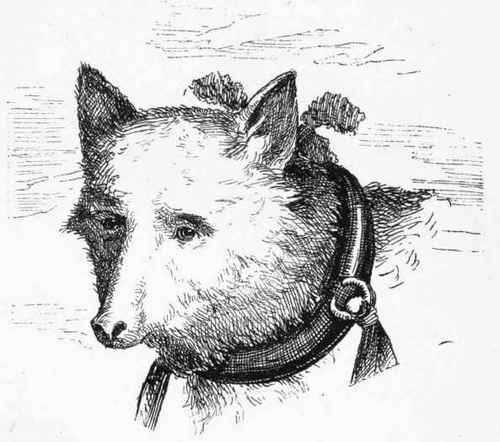
THE TIMBER WOLF DOG.
Mr. Neison's remarks cannot fail to be of interest to those who take delight in the varieties our great shows now bring together, and among which are so often found specimens of Esquimaux type.
The first that Mr. Neison, who was writing of sleigh dogs, noticed was a cross with the Newfoundland; of those of decidedly Esquimaux character; he says, "The next is the most common breed of sleigh dog, and isbetter known as the plain • Husky' dog, of which there are two distinct varieties. It is quite evident that they are of the same stock, if not descendants of tamed specimens of the large timber or Arctic wolf, and of prairie wolf or Toganee. The other dog is the Hoosque of the Mackenzie river district, and is the dog used by the American Esquimaux, and of these there is a yellow and a black variety.
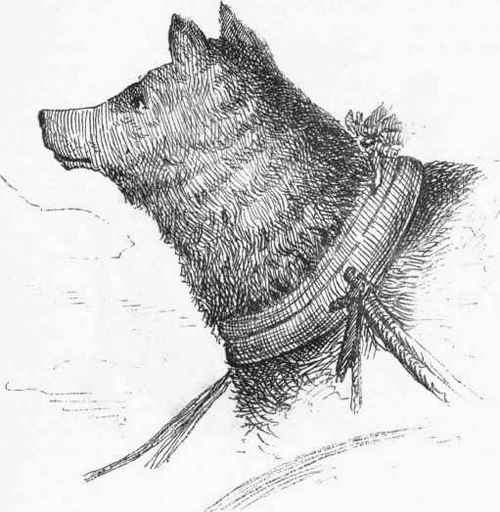
THE TOGANEE DOG.
"Of course these breeds are found more or less mixed all over the continent, especially varieties of the wolf breed, as these are by far the most numerous.
"1 have observed them crossed until almost lost in the Newfoundland, and I am told on the best authority it is the same in Labrador.
"The dog is only found pure to my knowledge in Abbitibbe, and on the Peace river.
"The Toganee and Arctic wolf dog are both much the same in general appearance. Their colour is stone grey, the build large and bony, with very large feet; they have sharp noses and prick ears. When crossed with others they always have a blotched appearance from the peculiar dark markings which they then take. The hair is long and wiry, and falls against the body. The Arctic is a very large dog indeed, his usual size being fully equal to the largest dogs I have seen in England; the Toganee is never larger than a spaniel, and is often smaller. This is the common so-called 'Husky' dog of Manitoba. North of the Saskatchewan and east of Lake Winnipeg it dissappears, and the Arctic takes its place - a peculiarity common to the two breeds of wolf, the prairie wolf being unknown in these regions. The true "Husky" dogs are, I believe, peculiar to the American Esquimaux. The dog of the Greenland Esquimaux, as obtained at Disco, being, I believe, a distinct breed. These I consider the best sleigh dogs known, especially the black variety of Hoosque. They are also found in all shades of yellow, sometimes almost white. Out of a good many hundred I have not seen a single specimen marked with either white or brown patches.
When skinned it is at once noticed that the skull is unusually flat; this peculiarity is hidden in the live animal by its hair. It has a heavy jaw, very small round ears, which are always erect, and the hair, which is long, hard, and wiry, invariably stands erect off the skin, very similar to that of a black bear, to which the whole dog bears a very close resemblance when lying down. All of this breed are fierce, treacherous, and active. A man would be considered a fool who attempted to harness them without his whip, and that whip must have some little bells, thimbles, or pieces of tin attached, so as to constantly jingle. Approaching the dog, the driver throws the lash, which is about 10ft. long, round the dog's neck, twists it until it almost chokes him, and then drags him to his collar by main strength, grasps his head between his thighs, and then slips the collar, which is very tight, over the head. From that instant the dog is quiet and submissive enough. The whips used are of plaited caribou hide, with from 2oz. to 8oz. of small shot woven into them to give them weight. Besides this, with most trains, it is necessary to carry chains to fasten the dogs at night, and, if travelling on ice, also a spear to picket them to.
Mr. Ouyon, of Fort Chippewyan, on Lake Athabasea, has some splendid dogs of this breed. This post has the reputation of having the finest dogs in the North.
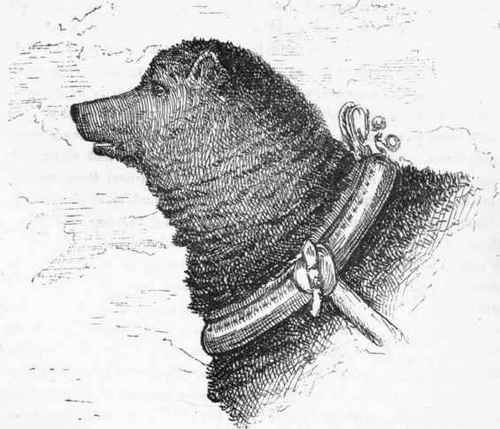
THE BLACK HOOSQUE DOG.
"A peculiarity in these dogs is that they all have bright, clear, yellow eyes, similar to a cat, with great powers of dilating the pupils."
The illustrations are facsimiles of some rough sketches which accom -panied Mr. Neison's letter.
Although we have had dogs exhibited under the distinctive names of the North American wolf dog and sleigh dogs, I have not seen any to warrant a separate description, and have, therefore dealt with them as Esquimaux dogs, of which they are varieties.
Continue to:


My Books

