


The Fox Terrier. Part 3
Description
This section is from the book "British Dogs: Their Varieties, History, Characteristics, Breeding, Management, And Exhibition", by Hugh Dalziel. Also available from Amazon: British Dogs.
The Fox Terrier. Part 3
I would much sooner breed from a dog with an unauthenticated pedigree that gets good stock, and is also the grandsire of good ones, than from such animals as Diver, Draco, Brick, Bitters, or Trimmer. Diver was by a bull terrier; Draco was, I have heard, by a carriage dog; Brick was nearly related to a beagle: Bitters' dam has no pedigree, and he has got no good stock; and Trimmer's sire (Rap) was undershot, and his dam had prick ears. Some of my readers will no doubt say, there are the champions Buffet and Nimrod, and their sire Buffer. Buffet must have had a lot of chances, and has got nothing worthy of notice, with the exception of the second prize dog at Nottingham, and he had the same fault as most of the Buffer breed, viz., heavy ears hung helplessly down by the side of the head; and I think that, with hardly an exception, the two worst dogs at Nottingham were by Nimrod; they had ears that would have suited a foxhound, and they were out of different bitches. Buffer, although he has got two exceedingly good ones, is the sire of some of the worst I ever saw - one, own brother to Speculation, weighs about 301b., and has immense ears.
I will now give my opinion as to how a first-class fox terrier should be made. The head should be of fair length, not too long, but in proportion to the size of the dog. The jaw should be muscular, and the muzzle not too fine; and, of course, the nose should be black. The ears small, not very thin, and dropping forward, so as to keep out the dirt. The eye must be small, rather sunken, and dark, a prominent eye being objectionable, as showing bull. The neck should be of fair length, lean, and muscular; the shoulders long, fine, and sloping; and the chest deep and rather narrow; the back short and strong; and the loin slightly arched and full of muscle. A very important part is the legs. The fore legs must be straight and strong in bone, and the feet small, round, and arched, with a good thick sole. This is of much importance, as a dog with a thin sole soon gets footsore. The thighs, of course, muscular, and the hocks straight and well let down. The tail should be strong, and set on rather high; and the coat hard and abundant, but close and smooth. The carriage of a good terrier should be gay and lively, and the expression of the face intelligent and good tempered.
There is one thing I want particularly to impress on readers, and that is, that a fox terrier should in no way resemble "a brick with the corners knocked off," or "a shorthorn," a simile that has frequently been used by more than one writer on fox terriers. Could anyone imagine an animal whose formation is less adapted for speed and endurance than a shorthorn, unless a brick could be endowed with life? If a fox terrier's build has been likened to a foxhound or good hunter, I would have agreed; but a shorthorn or brick, never!
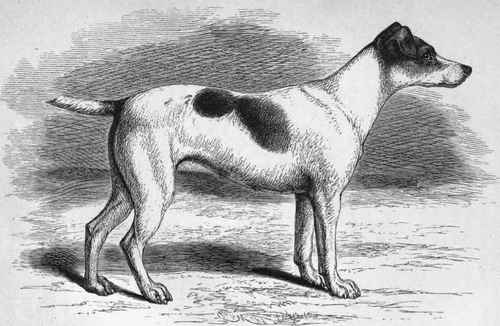
MR. E. M. SOUTHWELL'S FOX TERRIER "SANS PEUR." Sire Scamp, by Turk (K.C.S.B. 610) out of Old Dame - Dam Lotes, by Old Jock (K.C.S.B. 558) out of Venom.
The standard recommended by the Fox Terrier Club is as follows:-
"1. Head: The skull should be flat and moderately narrow; broader between the ears, and gradually decreasing in width to the eyes. Not much " stop" should be apparent; but there should be more dip in the profile, between the forehead and top jaw, than is seen in the case of a greyhound. The ears should be V-shaped, and rather small; of moderate thickness, and dropping forward closely to the cheek, not hanging by the side of the head, like a foxhound's. The jaw should be strong and muscular, but not too full in the cheek; should be of fair punishing length, but not so as in any way to resemble the greyhound or modern English terrier. There should not be much falling away below the eyes; this part of the head should, however, be moderately chiselled out, so as not to go down in a straight slope like a wedge. The nose, towards which the muzzle must slightly taper, should be black. The eyes should be dark rimmed, small, and rather deep set; full of fire and life. The teeth should be level and strong.
"2. The neck should be clean and muscular, without throatiness, of fair length, and gradually widening to the shoulders.
"3. The shoulders should be fine at the points, long, and sloping. The chest deep, and not broad.
"4. The back should be short, straight, and strong, with no appearance of slackness behind the shoulders; the loin broad, powerful, and very slightly arched. The dog should be well ribbed up with deep back ribs, and should not be flat-sided.
"5. The hind-quarters should be strong and muscular, quite free from droop or crouch; the thighs long and powerful; hocks near the ground, the dog standing well up on them, like a foxhound, without much bend in the stifles.
"6. The stern should be set on rather high, and carried gaily; but not over the back, or curled. It should be of good strength, anything approaching a pipe-stopper tail being especially objection-able.
"7. The legs, viewed in any direction, must be straight, showing little or no appearance of ankle in front. They should be large in bone throughout, the elbows working freely just clear of the side. Both fore and hind legs should be carried straight forward in travelling, the stifles not turning outwards. The feet should be round, compact, and not too large; the toes moderately arched, and turned neither in nor out. There should be no dew claws behind.
"8. The coat should be smooth, but hard, dense, and abundant.
"9. Colour: White should predominate. Brindle, red, or liver markings are objectionable. Otherwise this point is of little or no importance.
"10. Symmetry, size, and character: The dog must present a generally gay, lively, and active appearance. Bone and strength in a small compass are essentials; but this must not be taken to mean that a fox terrier should be cloggy or in any way coarse. Speed and endurance must be looked to as well as power, and the symmetry of the foxhound taken as a model. The terrier, like the hound, must on no account be leggy; neither must he be too short in the leg. He should stand like a cleverly-made hunter - covering a lot of ground, yet with a short back, as before stated. He will thus attain the highest degree of propelling power, together with the greatest length of stride that is compatible with the length of his body. Weight is not a certain criterion of a terrier's fitness for his work. General shape, size, and contour are the main points; and if a dog can gallop and stay, and follow his fox, it matters little what his weight is to a pound or so, though, roughly speaking, it may be said he should not scale over 201b. in show condition.
"Wire-haired Fox Terriers. - This variety of the breed should resemble the smooth sort in every respect, except the coat, which should be broken. The harder and more wiry the texture of the coat is, the better; on no account should the dog look or feel woolly, and there should be no silky hair about the poll or elsewhere.
"The coat should not be too long, so as to give the dog a shaggy appearance, but at the same time it should show a marked and distinct difference all over from the smooth species.
"Points. - Head and ears, 15; neck, 5; shoulders and chest, 15; back and loin, 10; hind quarters, 5; stern, 5; legs and feet, 20; coat, 10; symmetry and character, 15. - Total, 100.
"Disqualifying Points. - 1. Nose, white, cherry, or spotted to a considerable extent with either of these colours.
"2. Ears, prick, tulip, or rose.
"3. Mouth, much undershot.
"(Signed) W. Allison, Sec."
Continue to:


My Books

