


The Skye Terrier. Part 3
Description
This section is from the book "British Dogs: Their Varieties, History, Characteristics, Breeding, Management, And Exhibition", by Hugh Dalziel. Also available from Amazon: British Dogs.
The Skye Terrier. Part 3
"Tail. Short, and rather bushy, about 9in. long (hair inclusive), and the nearer straight in carriage the better it looks. A long ' whiphandle ' style of tail does not belong to the breed.
"Height. From 8in. to 9in. at shoulder, and should not be lower behind.
"Coat. Should, on the body, be dense, and the outer (or longer hair) of a decidedly wiry texture, that underneath being much finer in quality.
"In different strains the length of coat varies, but the pure-bred Skye terrier never shows (within 5in. to 6in.) the extraordinary length of hair on the back of some show dogs, nor can such unusual length of coat be ascribed to any cause apart from cross breeding, to attain the distinction.
" Dogs bred in the recognised best kennels in the Isle of Skye exhibit hair on them measuring, say, about 3in., although apparently not above half the length here indicated. While the strains most popular in the 'Argyle Country,' bred for so many years at Inverary Castle, as well as in the Isle of Mull, and more recently at Roseneath, are generally longer coated, perhaps to the extent of about 2in., a circumstance which can be easily explained, without reference to 'differences of temperature ' in the localities named. In short, it may fairly be ascribed to the fact of systematic breeding by selection, for moderately rough-coated terriers, being pursued in Argyleshire.
"Colour. A matter of taste. In the Isle of Skye dark-grey is the general colour of the breed, but there are also some very light-coloured specimens, and others nearly black; while the Skyes in Argyleshire are chiefly reddish-yellow, with some darker hairs intermixed, If the dog is of any light colour, a dark muzzle, with tips of ears and tail also dark, should be considered a strong recommendation, as lending to the dog a distinguished appearance. White on feet, breast, or any other part of the dog should be regarded as a blemish.
"Weight. Males from 121b. to 161b., females ranging about 31b. less.
"Value of Skye terrier points: "Head (number indicating relative value), 15; jaws and teeth, 10; eyes, 5; ears, 5; body and neck, 25; legs and feet, 15; tail (carriage of), 5; coat (texture of) and colour, 10; symmetry, 10."
Here follow the signatures of twenty-two persons.
Mr. J. Gordon Murray's contribution to our knowledge of the subject, which I now propose to give, at least does credit to his industry and his patriotism. Unfortunately his is not a judicial mind, the clan spirit crops out, and shows the bias. In his advocacy of what he calls the "very real and pure Skye terrier," he reminds me of the anecdote of the two Scottish dames who were discussing the prospects of our arms on the eve of a great battle, when one wound up with the pious exclamation that she " hoped Providence would be on the side of those who were right," when the other, showing the true national spirit, indignantly exclaimed, "Houts, woman! let Providence be on our folks' side, whether they're right or wrang."
There is no praise too ridiculously fulsome, and no expression of opinion too absurd in favour of his "very real and pure," which he hesitates to entertain, or, at least, express.
The comparison of the dog with a retriever in his work, and the statement that a dog 7in. to 9in. high at the shoulder could retrieve any "quadruped" bigger than "rats and mice and such small deer" is an injustice offered by Mr. J. G. Murray the partisan to J. G. Murray the sportsman, which the latter does not deserve. Mr. Murray's partisanship also carries him aside from facts which should be known to him as a frequent visitor at London and other large shows. He insinuates that the winning dogs at such shows have coats soft in texture; he says that their heads are round and apple shaped, and the tail carried "a la pug," whilst they have "almost no legs, and a caterpillar body" - that is, an excessively lengthy body. Every one of these statements are untrne of the principal winners at our best shows, for, although long in coat, it is hard and coarse in texture, the carriage of the tail is low, and the proportions of length of body to height at shoulder practically the same as he and his friends of the "manifesto " lay down as correct - that is, the length rather more than three times the height - their ideal of perfection being 3 1/3 to 1. I have not measured either Mr. Bead's Roseneath dog Garelock, or Mr. Murray's Otter, but the illustrations* certainly give one the impression that they are each of them very much shorter in length than the written standard put forward by their admirers require, and, having seen Otter in the flesh, that impression of him is strong with me.
In appearance, Otter has nothing but his decidedly "varmint" look to recommend him; he is decidedly ugly, and to ask fanciers of dogs and lovers of the beautiful in these animals to give up the charming Skye terriers, brought to their present perfection by careful and judicious breeding, and take in their place such a dog as Otter, or even Garelock, I can only consider one of those ponderous things known as a "Scotch joke." It is very easy to understand that a hardy rough terrier, with a shortish wire coat, and something of the sort Mr. Murray describes, would be kept for vermin hunting, and, as at one time was the case with other breeds, their quality as workers considered almost entirely, and the beauty of appearance almost ignored, but it has been proved in Skye terriers, as in other breeds, that a beautiful exterior is quite consistent with good working qualities, and has, in fact, been produced without loss of hardihood, pluck, and endurance. That some of the prize Skyes are capital workers, as also some of those bred from prize winners, I can testify from experience of them, and when put to work the excessive length of coat would not be long in the way.
To ask us, however, to change the coat of dogs principally kept for their beauty, one of the great charms of the modern Skye, for the short harsh uncultivated one, such as covers Otter, would be equivalent to ask the descendants of Highland gentlemen settled in the south to give up all the advantages of modern civilisation and culture and betake themselves to the garb of a Dunniewassal of the last century; but all this is giving Mr. Murray the benefit of his assertion, that a short coat is the correct thing and the original, which I do not grant.
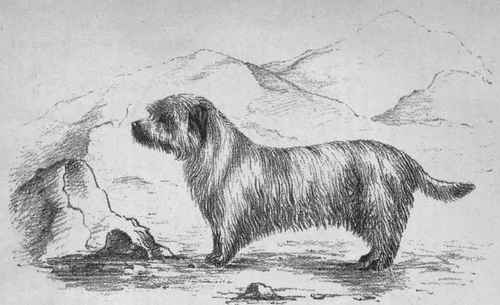
MR. R. READ'S SKYE TERRIER "ROSENEATH."
Sire Mr. Dodd's Foxy II, by Clark's Punch II. out of clark's Spunky-Da,,, Clarks Whity I. by Marquis of Lorne's Ossian II, ex Jessie.
* The illustration of Garelock is a fac-simile, by a patent process, of a drawing by Mr. Barron.
Continue to:


My Books

