


Anthrax Of The Horse
Description
This section is from the book "The Horse - Its Treatment In Health And Disease", by J. Wortley Axe. Also available from Amazon: The Horse. Its Treatment In Health And Disease.
Anthrax Of The Horse
The disease which is recognized as true anthrax is due to the existence in the body of a specific organism, the Bacillus anthracis (fig. 218), a motionless rod which is found in the blood and in all the tissues of the body into which blood can penetrate. The organism belongs to the class of aerobic bacteria, that is, living only in air. Without the presence of oxygen the anthrax bacillus very quickly dies. Anthrax bacilli are readily cultivated in bouillon or gelatine. In the animal body the organism multiplies by the formation of spores, and the almost invariable fatality which results from the introduction of the microbe is due to the formation of a poison during the development of the organism. Anthrax is much more prevalent among cattle and sheep than among horses, and when the latter are infected it is usually in consequence of a previous outbreak of the disease among other stock on the farm. Cases which have occurred recently, however, leave no doubt that the horse may be infected with the disease in its own stable, through the agency of contaminated provender, hay, or oats; the latter particularly have been proved in several instances to be highly infective to the horses which consume them.
Symptoms
Anthrax in all animals runs its course to a fatal termination with remarkable rapidity, and there is often nothing in the indications to excite suspicion of the nature of the disease. There are the ordinary signs of fever, rise of internal temperature, quick pulse, and increased respiration. The animals stagger when attempting to walk, and sometimes suffer from colic. The most characteristic symptom is swelling of the throat, extending downwards towards the chest; finally there is profuse perspiration, which is followed by death usually within thirty hours from the time of the attack. In most cases a fatal result is the first indication of the existence of the disease. An animal which has been left in apparent health is found dead an hour or two afterwards.
The post-mortem appearance indicates general congestion of the internal organs, with effusion of blood into the tissues and cavities of the body and also under the skin.
Treatment
Owing to the rapid progress of the disease, curative treatment is never attempted in cases which are diagnosed as anthrax, but it may be remarked that the diagnosis is extremely difficult, even when the disease is suspected to be anthrax, from the fact that the organism is not detectable in the blood until shortly before death, and it is only found in abundance after death, as seen in fig. 218, B.
Prevention will include an enquiry into the circumstances which have led to the introduction of the disease, and with this view it will be necessary to examine the articles of food by the aid of the microscope, and also by use of cultivative media on which the organism is known to grow. The final test of the inoculation of guinea-pigs or rabbits with the water in which the suspected provender has been soaked will probably be necessary.
In cases of the outbreak of anthrax among horses kept in stables it will be safe to conclude that the organism had been introduced into the blood by contaminated provender, water, or litter, but when horses are attacked while on a pasture it is very likely that an enquiry will prove that the ground has been contaminated with the infective material conveyed in refuse from manufactories, or from a previous outbreak of the disease among cattle or sheep. In any case the immediate removal of horses from the place where the disease originated is an obvious precaution which should be at once adopted.
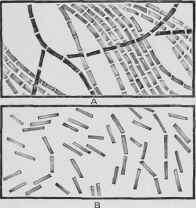
Fig. 218. - Bacillus anthracis A, Bacilli in chains. B, Bacilli disconnected.

HORSE-POX, TUBERCULOSIS, AND ENDOCARDITIS.
1. Natural Horse-pox simulating Glanders 2.Natural Horse-pox simulating Aphthous Stomatitis. 3. Tuberculosis: Section of Affected Lung; aa, newly-formed tubercles; BB, tubercles undergoing caseous degeneration; CC, divided bloodvessels. 4. Endocarditis (valvular disease).
Anthrax is easily communicated to man by accidental inoculation during post-mortem examination or while cutting up carcasses of animals dead of the disease. It is on this account particularly desirable to note that for the purpose of diagnosis a portion of the ear may be cut off and the blood which flows from the cut surface may be used for microscopic examination, cultivation of the organism on artificial media, or for test inoculation, without any serious risk to the operator.
Carcasses of animals which have died of anthrax should be burned or buried uncut and covered with quick-lime. The anthrax bacillus, when cut off in this way from contact with air, very quickly becomes inert.
Continue to:


My Books

