


Osteo-Porosis - Big Head
Description
This section is from the book "The Horse - Its Treatment In Health And Disease", by J. Wortley Axe. Also available from Amazon: The Horse. Its Treatment In Health And Disease.
Osteo-Porosis - Big Head
By this term is understood a swollen, soft, and porous state of the bones. It is a constitutional disease usually involving the entire skeleton, but manifesting itself with much greater severity in some parts than in others. This is especially the case with regard to the head, from which circumstance it has received the common appellation of "big head ".
Not only is this difference observed in different regions of the skeleton, but likewise in different parts of particular bones. In the long bones of the legs, for example, it becomes much more pronounced at the extremities where they unite to form joints, and where, as in the bones of the face, the osseous tissue is naturally of a loose, spongy character (cancellated).
Osteo - porosis is essentially a chronic and slowly progressive disease affecting all classes of horses, both male and female, and at all periods of life, but young animals seem to be more predisposed to it than those advanced in years.
It has not been found to exist to any considerable extent in Great Britain, but in America, India, and Africa it is of more frequent occurrence.
Origin
Although much has been written both in this country and on the Continent with regard to its origin, the writer is compelled to admit that practically nothing is known as to the causes which give rise to it. Captain Hayes, who refers to numerous cases as coming within his experience in Africa and India, believes that "feeding on unnutritious grasses is one of the chief causes of the malady". This statement, however, receives no support from experience in this country, where the cases hitherto recorded have been stabled animals receiving a liberal supply of good food. By others it has been attributed to damp and insanitary stables, and Professor Varnell saw reason to regard it in one instance as in some way connected with a too exclusive bran diet, and deficiency of lime in the food. It is quite clear that the precise nature and conditions of the origin of the disease still remain to be determined.
Symptoms
The first noticeable indications of the affection are slight stiffness and subsequent lameness in one or more of the limbs, with tenderness over the region of the joints, which sooner or later become enlarged.
The disease may attack all the limbs more or less severely at once, or in succession at varying intervals of one to three weeks. At the same time the head and face attract attention by the gradual obliteration of their sharp angles, and the steady increase in size of the head as a whole. At this time there is no perceptible constitutional disturbance. The animals feed and rest and keep their condition. The swelling of the joints may to some extent subside, only, however, to return again and add to the permanent enlargement.
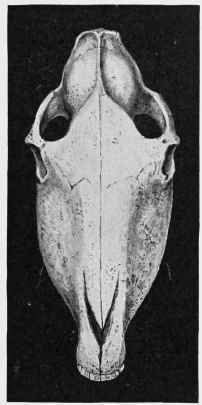
Fig. 321. - Osteo-porosis.
Bones of the face enlarged, thickened, and rendered soft and spongy.
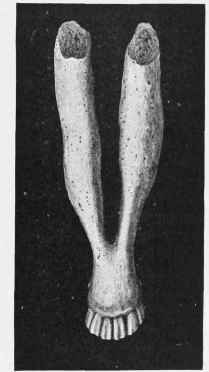
Fig. 322. - Osteo-porosis Lower Jaw affected by the disease.
As the disease progresses the bones continue to increase in size and at the same time to become spongy and soft, so much so in some parts as to yield to the pressure of the fingers from without. When in this condition the animal has difficulty in rising, and the ligaments of the joints soon fail to resist the weight imposed upon them, and break from their connections with the soft and yielding bones.
In the early stages of the disorder the turning movements are noticeably stiff, and pressure, if applied to the spine, causes pain and shrinking. The head continues to increase in size and to present an unsightly appearance. The lower jaw becomes thick and rounded, and as the bones of the face enlarge, the teeth become loose in their sockets and more or less displaced. At this time mastication is imperfectly performed, nutrition is impaired, and symptoms of constitutional derangement appear and continue to become more and more severe to the end. In fatal cases the duration of the disease extends from two to eight months or longer.
Treatment
Osteo-porosis is usually fatal. It is worthy of note, however, that a case given up to the writer was returned cured after undergoing three courses of iodide of potassium and nux vomica at intervals of three or four weeks.
Continue to:


My Books

