


Stomatitis Pustulosa Contagiosa
Description
This section is from the book "The Horse - Its Treatment In Health And Disease", by J. Wortley Axe. Also available from Amazon: The Horse. Its Treatment In Health And Disease.
Stomatitis Pustulosa Contagiosa
This is a specific contagious disease of a febrile character, in which an eruption appears in the mouth and on the lips, and sometimes on the skin of the face, rarely on other parts of the body. It is communicable from horse to horse, either by inoculation or by contact of the virus with the mucous membrane of the mouth. It has a period of incubation from one to three days, and runs its course in from ten to twelve days.
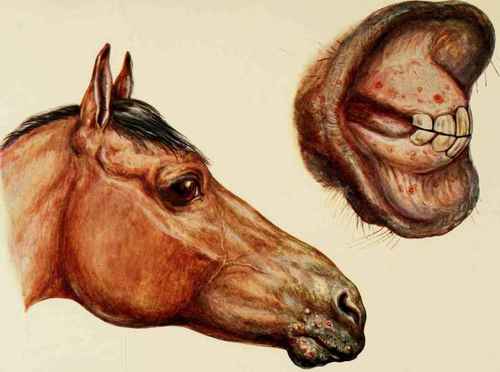
STOMATITIS PUSTULOSUM.
Foals and young horses are most susceptible to infection, and old ones least so.
The spread of infection usually takes place by means of food and water, and by the use of infected mangers, troughs, pails, and other stable utensils.
It is seldom fatal, but on gaining access to a stable of young horses it spreads rapidly through them unless prompt measures of precaution are taken for its suppression.
One attack of the disease is protective against another for some time, bub for what period is not known.
Symptoms
Save in exceptional cases there is not much constitutional disturbance. A slight rise of temperature, a little increase in the number of pulsations, are the only signs of general disorder.
Twenty-four to forty-eight hours after infection, soreness of the mouth is evinced by the discharge of sticky saliva in the act of feeding, and more or less difficulty of mastication. The mucous membrane of the mouth is at this time of a bright red colour, and here and there small pimples are seen on the inner surface of the lips, or beneath the tongue or the gums, or maybe on the skin of the lips, or on all these parts in succession. Each pimple becomes charged with matter, and is quickly resolved into a round superficial ulcer with a sharp thin edge, and showing little or no tendency to spread. The eruption may be considerable and closely packed, or it may consist only of a few scattered sores. In some instances the gland beneath the jaw (submaxillary lymphatic gland) is enlarged, and the eruption may appear in the nostrils, giving rise to a discharge, when the disease is sometimes mistaken for glanders.
With the soreness of the mouth there may or may not be difficulty of swallowing. About the sixth day the sores begin to heal, while others of more recent eruption will still be in the nodular form or in the early stage of ulceration.
The features which distinguish this disease from glanders, with which it may be confounded, are: (l) the short period of incubation; (2) the rapidity of its spread; (3) the superficial, sharply-defined, thin-edged ulcer; (4) the great rapidity with which the sores heal; (5) the absence of any inflammation of the lymphatic vessels; (6) the sudden onset and the short duration of the nasal discharge.
Treatment
The disease usually runs a benign course, and requires but little interference on the part of the attendant. The mouth may be washed out two or three times a day with a solution of chlorate of potash, or a weak solution of alum, but beyond this no local applications are needed. General treatment will not go beyond the administration of a little nitrate of potash in the food once a day.
The diet should consist of bran, boiled roots, and scalded chaff, over which a little common salt may be sprinkled.
Continue to:


My Books

