


Tetanus Of The Horse
Description
This section is from the book "The Horse - Its Treatment In Health And Disease", by J. Wortley Axe. Also available from Amazon: The Horse. Its Treatment In Health And Disease.
Tetanus Of The Horse
Tetanus occupies a somewhat dubious position in the classification of diseases. Formerly it was looked upon as a tonic spasm of the voluntary muscles, resulting from irritation affecting the nerves from an unhealthy wound. The affection was divided into traumatic tetanus, when it was traced to an injury or wound, and idiopathic, when it occurred independently of any external wound.
It is somewhat remarkable that the older writers insist very strongly upon the influence of various common causes in the production of this disease. Thus Delatere Blaine, writing in the early part of the present century, refers to tetanus or locked-jaw as a morbid irritation of part or the whole of the nervous system, originating in the brain itself, or ultimately reaching it, according as it is idiopathic or symptomatic. Idiopathic tetanus, he remarks, is most frequent in the horse, and its causes are, some of them, evident, others, occult.
In the list of ordinary causes to which he attributes the disease is cold, especially when the body is heated, as in the case of a plunge into a river during a hunting run, or a horse standing still during a check after a severe burst, or the constant dripping of water on to the body from a defective roof of a stable; also the presence of worms in the alimentary canal, especially botts in the stomach. Traumatic or symptomatic tetanus he traces to various external injuries, contusions, lacerations, and wounds made in surgical operations. Wounds of tendinous and ligamentous parts have always been considered to be particularly dangerous.
Even twenty years ago tetanus is described as a disease, the general pathology of which is very little known, and writers referred it to an exalted polarity of the nerve-centres, or to a bad condition of the blood, or the effects of cold acting on the sensitive nerves.
The views above stated, with certain modifications, obtained until Nicolaier, in 1884, discovered that inoculation of mice, rabbits, and guinea-pigs with portions of soils, obtained from streets and from fields, produced symptoms which were considered to be tetanic in their character. In the abscess which was formed at the point of inoculation several microorganisms were found, and one of them produced similar tetanic symptoms when inoculated into other animals.
Some considerable time elapsed before what is now known as the tetanus bacillus was obtained in the state of pure cultivation, owing to the fact that the microbe was anaerobic, and consequently would not grow in the air. Pure oxygen, it is said, destroys it completely. The bacillus occurs in the form of small motile rods with the spore at one end, giving to the organism the appearance of a minute drum-stick, and it grows readily on the usual media when kept in an atmosphere of hydrogen. Dr. Sims Woodhead, in his work on Bacteria and their Product, remarks, in reference to the universal distribution of the bacillus, that M. Bos-sano obtained soil from forty-three different regions in various parts of the globe, and produced tetanus in white mice and guinea-pigs with twenty-seven out of the forty-three specimens, and from his experiment Bossano concluded that soils which contain much organic matter almost invariably contain tetanus bacilli.
The information which has been obtained of late years proves that tetanus is one of the pure contagia, and is due to the introduction of the specific microbe into the animal system through a wound in some part of the exterior of the body. Whether or not it is possible that the disease may arise from the introduction of contaminated soil into a wound in any part of the alimentary canal it is impossible to determine. There do not, however, appear to be any facts which would militate against this assumption, and infection occurring in this way - that is, through the agency of a wound in the interior of the body - would naturally give rise to the idea that the disease was idiopathic in its origin. There can be no doubt, however, that the majority of cases are due to the infliction of a wound on the exterior of the body, especially in such a position that the injured part is likely to come frequently in contact with the earth.
It appears that on entering the wound the bacillus of tetanus locates itself in the damaged tissues, and is not distributed throughout the body The poison, however, which it produces in the wound during its growth will be readily absorbed and carried to the nerve centres, inducing the irri tation which results in the tetanic spasm of the muscles.
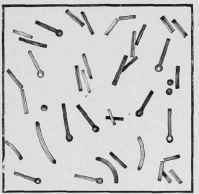
Fig. 219 - Bacillus tetani.
Tetanus does not spread from one horse to another by contagion or infection, but it can be transmitted by inoculation with the pus, or by a portion of the damaged structure of a wound, and there is a certain amount of risk incurred by the persons who dress such wounds if they happen to have any abrasions of the skin of the hands.
It is usual to classify the disease according to the part of the body which is most affected, and in accordance also with the rapidity of its progress. Thus there is acute and chronic tetanus. The terms which are sometimes in use - rheumatismal tetanus as the result of cold, and toxic tetanus due to poisoning by strychnine - do not properly come under consideration in connection with the true contagious disease. When the tetanic spasm affects the muscles of the head and neck the condition is described as trismus. When the spasm affects the muscles of the back, and pulls the head backwards, the term opisthotonos is applied; in the opposite condition the word emprosthotonos was used to indicate the bending of the body forward, and in cases where the spasm affected one side of the body, causing it to curve to that side, the condition was defined as pleurosthotonos. All these states are recognized in different phases of the disease in the human subject, but they are rarely met with in the horse, with the single exception of the first, described as trismus, which is the most common form.

Fig. 220. - Tetanus.
Continue to:


My Books

