


Examination Of The Head
Description
This section is from the book "The Horse - Its Treatment In Health And Disease", by J. Wortley Axe. Also available from Amazon: The Horse. Its Treatment In Health And Disease.
Examination Of The Head
Carrying the eye down the face, the examiner should look for enlargements in the region of the jaws from disordered teeth and other causes.
The nostrils should then be dilated with the finger and thumb as shown in fig. 598, and the interior examined as far as the eye can see. The natural colour of the lining membrane is of a uniformly pale-pink hue, which in certain diseases becomes seriously changed. In glanders the membrane assumes a bluish, or dark slatey hue, and may present-one or more red elevated pimples, or ulcers, or, where the latter have healed, white irregular scars. Thickening of the membrane from other causes, or polypi, may also exist here and interfere with the entrance of air into the lungs. Disease of the nostril is usually associated with more or less enlargement of the lymphatic gland (submaxillary), situated on the inner side of the lower jaw (fig. 77, Vol. I), which is readily accessible to the fingers, and should always be examined. Any discharge from the nostril should be regarded with suspicion, and if resulting from a cold, or some abiding cause, or if associated with tumefaction of the gland referred to above, would constitute unsoundness.
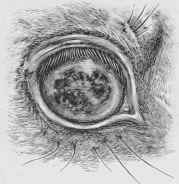
Fig, 597. - Cloudy Cataract.
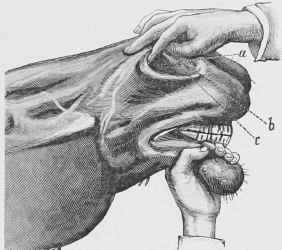
Fig. 598. - Examination of the Nostril a, True Nostril. 6, False Nostril, c, Nasal Duct.
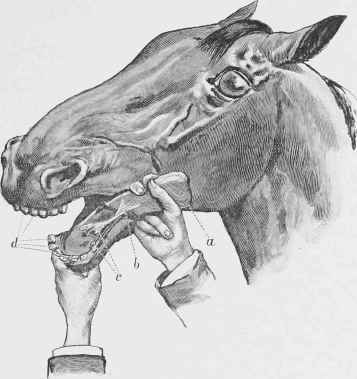
Fig. 599. - Examination of the Mouth a, Tongue; b, froenum; c c, openings of the salivary ducts; d, teeth.
To avoid error it may be necessary to point out that on the floor of the nostril, a little way within it, and at the line where the skin joins the mucous membrane, a small round hole appears. This is a natural formation - the outlet of a duct, by which any excess of tears is conveyed from the eye (c, fig. 598). We call attention to it because it has sometimes been regarded as an ulcer.
Before leaving the facial region, the examiner should open the mouth widely as shown in fig. 599. This affords an opportunity to decide upon: 1, the age; 2, as to whether the teeth show any excess or deficiency in number; 3, any irregularity in their growth, distribution, or direction; 4, any disease. A horse whose teeth are so situated, or directed, or exist in such number or condition as to interfere with his feeding, is unsound.
The tongue should be free from disease, and the lower jaw, between the tush and the grinders, needs careful attention, as here serious damage is sometimes done with the bit, causing abscess and sloughing of a portion of the bone, a state of things which unfits the horse for work and renders him unsound.
The hand should now be passed along the sides and under part of the throat, over the poll and the withers. The glands of the throat may show enlargement left as the result of cold, influenza, or strangles. The poll, or the withers, may be enlarged and tender from a forming abscess, or from a declining fistula.
It sometimes occurs that the jugular vein becomes blocked as the result of injury inflicted upon it by bleeding. If pressure is made upon the vessel in the middle of the neck groove, and the flow of blood from the head be interrupted, the vein in a normal state will become filled out and distended, but if obliterated, or spoilt, will undergo no change above the seat of pressure.
Continue to:


My Books

