


Fossil Ancestors Of The Horse. Continued
Description
This section is from the book "The Horse - Its Treatment In Health And Disease", by J. Wortley Axe. Also available from Amazon: The Horse. Its Treatment In Health And Disease.
Fossil Ancestors Of The Horse. Continued

Fig. 667. - Upper Molars of Fossil Ancestors of the Horse.
a, Hyracotherium; b, Mesohippus; c, Anchitherium; d, Protohippus; e, Hipparion; f, Horse - 1, dentine; '_', enamel; 3, crusta petrosa.
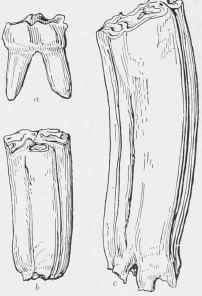
Fig. 668. - Short- and Long-crowned Molar Teeth.
a, Anchitherium; b, Hipparion; c, Horse.
The Protorohippus has a well-developed ulna, a well-developed fibula, and short-crowned grinders of simple pattern.
Comparing its skeleton (Plate LXX) with that of the horse, we see that there is a general correspondence in grace and delicacy of outline in the two animals.
The next drawings (fig. 3, Plate LXXI) represent the fore- and hind-feet of the Mesohippus, from the Lower Miocene immediately succeeding the Eocene in which the Protorohippus was found. In comparing this set of figures with those last described, it will be seen that only three prominent digits remain in both the fore- and hind-feet, the fifth digit being reduced to a very slender rudiment. In this animal the ulna (fig. 669) is well developed, but the fibula has become quite rudimentary; the forms of the molar teeth have not undergone very considerable change.
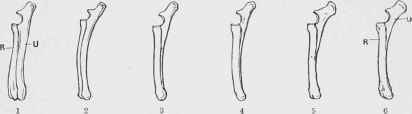
Fig. 669. - Radius (r) and Ulna (U) of Fossil Ancestors of the Horse, showing the gradual diminution in relative size of the ulna (not to scale). 1, Phenocodus; 2, Protorohippus; 3, Mesohippus; 4, Miohippus (Anchitherium); 5, Protohippus; 6, Horse.
In the Miohippus, the contemporary of the Anchitherium of Europe, the extremities remain nearly as in the Mesohippus. The ulna has the lower part greatly reduced; the other limb-bones remain nearly the same.
To the Miocene period also belongs the Merychippus, found throughout a large portion of North America, which is remarkable in that in the young condition it has the short-crowned, uncemented teeth of its ancestors, while the adult animal has the long-crowned and cemented teeth of its successors.
Proceeding upwards to the Protohippus and its near relative the European Hipparion from the Lower Pliocene, it appears that the changes chiefly relate to the ulna, which in these animals has decreased considerably in length, only reaching to the middle of the radius. The two extra toes in the fore- and hind-feet still remain, but they are evidently shrinking in size. The changes in the molar teeth are also very considerable. As will be seen on reference to fig. 668, the teeth are passing from the brachydont or short-crowned to the hypsodont or high-crowned variety, a change which goes on progressively in correspondence with the vanishing of the extra digits. In the upper molars of the Hipparion there is a distinctive feature which is at once recognized by the anatomist, in the presence of an interior column of dentine completely isolated from the rest of the mass, as shown in the section of the upper molar (e, fig. 667) close to the bottom, in the form of a white oval spot surrounded by a double line.

PLATE LXXI. COMPARISON OF THE FORE AND HIND FEET OF THE HORSE WITH THOSE OF SOME OF ITS ANCESTORS.
1. Phenacodus. 2. Protorohippus. 3. Mesohippus. 4. Miohippus and Anchitherium. 5 Protohippus. 6. Hipparion.
7. Horse. (All these figures are drawn to one scale).
There can be no doubt that the Hipparion was remarkably like a horse, though possibly not a direct ancestor. It was somewhat smaller than the Wild Mongolian Horse, of which an illustration is given on Plate LXXIII, and differed from it in the presence of the extra digits, which were, nevertheless, becoming rudimentary. The animal evidently used only the single hoof, the extra toes being some distance off the ground surface. It may be remarked that some of the species of Protohippus are said to have been as large as an ass; this is particularly the case with the European Hipparion.
Proceeding from the Lower Pliocene to the Upper, the Pliohippus is met with, in which the extra digits have become entirely rudimentary, closely approaching in form the splint bones as they are found now in the limbs of the horse. The lower phalanges and the hoofs of the extra digits which were depicted in the Protohippus have entirely vanished. The ulna and the fibula are very much the same as we find them in the horse, the molar teeth are assuming a more equine character.
The next step is to the Pleistocene and recent strata in which the fossil remains of the true horse are found. Some of the fossil types have, however, peculiarities of their own, such as the large nasal development of the Hippidium from South America, figured in Plate LXXII. The extra toes, the ulna, and the fibula are now in their present rudimentary form, the molar teeth show the characteristic hypsodont type, and the anterior separate column of dentine has entirely disappeared in the upper molars. The history of the evolution of the horse, so far as the evidence furnished by geological researches is available, is thus complete, and surely a more connected and consistent story was never constructed.
According to promise, the chain of events in the descent of Equus caballus has been traced along its many links from the most distant, the Eohippus of the Lower Eocene, to the modern horse found in recent geological deposits.
For the rest of the story of the horse no further demand will be made on the reader's patience or imagination. An active or perhaps a despairing mind may indulge in gloomy anticipations of a time when the Equus caballus, no longer necessary for man, will gradually disappear, and be known to future enquirers only through the science of paleontology.
Continue to:


My Books

