


Schooling The Hunter
Description
This section is from the book "The Horse - Its Treatment In Health And Disease", by J. Wortley Axe. Also available from Amazon: The Horse. Its Treatment In Health And Disease.
Schooling The Hunter
The earlier days of the hunter that is to be are beyond all question far happier than those of any other breed of horse, and, in fact, until old age or accident has rendered him unfit for work, a horse of this variety may be regarded as the most fortunate of all the members of the equine world. For, at all events, the whole of the first twelve months of his existence the hunter is permitted to enjoy a life of absolute immunity from all annoyance, the best of everything being provided for him in the way of good pasture and keep; and, though he may have been handled by his attendant, it is not the custom to attempt to lead him until he is well into his second year Having then accustomed him to the feel of a bit (fig. 567) in his mouth, and to wearing a cavesson (fig. 568) or a head-stall and a surcingle as described in the chapter on Training the Trotter, the youngster should be well initiated into the mysteries of long driving-reins before being subjected to the lunging operations which are regarded as indispensable to the education of the future hunter. It is desirable, however, that the colt or filly should be pretty steady in the driving-reins before lunging commences, as the latter takes a good deal more than many persons may imagine out of a young horse; for at first he is worried and perplexed by learning what to do, and when the lesson is properly learnt it is hard work to be sent round in a circle for so long a time as many two-year-olds are. To vary the monotony, the breaker should repeatedly reverse the direction of going round, sending his pupil first to the right and then to the left, taking care that he always leads with the right leg, and checking him as soon as ever he breaks from the canter into a gallop. The lunging should not be a long affair, half an hour, including the necessary halts for rest and the rectification of faults, being amply sufficient for each lesson; and when the youngster has become quite steady he may be tried over small obstacles to teach him how to jump, but always kept on the lunging rein. Most colts require a little humouring at first when it comes to leaping, but patience and kindness soon teach them what they are required to do, and every possible effort should be made to spare them injury and save them from being frightened when an obstacle is first presented to them to negotiate. Falls and bumps will come quite soon enough to warn the colt of the unpleasant consequences which succeed a mistake; and, above all things, it is necessary to give him confidence at the start.
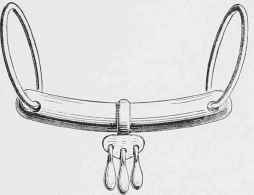
Fig. 567. - Key Bit.
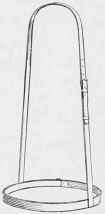
Fig. 568. - Cavesson.

Fig. 569. - Lunging Tackle.
Continue to:


My Books

