


The Grecian Horse. Continued
Description
This section is from the book "The Horse - Its Treatment In Health And Disease", by J. Wortley Axe. Also available from Amazon: The Horse. Its Treatment In Health And Disease.
The Grecian Horse. Continued
At the battle of Marathon (b.c. 490) the Greeks used no cavalry, while the Persian army comprised 100,000 foot and 10,000 cavalry. It seems difficult to understand why the Greeks did not employ cavalry in battle, surrounded as they were by nations who made great use of this branch of the service in times of war. Yet, unaided by cavalry, they routed the Persians at Marathon, and on other occasions they had beaten their enemies without the aid of this auxiliary, and instances had occurred where chariots had caused confusion and disaster. Xerxes' army which passed over the Hellespont, according to Herodotus consisted of infantry 170 myriads, of cavalry 8 myriads, exclusive of chariots and camels. In this expedition fifty-six different nations took part, the infantry of which appears to have been little better than a rabble, whose vast numbers, crowded together on the battle-field, interfered with the action of the cavalry and put them into confusion. Marathon, Plataea, and Mycale are witnesses of like dilemmas. The war-chariots could not act upon uneven and broken ground, and thus, being rendered incapable of acting, became dangerous impediments. Another reason why the Greeks did not employ cavalry might have been the rough and stony ground over which their armies had to march, over roads whose surfaces wore down their horses' hoofs so low as to cause them to become sore and almost incapable of locomotion. For short journeys and performance in the hippodrome the tracks were laid down with soft material, so that horses could run over their 4-mile courses with impunity; but over hard roads during arduous and prolonged marches their hoof horn constantly wore down to the quick, when the sufferers had to be left in the rear. It is evident that although the horse was not, in the early part of Grecian history, used extensively as a war-horse, he was highly esteemed as a hunter, for pageants, for racing in the hippodrome, and for purposes of pleasure, and the pens of the greatest-minded Greeks were devoted to the narration of his qualifications and the means to he adopted so as to protect him from disease and injury and to preserve him in health.
The writings of the Athenian general and historian Xenophon prove to what a high degree of perfection the horse at this day had arrived, and the attention he required to keep him in sound condition. The retreat of the 10,000 Greeks, after their defeat by the Persians under Cyrus, 401 B.C., shows that in his day Grecian cavalry had become an important branch of their military organization. At this period Xenophon had the same difficulties to contend with as previous horse-owners had complained of, namely the wearing away of the horses' hoofs during long and protracted journeys over rougli and stony roads, and for this reason he prescribes treatment calculated to harden the unshod hoof, by causing horses to stand upon rough stone stable-floors, and upon similarly constructed pavement when groomed outside the stable. He adds: "Those horses whose hoofs are hardened with exercise will be as superior on rough ground to those which are not habituated to it, as persons who are sound in their limbs to those who are lame". Xenophon also has described the points of a good horse, and the breeding, rearing, and treatment of young horses; from which it is evident that at this period horses were used not only for the sports of the hippodrome and for hunting, but also for war; but as yet they had not been used as beasts of burden, neither had they been yoked to the plough nor engaged in farming operations - the mule, the camel, and the ox performed these services.
Although Greek authors have described the capacities in which horses were employed, they have not given us pictures of the various equine breeds which it is natural to imagine surrounded them. Xenophon certainly has described the horse of his day, and the friezes of the Parthenon now at the British Museum (Plate LXXIV) give us an idea of one equine type, but not of the many which must have existed during the flourishing days of ancient Greece. At the same time the Grecian horse might have been of one type - the one linked to the chariot might have been of the same breed as the one on which the trooper rode in battle, - and if such was the case it must be accounted for on the supposition that the Grecian stock was of Arabian descent, for the statuary of horses discovered in the ruins of Nineveh gives portraitures of these animals very similar to the Grecian horses represented in the Elgin marbles, and consequently both might have originated from a common stock and birthplace. Buffon considered that Arabia was the centre from which the horse sprang, and this has been the generally accepted opinion. This subject will be recurred to when writing on Arabian horses; let it suffice for the present to give the opinion of an eminent authority. " It is generally supposed from the omission of all mention of horses while the Israelites were in Arabia that this country, which has since become so celebrated for them, was at that time entirely without them. The proof is, however, of an entirely negative character, though I confess that it is as-good as any of that nature can well be. Indeed 600 years later Arabia could not in any way have been celebrated for her horses, for Solomon, whilst he resorted to her for silver and gold, mounted his cavalry from Egypt. Yet the latter country could scarcely have been the native land of the horse, not possessing the extensive plains which are so peculiarly suited to his existence in a wild state, and it is considered probable that he was introduced from the central regions of Africa, which are undoubtedly the native plains of the quagga, the zebra, and some other congeners of the horse, but where, curiously enough, he is not found in a wild state." - Stonehenge on the Horse.

PLATE LXXIV. ASSYRIAN HORSES From the Palace of Assur-bani-pal, Nineveh.
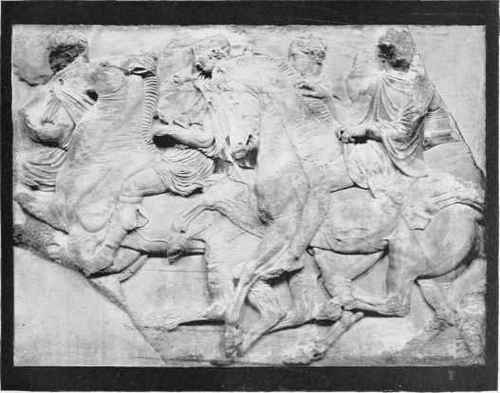
PLATE LXXIV. GREEK HORSES From the Parthenon Frieze.
These arguments are based on the supposition that the various equine races emanated from one common stock, if not from one pair. But if we accept the theory that different varieties originated in several regions of the world, whether by creation or by evolution, it can easily be understood that horses of more than one type existed at one and the same time, and inhabited countries situated at long distances one from the other, each country possessing a distinct stock of its own, upon which horses imported from Africa or Arabia, by intermingling, were sure to produce a good cross. Tradition tells us, and history lends its authority to the assertion, that in the earliest ages of the world Africa was conspicuous for a celebrated breed of horses. No doubt the Sahara was the birthplace of the barb, which in the past gave as excellent impressions to the equine stock of ancient nations as its descendants, the Oriental horses of the Stuart epoch, did in the production of the British thoroughbred. It is possible that the barb and the arab may have descended from the same stock, but they may have been distinct breeds; and this seems most likely to have been the case, as the Assyrians possessed horses, chariots, and horsemen at the same time as the Egyptians.
Continue to:


My Books

