


Mastication
Description
This section is from the book "Stable Management And Exercise", by M. Horace Hayes. Also available from Amazon: Stable Management And Exercise.
Mastication
A horse with a "full mouth" has forty teeth, namely, six front teeth in each jaw, and one tush and six back teeth on each side of each jaw (Fig. 1). Each tooth is covered with a very hard, white, and comparatively thin layer of enamel, which in the front teeth forms a depression in the middle of the cutting surface of the tooth. Hence, when a front tooth comes into wear, its table has two irregularly-shaped rings of enamel with soft tooth-substance (dentine) between them. In each back tooth, the layer of enamel is doubled in on each side so as form on the table sharp and hard ridges, which project above the soft dentine. The tables of the back teeth slope downwards and outwards, that is to say, their inner edges are higher than their outer edges. The action of the back teeth is that of a mill, in which the sharp surfaces of the lower back teeth on each side of the mouth are worked laterally against those of the upper jaw, and thus the food which is brought between them by the tongue and cheeks, is ground. As the lower jaw is narrower than the upper jaw (Fig. 2), a horse can chew with his back teeth only on one side of his mouth (Fig. 3) at a time, which he often continues to do for even as long as an hour, without changing to the other side. A horse is unable to use his front teeth and his back teeth at the same time; for when he works his lower jaw laterally, the front teeth of the lower jaw become separated from those of the upper jaw (Figs. 4 and 5).
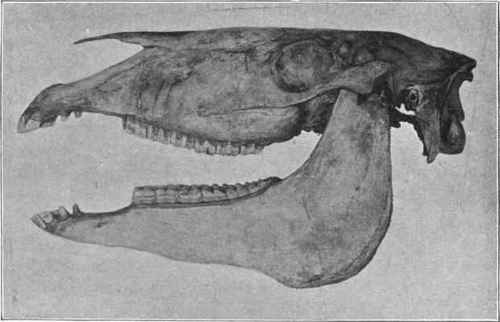
Fig. 1. Teeth of Horse.
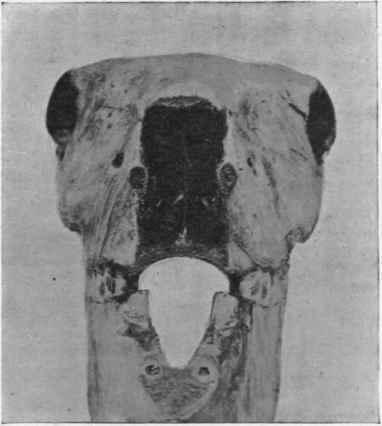
Fig. 2. Transverse Section of Skull of Horse, immediately in front of his back teeth.
Each tooth is lodged in a socket in it's jawbone, and is developed from its dental pulp, which is provided with blood-vessels, nerves, and secreting cells. Owing to the continued secretion of dentine, the teeth are forced slowly out of their sockets, which movement more or less makes up for the wear entailed on the teeth by mastication. Our own teeth, on the contrary, remain stationary in their sockets after they have attained their full size. The greater amount of wear undergone by the back teeth of a horse is compensated for by the increasing obliquity of the incisors with age. As the teeth wear down in time, the layers of enamel of both the front and back teeth gradually become thinner and weaker, until at last they disappear altogether or fail to fulfil their purpose as cutting projections on the tables of the teeth. Hence, mastication becomes less perfect with age, and as the animal grows old, he becomes increasingly liable to indigestion from the faulty action of his teeth.
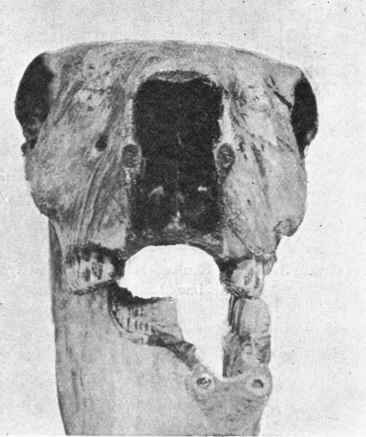
Fig. 3. Transverse Section of Skull of Horse, showing position of back teeth when the animal is chewing on the left side of his mouth.
On an average, a horse takes about 9 minutes to eat 1 lb. of oats and about 12 minutes to consume the same weight of hay (Colin).
While food is being chewed, it becomes more or less mixed with saliva, which flows into the mouth by tubes from the salivary glands (parotid, submaxillary, and sublingual glands), in response to the stimulus caused by the presence of the food, and which helps the animal to swallow. In horses, the chief source of saliva is the parotid glands, which are of greater comparative size in them than in all other animals, except ruminants. The saliva of the parotid glands consists of about 99.2 per cent. of water. Carpenter points out that the size of the parotid glands in animals is proportionate to the degree in which the mastication of their food is performed; and that these glands are absent in birds which swallow their food whole. Although dogs secrete saliva abundantly, starch is not a component of their natural food. As the requirements of a horse's digestion demand that he should thoroughly chew his food, we ought to give it to him in a condition that will induce him to eat slowly. Furthermore, the amount of saliva secreted during mastication is more or less proportionate to the dryness of the fodder; for the dryer it is, the more saliva will a horse require to enable him to swallow it. Lassaigne gives, from experiment, the following results: -
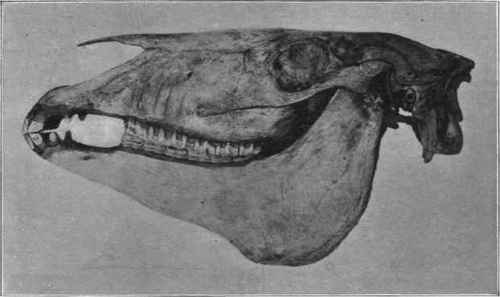
Fig. 4. Jaws of Horse placed evenly together.
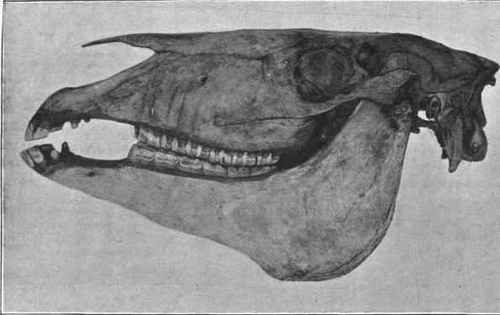
Fig. 5. Lower Jaw moved to the left, as in Fig. 3.
100 parts of grass require 49 parts of saliva. „ ,, oats ,, 113 ,, ,, ,, barley ,, 186 ,, ,, dry hay,, 406 ,,.
The frothy nature of saliva, caused by the presence of air bubbles in it, aids digestion by rendering the food through which the saliva becomes mixed during mastication, more easily penetrable by the digestive juices, than it would be if air bubbles were absent. The presence of saliva in the food materially aids digestion in the stomach, as we learn from the experiments of Spallanzani and Reaumur, who "found that food enclosed in perforated tubes and introduced into the stomach of an animal was more quickly digested when it had been previously impregnated with saliva, than when it was moistened with water. Dr. Wright also found that if the oesophagus (gullet) of a dog is tied, and food mixed with water alone is placed in the stomach, the food will remain undigested, though the stomach may secrete abundant acid fluid, but if the same fluid is mixed with saliva, and the rest of the experiment similarly performed, the food is readily digested" (Kirkes). I think we may conclude from these observations, that the food of horses should be supplied to them in a more or less dry state, and that the practice of giving soaked food or boiled food is, as a rule, objectionable. If, however, such food is given, as in case of illness, or for a change, it is well to mix it with a suitable quantity (say 1 1/2 oz.) of common salt, the presence of which in the mouth excites the flow of saliva.
Saliva, being of an alkaline nature, aids the digestion of fat by forming it into an emulsion, in which the fat is split up into minute particles.
Saliva contains the ferment ptyalin, which has the property of converting starch into sugar, in which form it is absorbed into the body. The action of the ptyalin of the saliva on starch is of too brief duration to have much effect; for it ceases soon after the arrival of the food in the stomach, on account of the presence of acid in the gastric juice. The digestive changes which the food undergoes in the mouth therefore appear to be more mechanical than chemical.
Continue to:


My Books

