


Time And Help Required For Grooming
Description
This section is from the book "Stable Management And Exercise", by M. Horace Hayes. Also available from Amazon: Stable Management And Exercise.
Time And Help Required For Grooming
For merely cleaning a horse, one man is enough; but for producing a healthy glow all over the surface of his body, at least two men - one on each side - are required; because one man could not possibly do the work with sufficient quickness. To thoroughly strap (groom) a horse, hand-rub his legs, put his clothing straight, and put on his bandages, will take two men at least half an hour; and one man, about double that time. "Quartering" (p. 341) or lightly grooming a horse will occupy a man from fifteen to twenty minutes.
Details Of Grooming
Let us consider the full grooming of a horse by two men, full grooming by a single-handed man, and finally light grooming or quartering.
If a horse returns hot, and especially wet, from work, and if he is put in a box or stall and is groomed in the ordinary manner, he will run a considerable risk of getting a chill or of "breaking out." A good plan to avert these ill results of bad management, is to loosen the girths, supposing that the animal has been ridden, shift the position of the saddle a little, by moving it a few inches from side to side, so as to relieve any parts that may have suffered from unequal pressure; give the horse half a bucket of cold water to drink; scrape him if he is sweating, and dry him quickly with rubbers, taking care not to neglect the space between the branches of his lower jaw; and walk him about until he is dry, with or without clothing on him, according to the state of the atmosphere, which will also determine the rate at which he should be walked. We may then take him into the stable, remove the bridle, put on a head-stall, give him as much cold water as he chooses to drink, and rack him up, if he is in a box, or put him on the pillar reins, if he is in a stall. If flannel bandages are used with this particular animal, they should be put on the legs loosely, the saddle or harness removed, and the surfaces which previously bore the gear (back or front of the shoulders, as the case may be) examined, so as to find if any swelling has taken place from unequally distributed pressure, as is specially liable to occur from the use of a side-saddle. If the skin is not broken, the best way to treat a lump of this kind is to pour into the hollow of the hand a little spirits (whisky or methylated spirits for instance), and rub it into the part with gentle friction, which may be continued for about ten minutes. In any case, the remainder of the back or shoulders should be well stimulated by rubbing with the palms of the hands and a dry rubber for preference. If the skin is broken, as may often result from contact with the girths, Friar's balsam or eucalyptus oil may be applied. In the meantime the groom who is not looking after sore places, should thoroughly go over the coat, from head to hocks, with the wisp, and as soon as the other groom has finished with the bearing surfaces, he should of course join in with his wisp. After the wisping has been completed, the ears should be gently pulled several times between the fingers and palms of the hands (' stripped"), which is a process that always appears. to refresh a horse.
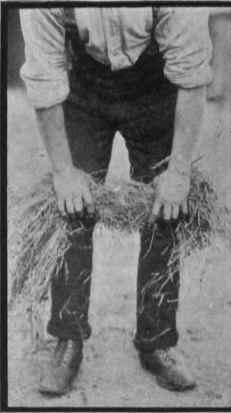
Fig. 58.
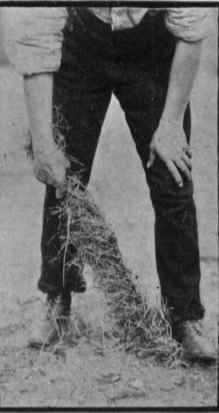
Fig. 59.
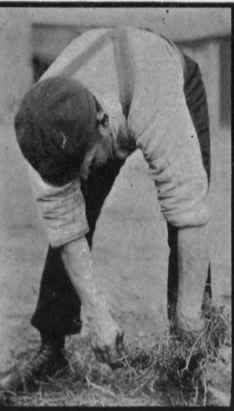
Fig. 60.
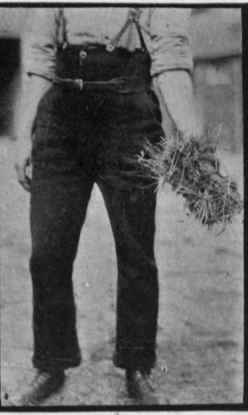
Fig. 61. Making a Hay pad.
If the beneficial plan of walking a horse which returns heated from work, so as to dry him, is not practicable, he should be taken into the stable, watered, scraped and dried, if necessary; his skin vigorously stimulated by wisping; and the details which have just been described, should be carried out.
If the animal has returned cool from work in clothing, or if he has not left the stable, the hood and breast-piece should be taken off, and the head and neck well wisped. The rug (after unbuckling its breast strap), or quarter-sheet, or both, as the case may be, can be turned back as far as they will go, without undoing the roller, and the breast and shoulders gone over. The roller can now be removed, the remainder of the clothing taken off, and the body and hind quarters wisped.
If a horse returns wet from work in clothing, as might happen if he had been given a sweat, he should be watered, and the hood, breast-piece and quarter-sheet or rug removed one after another, while the respective parts covered by them should be successively scraped and dried. A single suit of dry clothing may be put on, and the animal walked as before advised. If a walk for drying purposes cannot be given, he should be well wisped. If a horse in clothing comes back only slightly heated from work, he can be walked about, until he is quite cool, before taking him into the stable.
A rider or driver will do well to expedite the grooming, and lessen the chance of the horse getting chilled or "breaking out," by bringing the animal back to the stable cool, which he can generally do by walking him for the last mile or two.
When the wisping has been finished, it is well to give the horse's head, neck, breast, shoulders, body, and legs down to the knees and hocks, a good hand-rubbing.
The horse now being thoroughly dry, a groom on each side (supposing that two men can be spared) should go over the coat with a body-brush. As moisture causes the particles of dandruff to become matted together and to adhere to the skin, no attempt to brush the coat should be made until the horse is dry.
The fore-lock, mane and tail should be cleaned with the body-brush or dry water-brush (p. 330); but not with the dandy-brush, which is apt to pull out the hairs. The groom should begin by brushing these hairs at their ends, and should work upwards as each kink or knot becomes opened out. When the hairs are all separate, they can be brushed, by small locks at a time, from their roots downwards, so as to remove the dandruff. The mane-comb should be used only when it is desired to keep the hair thin, because the hairs get broken and pulled out by it. If the hair of the fore-lock, mane or tail does not lie smooth, it may be "laid" by brushing it with a wet water-brush, which should not be done, except for the purpose in question; because wetting the hair takes the gloss off it, and stimulates the production of dandruff.
Continue to:


My Books

