


Sawdust
Description
This section is from the book "Stable Management And Exercise", by M. Horace Hayes. Also available from Amazon: Stable Management And Exercise.
Sawdust
Sawdust is generally obtained in the form of sawdust and chips, from which all hard pieces of wood should be removed. The only sawdust fit to be used for horses, is that which is obtained from dry and well-seasoned (usually foreign) wood; for the sawdust of green wood has but little absorbent power, and is apt to become decomposed. Good sawdust forms an excellent bedding, and as a rule can be bought very cheaply at saw-mills, which unfortunately do not often exist in the vicinity of stables.
We may, with more or less exactness, apply to sawdust everything said in the preceding paragraphs of this chapter about peat moss as regards its applicability to the use of horses that are inclined to eat their bedding, noiselessness when trodden on, protection it affords the coats of grey and white horses from becoming stained by the urine which falls on the litter, usefulness in filling up inequalities on a floor, and tendency to ball in the feet and to block up subsoil drains. It is not so portable, so absorbent, and so easily procurable as a rule as moss litter; but it looks much better, smells much nicer, is cheaper near sawmills, and can be usefully employed for sprinkling over passages and places which have become wet, and which can be improved in appearance by being lighted up by this white covering. It requires far less labour for laying down and mucking-out than straw. When made from fir, it gives a pleasant and healthy odour to the stable. Darbot states that oak sawdust is not a good bedding, on account of the large proportion of tannic acid it contains. A combination of sawdust and carbolic acid (p. 259) forms a handy and valuable antiseptic.
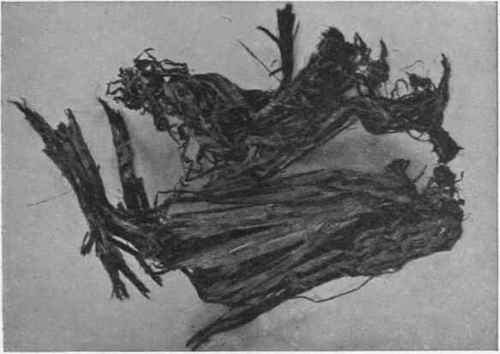
Fig- 33. Cotton Grass in Peat.
Continue to:


My Books

