


Mucking-Out
Description
This section is from the book "Stable Management And Exercise", by M. Horace Hayes. Also available from Amazon: Stable Management And Exercise.
Mucking-Out
Whenever a groom sees dung, urine or contaminated litter on the floor of box or stall, he should at once remove it outside; because its retention in the stable will be injurious to the animal's health, by the emanations given off; and to the soundness of his feet, if he happens to stand in such filth. Besides, for economic purposes, the dung and urine should be taken to the midden without delay, and disposed in a manner that will curtail the loss of ammonia as far as practicable. When litter becomes saturated with the horse's droppings, its presence in the stable is not only useless for soaking up moisture, but it is also hurtful from a sanitary point of view. The dung and soiled litter are generally removed by means of a skep.
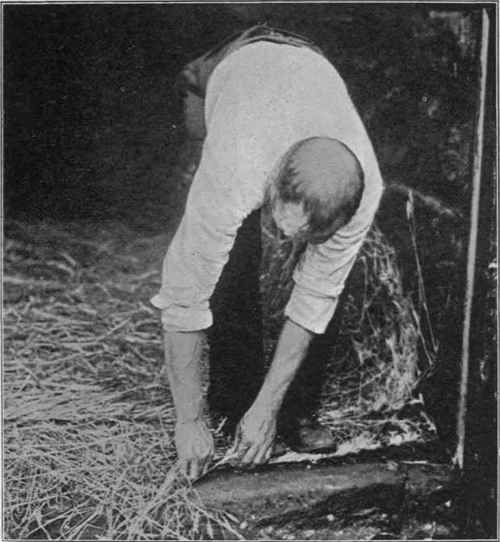
Fig. 35. Twisting in ends of straw bedding.
With straw bedding, the groom places the edge of the skep close to the dung, which he tilts into this receptacle by raising the straw behind it with his right hand, while he holds the skep in the left; or having placed the skep between his legs, and sloping downwards and forwards, he gets both hands under the dung and straw upon which it is lying, and cants the dung into the skep. The same procedure may be observed with other kinds of comparatively long litter. If a horse is in the act of dunging, and the groom is within reach, he can, at no loss of dignity and with a considerable gain in cleanliness, receive the dung in his hands, and deposit it in the skep; or, if there is time, he may catch it in the skep in the first instance. In India, the practice among native grooms is to hold an earthen pot under the horse or gelding, and behind the mare, so as to catch the urine the moment they see the animal stretch itself out. The same custom is observed in some places on the Continent, where a pot with a long handle is used. I do not like this plan, because horses which are accustomed to it are apt, if the groom does not hold the vessel for them, to abstain from staling for a long time. This, however, is a mere matter of opinion on my part; for I have no exact data of any kind, either for condemning this practice or for supporting it.
In regular mucking-out with straw, any dung or soiled portions of litter which are on the surface of the bedding, should be picked up and put into the skep for removal to the midden (dunghill), or in case of only slightly soiled straw, to be dried in the open air or in the litter-shed for future use. All the clean straw is heaped up in two or three corners of the box or stall; the floor swept out with a broom; all swept-up dirt removed; and, if necessary, the floor dried and disinfected in the manner described. The floor is then allowed to remain exposed to the purifying action of the air, until the bedding is required to be put under the horse, when it is spread with the addition, if necessary, of fresh straw or of slightly soiled straw that has been dried, and is banked up, twisted in and finished off as already stated. Instead of keeping the clean straw heaped up in the box or stall, while waiting to spread it, by far the better plan, if there is time and opportunity, is to take it outside, and air and dry it.
Mucking-out with shavings and ferns may be effected in the same way as with straw.
With moss litter, sawdust, tan, fir needles, and sand, we may get all the dung on the surface and all the wet spots removed with a hand-shovel or rake and skep, and the whole of the bed raked carefully over, so as to find all contaminated parts, which should be promptly taken away. When the daily allowance is added, it should be distributed evenly through the remainder of the bedding. The whole of the bedding need not be taken out to be aired and dried and the floor purified oftener than once a week.
Disposal Of Used Litter
The best plan is to remove the whole of the used litter and dung from the precincts of the stable every day, which can be conveniently done by means of a cart lined with metal and made for the purpose, if expense be no great object. If a midden in the premises cannot be dispensed with, it should be placed well away from the stables and the water supply, and should have its foundation and sides of waterproof material, so that the surrounding ground may not become contaminated in any way.
Continue to:


My Books

