


Falling
Description
This section is from the book "The Stable Book: Being A Treatise On The Management Of Horses", by John Stewart. Also available from Amazon: The Stable Book.
Falling
Horses sometimes fall on the side, sometimes on the head, and sometimes back upon the haunches; but moat frequently they fall upon their knees. A saddle-horse seldom needs assistance to rise; but if old, stiff, exhausted, lying in an awkward position or upon ice, he may not be able to get up without help, and the rider should know how to afford it. Almost every horse rises with his head first; he begins by throwing out his forelegs, one by one; he can not rise when they are below him; he elevates the head, and then, by a sudden and single effort, he springs to his feet. If assistance be needful, it must be given by supporting the head. Do not stand before the horse, nor on the side, to which his feet are lying. Go to the back, seize the reins close to the mouth; when the horse elevates his head, endeavor to keep t up, to render it a fixed point from which the muscles may act in raising the body; while one hand is supporting the head, place the other on the withers or shoulder, and push the horse off you, so as to set the body over the legs. It requires a good deal of practice to become expert in giving this assis tance.
Some are so awkward about it that they will have the horse up and down half-a-dozen times, and bruised all over, before they get him on his feet.
Fig. 22.
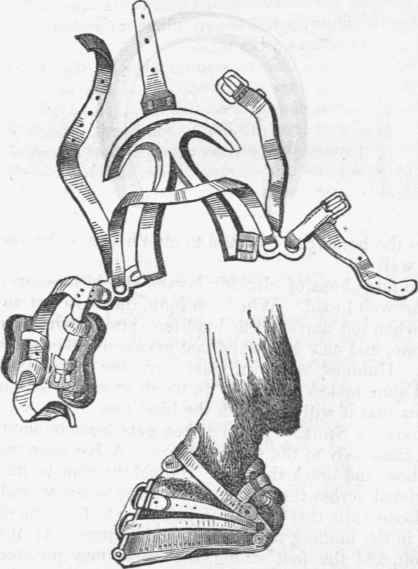
In harness, the horse is seldom able to rise till liberated from the shafts or traces. About towns the moment a horse falls, he is surrounded by a crowd of officious assistants, every one giving orders, or doing some mischief. They are very fond of cutting the harness; and if the owner do not look sharp, he will have traces, pole-piece, and back-bands, cut to shreds before he hears a word about it. The first thing to be done is to secure the horse's head. Keep it down that he may not injure himself, or do further mischief, in fruitless attempts to rise. The next thing to be done, is to unbuckle such parts of the harness as connect the horse with the draught. In double harness, it is generally sufficient to unbuckle the neck strap, which connects pole-piece and traces to the collar. By backing the carriage a few yards, the horse gets room to rise. When lying with his feet inward, his companion should be removed. If the harness do not come separate upon loosing the neck strap, the traces must be taken off the horse, or off the bar. In shafts, the carriage must be put back before the head is freed; but if there is no weight on the back, and the legs are not entangled, it is enough to support the head, without unyoking the horse.
After the horse is up, steady him for a few moments till he collect himself. Examine his knees, legs, haunches, head, and mouth; see that none of the shoes are torn off. If not disabled, let him start at a gentle pace; some part may be so painful or benumbed, that a hurried start will produce a second fall.
The Causes of Falling are very numerous. Bad riding, bad shoeing, or neglect of shoeing; bad roads, over-reaching, cutting, an ill-fitting or ill-placed saddle; a stone in the foot, and weakness of the horse, are among the most common causes. A bad rider may permit a horse to fall, merely by neglecting to support his head; he may hurry over roads hardly fit for a walking-pace; he may lean too much forward; or he may ride the horse Jill he can scarcely put one foot before another. Bad shoeing may throw a horse down. By neglecting to shoe at proper times, or to change the mode of shoeing when the work changes, the feet become long, the shoes defective, or perhaps the horse goes to the field with shoes made for the road There are various other causes which I have no room to describe. Indeed they all belong to horsemanship more than to stable economy.
The horse is sometimes severely injured. Mere abrasions of the head, the haunch, and other parts, need no notice. Among the most common and severe injuries, are those of the knee, the head, the neck, the back, and the legs.
Continue to:


My Books

