


Kicking
Description
This section is from the book "The Stable Book: Being A Treatise On The Management Of Horses", by John Stewart. Also available from Amazon: The Stable Book.
Kicking
This vice is not so common as that of biting; but it is much more dangerous, and the mischief is not so easily avoided. Some strike only at horses, and never attempt to injure persons. These have little chance of doing harm when placed in the end stall of a single-headed stable, where other horses will never have occasion to stand or pass behind them. Those that kick at the groom, or persons going about them, are always most dangerous to strangers. A great many can be intimidated by threatening them with the whip. Previous to entering the stall, the man warns the horse by speaking roughly to him; and by placing him on one side, he may be approached on the other. A drunken, or awkward groom, however, is almost sure to receive injury from a confirmed kicker; and a timid man is never safe. Vicious, and perhaps all kinds of horses, discover timidity very quickly; those that are so inclined soon take advantage of the discovery. Many kickers give warning. They whisk the tail, present the quarters, and hang the leg a moment before they throw it out. Others have more cunning, and give no notice. They often let a man enter the stall, when they turn suddenly round and strike out, either with one foot or with both.
Some strike only as the man is leaving the stall with his back to the horse; some are slow, and some so quick that the motion is scarcely seen till the blow is struck. Some strike with the fore-feet but these are easily avoided when the vice is known.
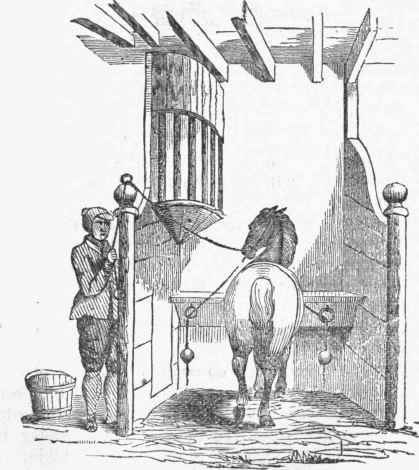
Fig. 16. Stall for a Kicker.
Timid grooms arc always too close, or too far away from a kicker. When the man must come within reach of the heels, he should stand as close to them as possible. A blow thus becomes a push, seldom injurious.
When the horse is a ferocious kicker, so malicious and determined that it is very hazardous to approach him even with a rod - which in such a case, however, oftener irritates than intimidates - he must be placed out of the way in a remote stall, the partitions of which should be high and long. A long rope must be attached to the head, nearly the same as for a savage biter; but this, instead of drawing the horse's head up to a ring at top of the stall, draws him backward so far that the head can be seized before entering the stall. As long as the man keeps well forward with his hand on the head, he is safe from the heels. This rope is not attached at the stall-head; it is supported in front by a ring placed in the travis near its top, and about three feet from the head-post. In some cases, a small door in the partition is requisite, through which the horse is fed and watered. When the door is large enough to admit a man, and the horse not a biter as well as a kicker, it renders a side-line unnecessary.
Continue to:


My Books

