


Modes Of Ventilating Stables
Description
This section is from the book "The Stable Book: Being A Treatise On The Management Of Horses", by John Stewart. Also available from Amazon: The Stable Book.
Modes Of Ventilating Stables
Many people are perfectly aware that their stables ought to be aired; but they are igno rant of the mode in which it should be done. The owner or groom is told that the stable is too close; and he replies, "The stable is not so close as you think; indeed, it is rather cold if anything. This window is generally open all day, and that hole is never closed. I got it made on purpose to air the stable, for it was too hot before." Now, it frequently happens that the stable is not too warm, and that the hole and the window do keep it cool. But this is not to the purpose. These people can not be made to understand the difference between warm air and foul air. They are always thinking and talking of the temperature, when it is the purity of the atmosphere that ought to engage their attention. Ventilation may be managed in such a way as to preserve the air in tolerable purity, without making it uncomfortably cold. There must be apertures for taking away that which has been vitiated, and apertures for admitting a fresh supply : and these must be properly placed. Their situation is of some consequence, particularly when it is desirable to keep the stable warm. In general they are placed too far from the roof, too near the ground, perhaps about a foot above the horse's head.
In this place, they must be so large, in order to air the stable, that they must also cool it.
When the impure air escapes from the horse's lungs, it is warmer than the surrounding air, and it is lighter. In consequence, it rises upward. It ascends to the highest part of the building; if permitted to escape there, it does no harm. When there is no aperture so high up, the air remains at the roof till it becomes cooler, or cold. When cool as that which occupies the lower part of the stable, or when cooler - and it soon loses its heat - the air descends, and is rebreathed a second, a third, or an indefinite number of times, until it becomes perfectly saturated with impurities, or exhausted of its oxygen - at least comparatively exhausted - unable to supply the demand. Then a part of the blood must pass through the lungs without undergoing the usual change, and the horse becomes less vigorous, and consumes more food and more water than he would if the air were purer. There may be large openings in the stable capable of admitting fresh air, yet they are of no use unless there be others for letting out the impure air before it cools.
Apertures for the Escape of the Impure Air, ought to be a the highest part of the building, or as near to it as possible.
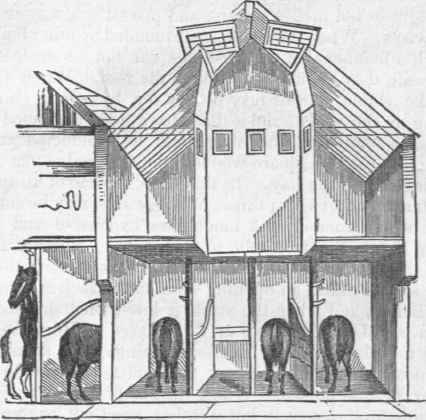
There should be one for each stall, and when the stall is empty, the hole may, in winter time, be closed. It should be from eight to ten inches square, and placed midway between the travises. When the stable is surrounded by other buildings in such a manner that the air-holes can not be made in the head wall, they should run through the roof. When a loft is over the stable, the air may be let out by small chimneys running up the walls; and if these have been neglected in the original construction, the air should be conducted through ceiling and roof by square wooden tubes, in order that it may not mingle with the hay. In this case, instead of an aperture to each stall, one, two, or three, of larger size, may be sufficient for the whole number, and much less expensive and inconvenient than a separate tube to each horse; whether few or many, they should be of sufficient size : taken altogether, the whole should afford an opening equal to ten inches square for every horse; and when the stable is low-roofed, this size may be too small. When two or three large ventilators are to supply the place of many smaller openings, they should be so constructed that their size may be regulated according to the number of the horses.
When the stable is only half filled, the ventilators, except in hot weather, need not be more than half open. But yet they should never be made to close entirely, lest an ignorant groom take it into his head to shut them all, or a careless fellow to neglect them. In a double-headed stable, two or three may be placed on each side, directly over the horses' heads; or they may be directly above the gangway: the first plan is the best, but the second is the cheapest. In the one case it may require four apertures, two on each side with as many wooden tubes to run through the loft; in the other case, only two of double the size may be placed in the gangway. Mr. Lyon's stables are thus ventilated.
The same tubes serve for air and for light. Whether large or small, the air-holes should be defended on the outside by cap to exclude rain and wind. In some situations an iron-grating may be necessary to exclude vermin, thieves, and persons maliciously disposed. When this is used, the apertures must be much larger.
In addition to the usual ventilating apertures, there ought to be one or two others for airing the stables more completely upon certain occasions. After washing, fumigating, or other purifying processes, or when the horses are all out, or when the weather is very hot, it may be convenient to produce a current through the stable capable of carrying off moisture and impure or noxious air, more rapidly and more perfectly than the ordinary ventilators will allow. When the litter is not wholly removed as soon as soiled, these extra apertures are particularly necessary during the time the stable is being cleaned. The door at the one end, and a window in the other, answer the purpose very well; better than a window in the roof, when the air is not heated. In cold weather, "a large and strong current is not quite harmless when the horses are at home, but it may be freely permitted while they are out.
Fig. 7.
Continue to:


My Books

